Listen to the article
Xi Jinping’s promise to the 20th National Congress of the Communist Party it would “resolutely win the battle” when it comes to core technology is looking as hollow as a Chinese drum.
Despite choreographed praise for his speeches promising tough and uncompromising leadership in his third term, they are taking place against a backdrop of what one expert referred to as the “complete collapse” of China’s semi-conductor chip industry.
Semi-conductor chips, while not sounding particularly exciting in themselves, are vital in the development of Artificial Intelligence technology, driverless cars, and military tech. China – already considerably behind the U.S. in the manufacture and use of the advanced computer chips – is desperate to win the race to develop AI beings which can mimic and outperform humans.
The collapse of its semi-conductor industry was caused by a directive from Joe Biden’s administration to restrict US firms from selling advanced chips used in super computers to China – a ban which also extends to Americans working in any capacity for Chinese chip companies.
And last week hundreds more U.S. executives and tech engineers – the directive covers citizens and also green card holders – who had previously been working in China’s advanced computer chip sector were returning home.
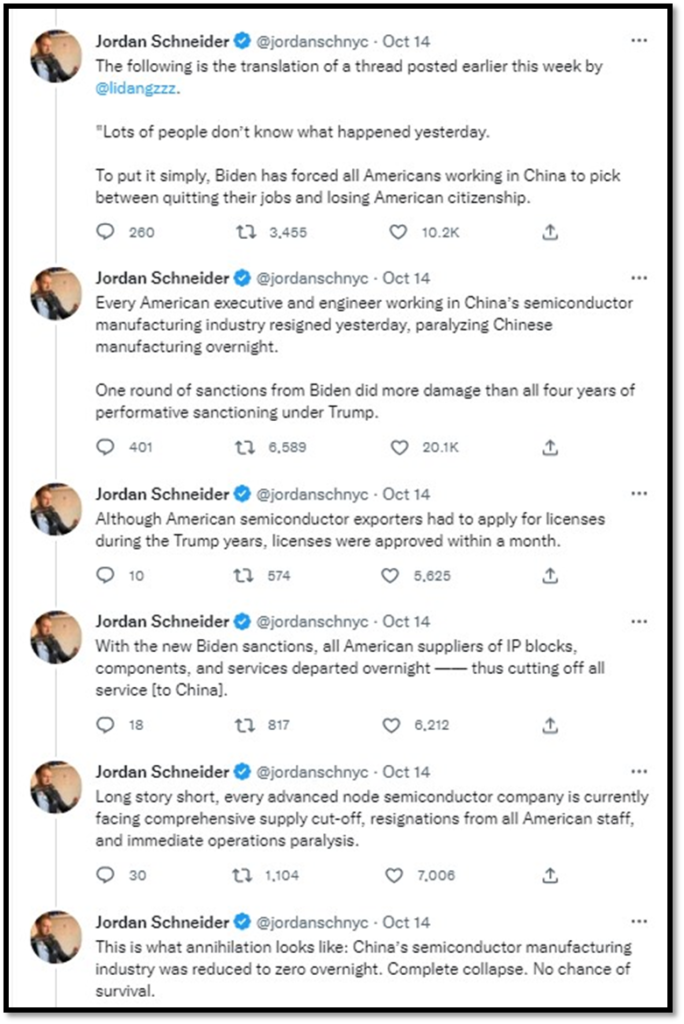
“This is what annihilation looks like: China’s semiconductor manufacturing industry was reduced to zero overnight,” said Lidang, CEO of Hedgehog Lab, ranked No.1 globally for mobile app and web app development.
In a Twitter thread translated by China Talk analyst Jordan Schneider, of Rhodium Group, Lidang added: “Every American executive and engineer working in China’s semiconductor manufacturing industry resigned yesterday, paralyzing Chinese manufacturing overnight.
“One round of sanctions from Biden did more damage than all four years of performative sanctioning under Trump.”
Biden reacted to months of pressure from his own party to crackdown on China by directing that Chinese state-owned Yangtze Memory Technologies Co, and 30 further semi-conductor companies in China be placed on the Unverified List by the Bureau of Industry and Security, a division of the U.S. Department of Commerce.
The sanctions are seen as America’s way of ensuring that China’s AI technology remains in the Stone Age, while its own races ahead thanks to financial packages produced by Biden to further boost the industry in the U.S.
They also forbid the export of chip manufacturing tools, and design software. The Taiwan Semi-Conductor Manufacturing Company (the world’s biggest advanced chip manufacturer) and Samsung are also limited when it comes to producing the cutting-edge chips for Chinese businesses.
And despite the official state media concentrating on pretending that the only story in Beijing was Jinping laying out his five year plan, the situation is so severe that China’s Ministry of Industry and Tourism has been holding emergency closed-door meetings over the past week with leading semi-conductor firms hit by the U.S. chip restrictions.