

Listen to the article
As the world eagerly anticipates the start of the 2024 Paris Olympics next month, a darker shadow looms over the festivities. The Microsoft Threat Analysis Centre (MTAC) has sounded the alarm on a significant uptick in malign influence campaigns orchestrated by Russia.
These campaigns, employing a mix of fake news, bogus websites, deepfake interviews, and AI-augmented content, are part of a broader strategy to undermine the International Olympic Committee (IOC), French President Emmanuel Macron, and the integrity of the Paris Games.
Russia’s embassy in France has hit back calling the allegations “Russophobic”.
“The Embassy declares that the Russian Federation has never interfered and does not interfere in the internal affairs of France – our country has other more important priorities. The Embassy urges the French authorities to put an end to this unfounded and unjustified anti-Russian disinformation campaign,” the embassy said in a statement.
A Historical Context of Olympic Sabotage
Russia’s attempts to undermine the Olympics are not new. The Soviet Union boycotted the 1984 Summer Games in Los Angeles, citing security concerns for non-white competitors—a tactic designed to sow discord and fear.
Fast forward to 2016, Russian hackers infiltrated the World Anti-Doping Agency, exposing private medical data of prominent athletes like Serena Williams and Simone Biles. In 2018, the “Olympic Destroyer” cyberattack disrupted the Winter Games in Pyeongchang, South Korea. These incidents highlight a pattern of using the Olympics as a stage for political and cyber-warfare.
Modern Tactics in the Age of AI
Starting in the summer of 2023, pro-Kremlin actors, tracked by Microsoft as Storm-1679 and Storm-1099, shifted their focus to the 2024 Paris Olympics. One of the earliest indications was the emergence of a video titled “Olympics Has Fallen,” a fake documentary narrated by an AI-generated voice resembling Tom Cruise. This video, along with a network of supporting social media accounts and websites, sought to disparage the IOC and create an atmosphere of anticipated violence during the Games.

These influence campaigns are not limited to digital propaganda. There have been attempts to exploit real-world events, such as fabricating threats related to the Israel-Hamas war and drawing false parallels to the 1972 Munich Olympics massacre. Digital forgeries of reputable media outlets and AI-generated content further amplify these efforts, creating a pervasive sense of fear and uncertainty.
The Mechanics of Disinformation
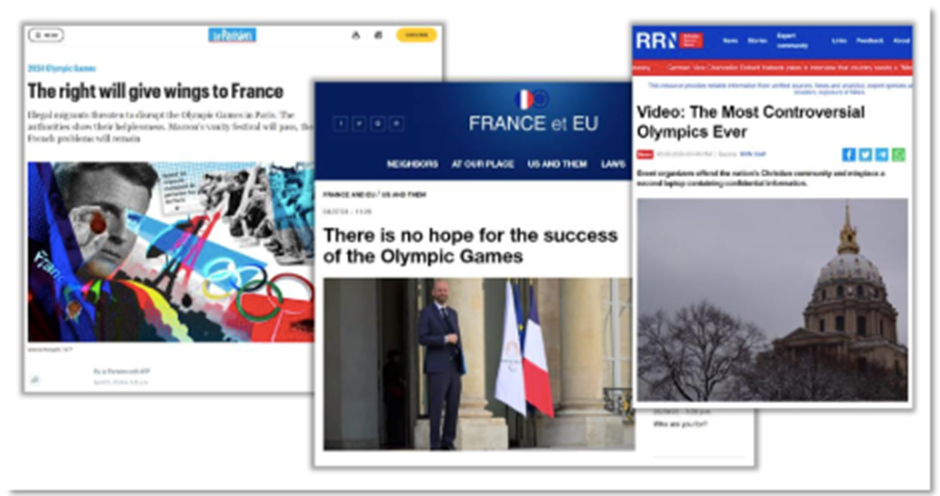
The campaigns orchestrated by actors like Storm-1679 and Storm-1099 use sophisticated techniques to spread their messages. AI-generated content, deepfakes, and spoofed websites are central to this strategy. For instance, Storm-1679’s fake documentary mimicked Netflix’s branding and used AI to generate realistic audio and visuals, giving it an air of legitimacy. The content was then leveraged and promoted through an extensive network of social media accounts, reaching a wide audience.
Storm-1099, known as “Doppelganger,” operates a disinformation outlet called Reliable Recent News (RRN) and several French-language ‘news’ sites. These platforms echo themes of corruption within the IOC and predict violence at the Games, aiming to erode trust in French authorities and the Olympics.
Anticipated Escalation as the Games Near
As the opening ceremony of the Paris Olympics draws nearer, we can expect these disinformation efforts to intensify. Russian actors are likely to deploy a mix of video content, automated social media accounts, and AI-generated messages to spread their influence. These tactics will be aimed at maximising visibility and creating a sense of widespread support for their narratives.
On the ground, we may see attempts to stage protests or provocations near Olympic venues, further undermining confidence in the IOC and French security forces. These real or orchestrated events will likely be used to further manipulate public perception and heighten fears around the Games.
Protecting the Integrity of the Olympics
Microsoft and its partners are committed to safeguarding the integrity of the Paris Olympics. MTAC continues to monitor and report on malign influence campaigns, while the broader tech community collaborates to combat deceptive uses of AI. As the Games approach, vigilance and proactive measures will be critical in countering the Kremlin’s sophisticated disinformation efforts and ensuring that faith is not shaken in the French authorities to make the Olympics a safe and successful event.
The 2024 Paris Olympics is not just a global sporting event but also a battleground for information warfare. The international community must remain alert and resilient in the face of these ongoing threats, preserving the spirit and integrity of the Olympic Games.
