


Listen to the article
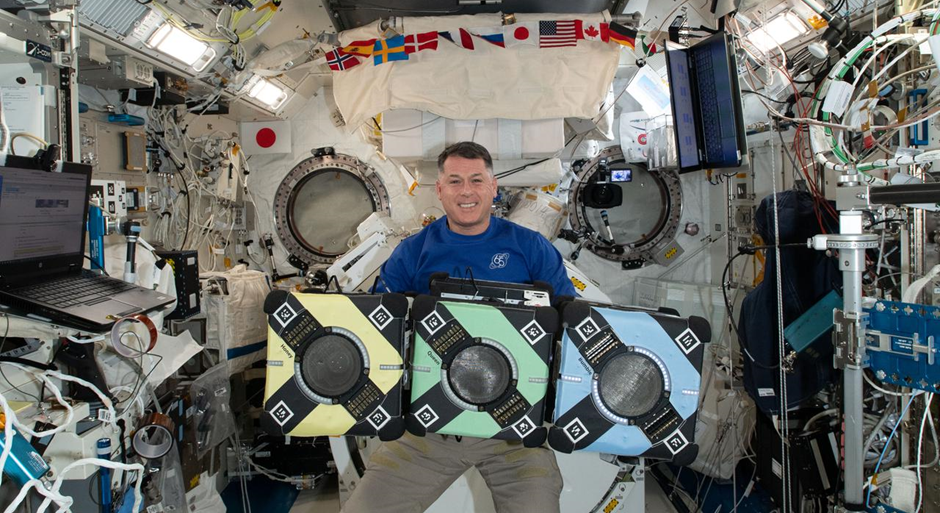
NASA is calling on American companies to share their ideas for using and operating a group of free-flying robots on the International Space Station (ISS).
The trio of cube-shaped robots, named “Bumble,” “Honey,” and “Queen,” are part of the Astrobee system, which have been assisting astronauts on the ISS since 2018.
Inspired by the Star Wars films, each of the 12.5-inch-wide robots can handle time-consuming tasks like monitoring the space station, performing maintenance checks, taking inventory, documenting experiments, or even moving cargo. The robots allow the astronauts to focus on more complex scientific activities that require human expertise.
NASA issued a request for information, in which it seeks partners who can manage and further develop the Astrobee capabilities to support future commercial and research activities in low Earth orbit.
“Dozens of institutions collaborate with NASA to use the Astrobee system,” said Jose Benavides, project manager for the Astrobee facilities at NASA’s Ames Research Center. “I’m excited to hear how respondents think Astrobee can continue to advance robotics in space.”
The Astrobees are battery powered and navigate the ISS using electric fans and rely on cameras, lights, and other sensors to “see” their surroundings.
Each robot is equipped with a robotic “arm” that can be used for perching on handrails, grasping objects, or assisting astronauts in their tasks.
The robots can operate autonomously or be remotely controlled by astronauts or researchers on Earth.
Jonathan Barlow, project manager for Astrobee, said: “Further developing human-robotic technology will pave the way for future crewed and uncrewed spacecraft maintenance and exploration tasks done by robots both off-planet and in deep space.”
Robots will play a crucial role in maintaining spacecraft and supporting exploration efforts on the Moon and Mars, NASA stated.
The space agency said that future robots could potentially transfer cargo between spacecraft or respond to critical situations like leaks, all without requiring human intervention.
The Astrobee robots continue to prove their value in space as they are being used for unique experiments.
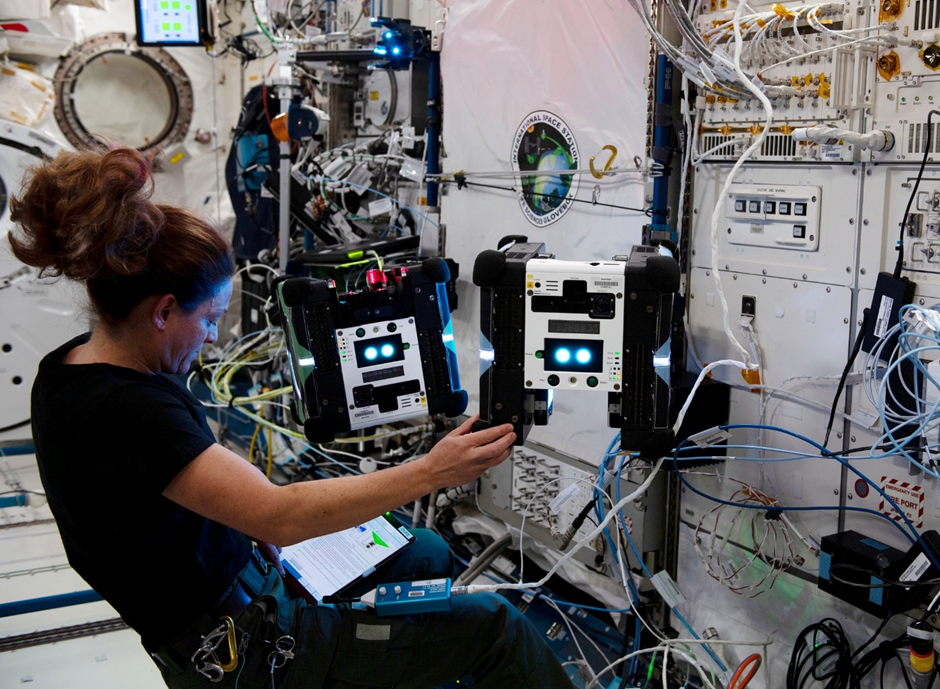
One collaboration involved global engineering firm Bosch, who partnered with aerospace company Astrobotic to test their smart SoundSee microphone technology.
The system, which consists of a microphone and machine learning software, is designed to identify anomalies in spacecraft and other equipment by making sense of sounds.
The Astrobee robots, equipped with the SoundSee system, were able to conduct autonomous sound surveys of the ISS, providing valuable data on the condition of various spacecraft.
Michael Foale, former NASA astronaut, said: “Such checks are particularly important for the vital systems on board the ISS, such as the air treatment or lighting systems.”
Foale, who supported the tests, explained how the use of the technology could save time, warning the crew before malfunctions occur. “It is easier to maintain a machine than to repair it after a malfunction,” he stated.
Samarjit Das, chief scientist at Bosch, said the robots act as an automated inspector, freeing up the astronauts to do more meaningful work.
In another project, researchers from the Massachusetts Institute of Technology (MIT) and the German Space Agency used the Astrobee robots to test algorithms and technology that could help recover tumbling satellites in space.
This experiment was part of a broader effort to address the growing problem of space debris.
Satellites that are no longer operational can collide with others, creating a chain reaction that generates even more debris. This phenomenon, known as the Kessler syndrome, poses a significant threat to safety in low-Earth orbit.
By testing the algorithms using Astrobee robots, the researchers demonstrated their effectiveness and provided valuable insights for future satellite recovery missions.
The German Space Agency said: “These findings are key to the continued development of robotic chasers.”
