

Listen to the article
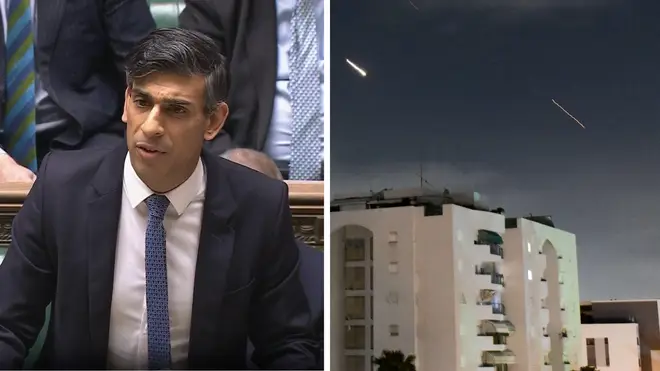
British Prime Minister Rishi Sunak has described Israel’s security as “non negotiable”, following Iran’s mass drone and missile attack.
Speaking in the House of Commons, Prime Minister Sunak told parliament that Iran is “intent on sowing chaos” across the Middle East after it attacked Israel over the weekend.
Addressing MPs for the first time since RAF fighter jets helped protect Israel, Mr Sunak said that Iran sought to “plunge the Middle East into a new crisis”.
“It was a reckless and dangerous escalation… The fallout and toll on Israeli citizens would have been catastrophic,” he said.
The Prime Minister called on all sides to show “restraint” and added that his fellow G7 leaders are “united in our condemnation of this attack” by Iran, adding: “We discussed further potential diplomatic measures which we’ll be working together to coordinate in the coming days.”
The Prime Minister spoke out as new details began to emerge on how the US managed to create a defensive alliance to protect Israel which relied on support from several Gulf States including Saudi Arabia.
US officials said that the operation was the culmination of years to break down political and technical barriers that previously had been a barrier to cooperation.
In a speech to MPs, Prime Minister Sunak added: “The Prime Minister told the Commons:
“I believe there are three vital steps to put the region onto a better path. First we must uphold regional security against hostile actors including in the Red Sea, and we must ensure Israel’s security – that is non-negotiable. It is a fundamental condition for peace in the region. In the face of threats like we saw this weekend, Israel has our full support.
“Second we must invest more deeply in the two state solution, that is what we have been doing over the past six months, including working closely with the Palestinian authority so that when the time comes they can provide more effective governance for Gaza and the West Bank.
“It is significant that other regional partners actually helped to prevent a much worse attack over the weekend, it reminds us how important the attempts to normalise relations between Israel and its neighbours really are, and it holds out precious hope for the region.
“Third, the conflict in Gaza must end, Hamas which is backed by Iran, started this war, they wanted not just to kill and murder but to destabilise the whole region.”
His views echoed those of Foreign Secretary Lord Cameron who earlier had described Iran’s assault on Israel as “an almost total failure”.
The former prime minister also urged Israel not to retaliate and to “think with its head not its heart”.
The foreign secretary made his call for restraint just hours after the Israeli government vowed to respond to Iran’s unprecedented attack at the weekend.
Although Israel’s allies have said they will continue to offer military support to Prime Minister Benjamin Netanyahu in the wake of further Iranian attacks, both the UK and the US have publicly stated they would not be joining Israel in any attacks against Tehran.
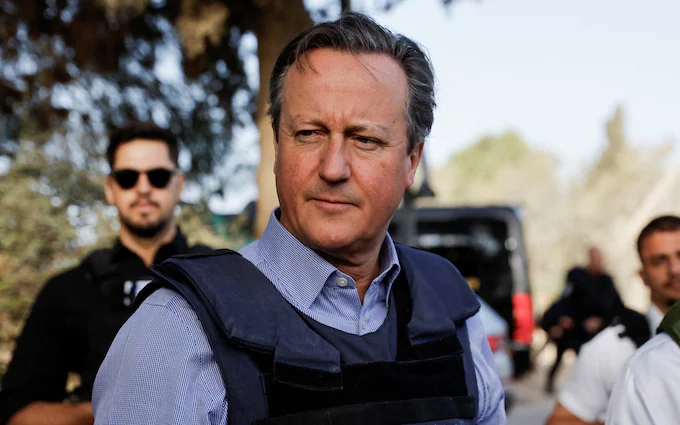
Lord Cameron added: “In many ways this has been a double defeat for Iran. The attack was an almost total failure, and they revealed to the world that they are the malign influence in the region prepared to do this.”
“They still hold those hostages. They’ve been offered a deal that prisoners can be released from Israeli jails in return for some of those hostages and there’ll be a pause in the fighting,” he said. “That’s what needs to happen next.”
Meanwhile, it has emerged that the defensive alliance which came to the aid of Israel late on Saturday night involved several Arab countries including Jordan and Saudi Arabia.
The US-led effort to protect Israel in the days and hours before the Iranian attack had to overcome numerous obstacles, including fears by Gulf countries at being seen as coming to Israel’s aid at a time when relations are badly strained by the war in Gaza.
Israeli, British and US forces intercepted most of the Iranian drones and missiles. But they were able to do so in part because Arab countries quietly passed along intelligence about Tehran’s attack plans, opened their airspace to warplanes, shared radar tracking information or, in some cases, supplied their own forces to help, officials said according to the Wall Street Journal.
The operation was the culmination of years of US effort to break down political and technical barriers that thwarted military cooperation between Israel and the Sunni Arab governments, officials said.
Instead of a Middle East version of the NATO alliance, the US has focused on less formal region wide air-defence cooperation to blunt Tehran’s growing arsenal of drones and missiles—the very weapons that threatened Israel Saturday.
Whether that alliance remains in place, however, is likely to depend on how Israel will respond in the coming days and weeks.
