

Listen to the article

By Sean Rayment
British-made unmanned air vehicles will be deployed to create a “drone wall” to protect Nato from Russian aggression, the UK government has revealed.
The new low-cost unmanned craft, developed in collaboration with Ukraine, are part of a strategy to deter Russian jets and drones from attempting to penetrate the alliance’s eastern flank.
European ministers are concerned about a spate of Russian incursions into Polish and Estonian airspace, which prompted Britain to deploy RAF Typhoons over Poland in a show of force to Moscow.
A suspected Russian “hybrid” incursion of drones this week took place in Denmark and Norway. Reports revealed that unidentified drones were seen over the Karlskrona archipelago in Sweden, a few miles from a naval base.
Residents of the islands of Sturkö and Tjurkö reported the drones, and police arriving at the scene spotted one of them, according to the report.
John Healey, the Defence Secretary, said that the “reckless” and “dangerous” manoeuvres would be met with a response from Nato countries, including new border defences.
The UK has launched a drone-building programme with Ukraine, codenamed Project Octopus, which will see interceptor drones built in British factories within weeks and deployed to deter Russian aggression.
European ministers met recently to discuss the “drone wall” concept, which would involve stationing ground-launched drones on the border to tackle Russian drones or missiles.
Mr Healey said the UK would mass-produce the drones using “modern manufacturing techniques that we have in this country that they haven’t got” and “supply them back in the thousands to help Ukraine defend themselves.”
Britain and Ukraine will jointly own the intellectual property of the drones, in a first-of-its-kind deal that will also allow them to be deployed in Nato countries.
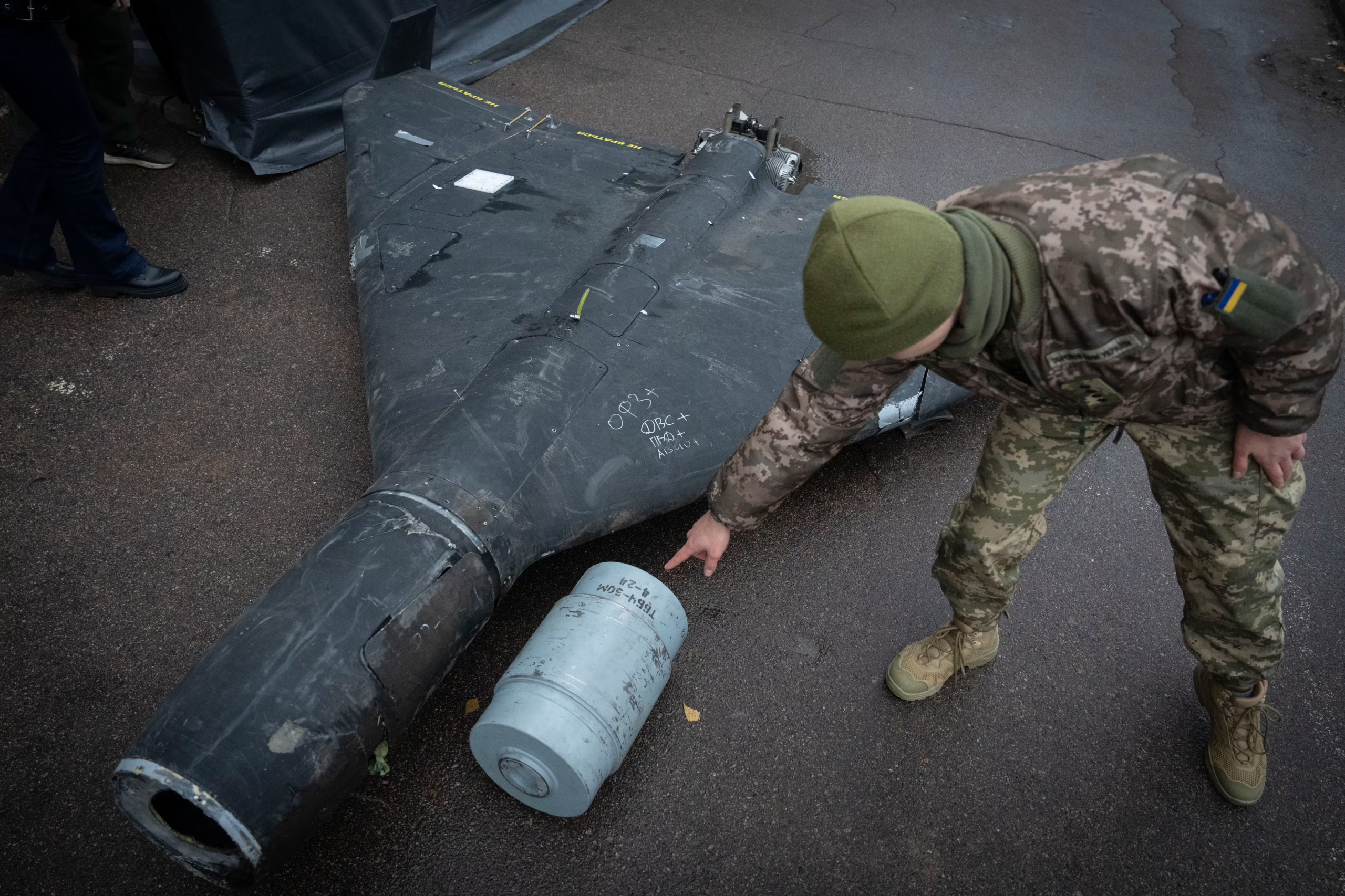
They have already proven effective against Iranian-made Shahed suicide drones, Mr Healey said, but have a production cost of less than a tenth of their rivals. He added that the system could eventually also be used as a missile defence system in the UK to protect military sites and critical national infrastructure.
“We’re ready with allies through Nato to demonstrate to Putin that his aggression and his incursions, reckless or intentional, will be challenged,” he said.
It came as fresh sightings of drones were reported over Denmark’s largest military base.
The Danish defence ministry said the drones were “observed at several Danish defence facilities” overnight on Friday, following a “hybrid attack” on the country earlier in the week, with Russia suspected to be responsible.
Troels Lund Poulsen, Denmark’s deputy prime minister, said at the time that the drones were probably launched by a “professional actor” but refrained from accusing Russia of involvement.
Mette Frederiksen, Denmark’s prime minister, said on Thursday: “There is one main country that poses a threat to Europe’s security, and it is Russia.”
At the same time, Oslo Airport closed its airspace for three hours after sightings of two drones. Norwegian police are also investigating a possible drone observation at Ørland main air station on Norway’s west coast. It is Norway’s largest military air base and the main station for its military aircraft.
Moscow said it “firmly rejects” the suggestion of any Russian involvement.
Estonia has also reported that its airspace was violated by three Russian MiG-31 fighter jets, which remained over the country “without permission” for 12 minutes. In response, the country is extending a fence along its border with Russia and building anti-tank ditches as a precaution against a land war with President Vladimir Putin.
Both Donald Trump and Mark Rutte, the Nato secretary-general, have said that members of the alliance should target Russian forces that violate their airspace where necessary. Allies have called for Moscow not to escalate the war in Ukraine into a wider conflict with Nato in Europe.
Volodymyr Zelensky, the Ukrainian president, told the UN this week that Europe must stop Putin before the war becomes “wider and deeper.”
Mr Healey also announced a new “forces first” housebuilding programme on surplus land owned by the Ministry of Defence, which he said would help solve the problem of substandard accommodation for serving personnel.
He said 100,000 homes could be built on the land in the coming years, with “thousands” in this parliament, contributing to the government’s target of building 1.5 million houses by 2029.
Forces’ families and veterans will be given “first dibs” to buy or rent the properties on MoD land.
“I want to change the recognition that there is amongst the forces and their families, that they recognise we’re a government on their side,” he said.
A pilot scheme for the programme has begun at MoD Feltham in Middlesex, where a housing site is under development that officials believe could create hundreds of homes and jobs.
