


Listen to the article
Zelensky’s warning about a PRC-backed rival to Starlink is less about one Russian constellation than about the end of the West’s monopoly on the connectivity that now decides modern wars.
By Andre Pienaar
Standing in Pryluky this month beside an apartment block that a Russian cruise missile had turned into a grave for twenty-two people, Volodymyr Zelensky chose to talk not about air defence but about LEO satellites. “Chinese representatives are involved in developing an alternative to Starlink,” he said. “They are getting closer, and they are passing it on to Russia. Russia could gain that kind of dominance.” Days earlier he had told the Financial Times that he had asked President Trump “several times”, most recently on the sidelines of the UN General Assembly in New York, to sanction the Russian and Chinese companies involved, and that the system could be operational “by the end of the year, beginning next year”.
It is tempting to file this with the other appeals a wartime president makes to Washington. That would be a mistake. Zelensky has identified the single most consequential shift in the technological balance of the war since the arrival of the FPV followed by Russian jet powered drones. The balance could be moving against the alliance of the West for reasons that have little to do with Ukraine and everything to do with Beijing.
Why Starlink matters more than tanks
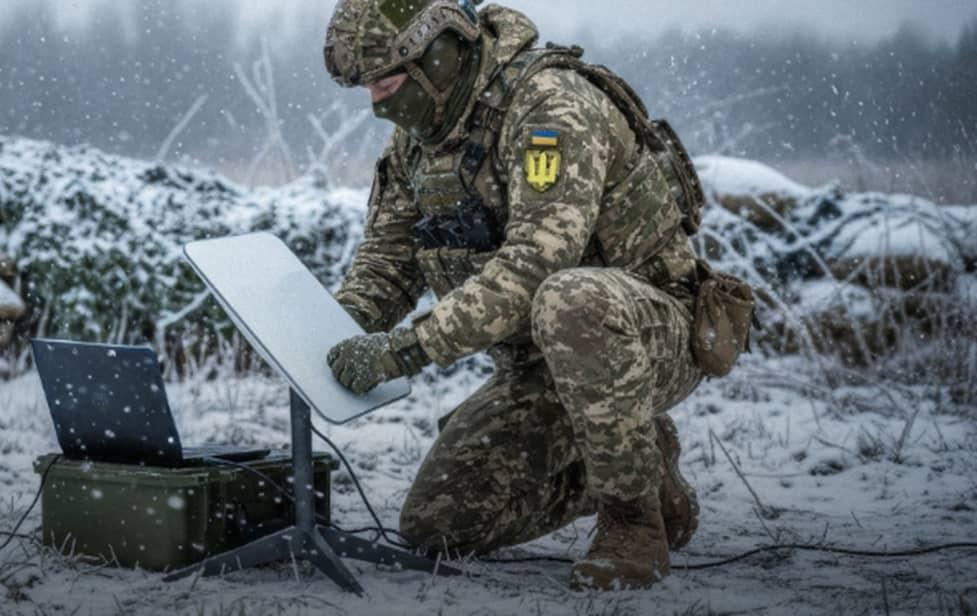
Four years into the war, the SpaceX constellation has done more to keep Ukraine fighting than any single category of Western military aid. More than 50,000 terminals have been delivered. They carry command-and-control, artillery fire direction, reconnaissance feeds and, above all, the video link between a drone operator and the munition he is flying. When Russia’s initial assault in February 2022 was designed to decapitate Ukrainian command through cyber attack and strikes on communications infrastructure, Starlink made the decapitation impossible. There are serious analysts who hold that its contribution exceeds the combined military support of the European NATO members, and the argument has merit. Space is now the strategic high ground of war.
The Russians understood this early enough to do something about it. Through 2023 and 2024 Russian units were running grey-market Starlink terminals bought through third countries. When SpaceX, under Ukrainian pressure, tightened geofencing and terminal authentication, the effect on Russian offensive tempo was immediate. By some accounts, close to halving their capacity to mount coordinated attacks. That experience taught Moscow two things: one, that satellite connectivity is now a precondition for manoeuvre warfare, and two, that depending on an American company for it is strategically intolerable for the Kremlin. Washington drew the mirror-image lesson. In February 2025 the United States has controlled Starlink access as leverage over Kyiv to calibrate the war. Zelensky has, in the same FT interview, asked for that restriction to be lifted to 200 kilometres so that Starlink-guided drones can reach ballistic missile and Shahed launch sites. Both belligerents, in other words, have been reminded that the switch is in someone else’s hands.
Rassvet: Russia’s alternative to Starlink
Russia’s response is Rassvet, or “Dawn”, built by Bureau 1440, a company founded in 2020 within the Iks Holding group of Alexei Shelobkov. After three experimental satellites in 2023 and three prototypes in 2024, the first serial batch of sixteen went up on a Soyuz from Plesetsk on 23 March this year, followed by a second sixteen in July. With the prototypes, Russia has at most forty spacecraft in orbit. The Russian state has committed 102.8 billion roubles, roughly $1.3 billion, and Bureau 1440 says it will add a further 329 billion by 2030. The published schedule called for 156 satellites in 2026, 292 in 2027 and 318 in 2028, with commercial service in 2027 and 900 satellites by 2035.
Measured against those targets, the programme is at perhaps a fifth of where it was meant to be this year. Russian commentators themselves put the threshold for a functioning service at around 250 satellites. Ukrainian military intelligence describes current Rassvet coverage over Ukraine as intermittent, available only when a satellite happens to be overhead. Rob Lee of the Foreign Policy Research Institute is right that Rassvet will not match Starlink’s effectiveness for years, if ever. But that is the wrong test. A constellation that can carry drone video from the front to a command post on the Russian side of the line, that cannot be geofenced by an US company and that Washington cannot threaten to switch off, changes the character of Russian operations even at a fraction of Starlink’s density.
The question is how Russia closes the gap from forty satellites to several hundred with the Russian launch industry that has lost its Western customers, a microelectronics sector under comprehensive sanctions and a Soyuz production line that cannot lift sixteen satellites a month. The only answer, as Zelensky said, is China.
What China is building to rival Starlink
It is worth being precise about what Beijing can offer, because the shorthand obscures it. China’s BeiDou system, often mentioned in this context, is a satellite navigation constellation, the counterpart of GPS and GLONASS. It delivers positioning and timing and a short-message service used by the People’s Liberation Army (PLA), but it is not a broadband network and cannot carry a drone feed. Russia and China have had BeiDou–GLONASS interoperability agreements since 2015, and that cooperation matters for guidance and targeting, but it is a different layer of the problem.
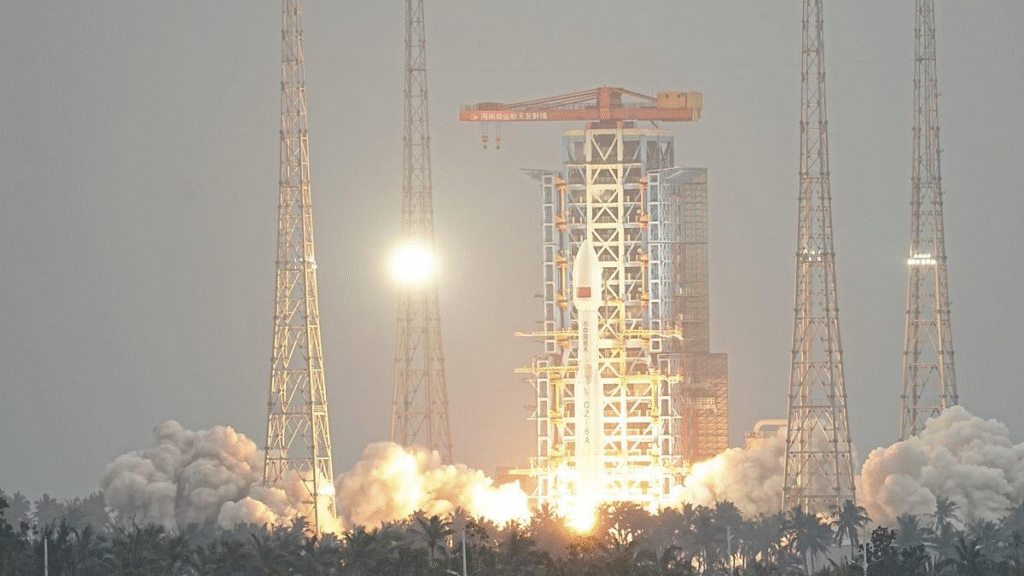
China’s Starlink equivalents are two programmes that most Western readers have never heard of. The first is Guowang, the “National Network”, operated by China SatNet, a state enterprise created in 2021 with a licensed plan for roughly 13,000 satellites in two sub-constellations. By mid-2026 it had placed something between 160 and 190 satellites in orbit over some twenty launches, with 310 targeted by year-end, 900 in 2027 and a planned cadence of 3,600 a year from 2028. Test satellites in the series have carried payloads for signals intelligence, imaging and positioning as well as communications. Guowang is a national-security programme with a civilian shopfront.
The second is Qianfan, “Thousand Sails”, the Shanghai-municipal and commercially structured track run by Shanghai Spacesail Technologies with an ITU filing for around 15,000 satellites at a comparatively high 1,160-kilometre orbit. It has been launching flat-panel satellites in batches of eighteen since August 2024 and stood at about 218 after its thirteenth group in July. Qianfan is explicitly an export product. Brazil’s regulator has authorised it to operate through the state carrier Telebras with commercial service targeted for the end of this year; agreements have followed in Kazakhstan, Malaysia and across the PRC’s Belt and Road footprint. A third constellation, Honghu-3, is behind the other two. Taken together, Chinese filings reserve orbital slots and spectrum for close to 38,000 satellites. Starlink, by contrast, has between eight and ten thousand in orbit.
None of this is yet a global service. Both Chinese constellations are behind their own schedules, both are launched on expendable rockets, and Qianfan has lost a meaningful share of its early satellites to failures. But the industrial base is unlike anything Russia possesses: a mass-production line for flat-panel broadband satellites, a maturing inter-satellite laser link capability, a phased-array terminal supply chain and a launch cadence that is accelerating rather than contracting. Those are precisely the inputs Rassvet lacks.
Three ways Beijing can “pass it on” to Russia
Zelensky has not named companies, and Beijing has, as ever, denied assisting Russia’s war. But there are three distinct mechanisms by which Chinese support could bring Rassvet into service sooner and better than its own timeline suggests, and sanctions designers need to separate them.
The first is components. Russia’s satellite programme, like its drone and missile programmes, runs on Chinese microelectronics, radiation-tolerant chips, solar arrays and RF modules. A Rassvet satellite that is Russian by design and Chinese by content is the most likely form of cooperation and the hardest to prove, because the parts flow through the same dual-use channels that the G7 has spent three years trying to close.
The second is capacity. Rassvet’s own terminals cannot be made at scale in Russia; Chinese phased-array user terminals for Qianfan and Guowang can. Ground-segment equipment, gateway antennas and the software that manages a constellation are all areas in which China is now well ahead of Russia. Chinese launch capacity is a further possibility that would, if confirmed, be the clearest sign of a state decision in Beijing.
The third is the most important and the least discussed: coverage sharing. Qianfan’s high orbit and Guowang’s density mean that within two or three years a Chinese constellation could provide continuous broadband over the whole of the Russian theatre without a single Rassvet satellite being involved. A Russian military user on a Chinese network, roaming on a commercial agreement, would be invisible to the sanctions architecture as currently conceived. This is the scenario Ukrainian intelligence should be mapping, and it is the one that would give Moscow the “dominance” Zelensky fears.
What the West should do
Zelensky’s request is for sanctions on the Russian and Chinese entities involved making the case that Bureau 1440 and Iks Holding belong on the US, UK and EU lists today, with the full secondary-sanctions apparatus applied to their suppliers.
First, it is crucial that allied governments must stop treating low-Earth-orbit broadband as a commercial matter. Allied governments must recognise it as the strategic high ground for war that it has become. The lesson of Starlink is that whoever owns the constellation owns the switch. Both Kyiv and Moscow have now felt the consequences.
Second, the Chinese constellations need to be understood as the connectivity layer of an alternative order. Qianfan in Brazil, Kazakhstan and Malaysia is not primarily a commercial play- it is the digital infrastructure of the axis of aggressors led by the PRC with Russia, Iran and North Korea. Foreign and defence policies will have to contend with the fact that a growing number of states will have Chinese satellite internet as their national backbone, and that the axis forces could ride on it.
Third, the counter-constellation capability that China is openly developing against Starlink- from lasers to co-orbital interceptors to electronic warfare, is one that the West will need against Rassvet and potentially against Guowang. The space domain is now a theatre of the war in the same way that maritime chokepoints have become.
Zelensky’s warning, delivered from the rubble of Pryluky, is not that Russia has built a Starlink. It is that China is already building two rivals, and is deciding how much of them to share with Moscow and Teheran. The West spent the first years of this war learning that satellite connectivity decides whether an army can see and talk. We are about to learn what happens when our adversaries has it too.
