

Listen to the article
As Europe ramps up its defence spending and braces for a future potentially without US protection, a prominent communications expert from the London School of Economics has issued a stark warning: the prevailing war panic across the continent could lead to a self-fulfilling prophecy.
Professor Bart Cammaerts emphasises that history has shown us a troubling pattern: when nations prepare for war in the name of achieving peace, they often find themselves embroiled in conflict instead.
This cautionary message comes in the wake of President Donald Trump’s remarks about the spectre of World War III, alongside an increase in defence spending in the United Kingdom and proposals for increased military spending throughout the European Union.
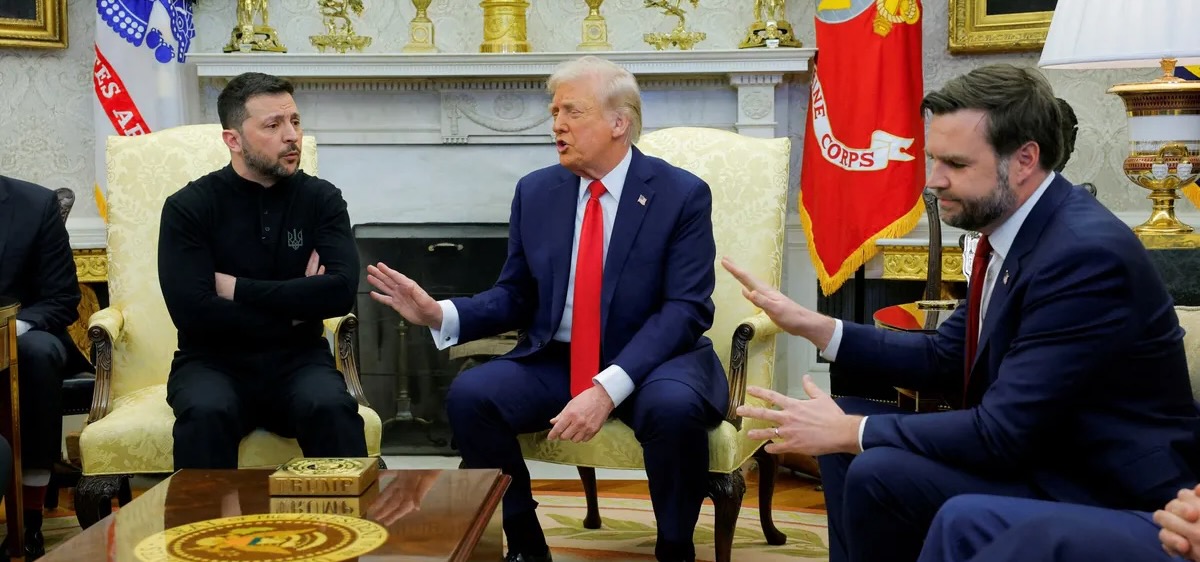
During the much-publicised fallout between US President Donald Trump and Ukrainian President Volodymyr Zelenskyy at the White House, President Trump accused the Ukrainian president of “gambling with World War III.” It prompted the French President, Emmanuel Macron to respond to reporters by saying, “if anyone is gambling with World War III, his name is Vladimir Putin.”
His words were echoed by a Ukrainian Member of Parliament, Kira Rudik who told Newsweek that if Ukraine were pressured into what she regarded as a “shameful peace” it would embolden countries like Russia, as well as China and North Korea “to continue manufacturing weapons and working together, which pose the risk of a “bigger and more brutal war.”
Rearm Europe
Fear of war is rising in Europe as it realises it is really on its own now and that it could probably not expect the US to back it up against Russia. Countries across the continent have increasingly started rearming themselves.
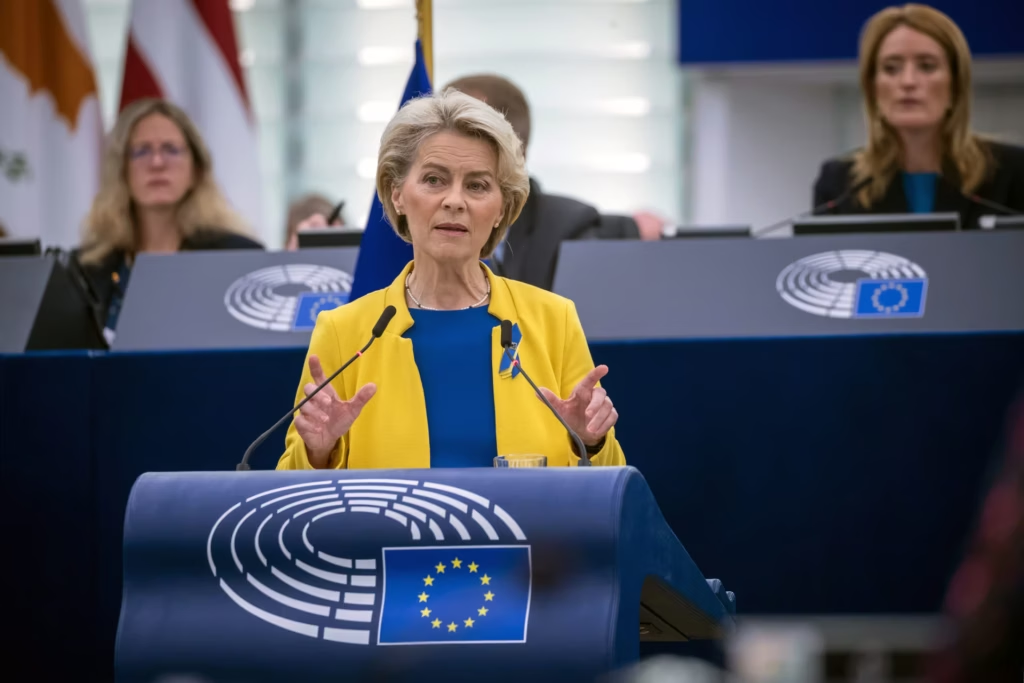
The United Kingdom increased UK defence spending with a target to spend 2.5 per cent of GDP on defence by 2027 and European Commission President Ursula von der Leyen has proposed a new common instrument to boost military spending across the European Union.
Von der Leyen has suggested allowing EU countries to draw on up to €150 billion in loans as part of a five-part plan to scale up defence spending. She told reporters that “Rearm Europe” plans to unlock up to €800 billion of additional defence spending over the coming years.
“Europe is ready to massively boost its defence spending, both to respond to the short-term urgency to act and to support Ukraine, but also to address the long-term need to take on more responsibility for our own European security,” von der Leyen said today.
To create more fiscal space, von der Leyen said she will trigger the EU’s national escape clause, under which military expenditure would not be counted toward the bloc’s punishment mechanism for countries breaching the EU’s spending limits.
Global war fears are rising according to poll
Global war fears are rising according to experts polled by the Atlantic Council’s Scowcroft Centre for Strategy and Security, which found in a poll that 40.5 per cent of security experts across more than 60 countries think that by 2035 there will be a multi-front war among the most powerful nations. However, it has to be noted that the majority, 60 per cent, said the opposite.
Should another world war break out, the use of nuclear weapons seems likely, the respondents say, with almost half, 48 per cent, saying they expect nuclear weapons to be utilised in the coming 10 years by at least one nation if a larger conflict breaks out, according to the poll.
What the experts “somewhat or strongly” agreed on in the poll is that there is a 65 per cent chance that China will attempt to take over Taiwan within the next decade. That is 15 per cent up from last year when 50 per cent predicted a Taiwan takeover.
In a blog for the London School of Economics and Political Science’s Media department republished here with permission from Media@LSE, Prof Bart Cammaerts warns that history has taught us that that war panic could be a recipe for a self-fulfilling prophecy. Prof Cammaerts explains how techniques used to generate moral panics in society which is currently used to demonise immigrants are now being used to create “war panic’ in Europe.
Moral panics, he said, is designed to affect policies and political choice “to provide justification for diverting funding from education, health and social policy to defence spending and to engineer the re-militarisation of Europe.”
Professor Cammaerts cautions that history has taught us that if you prepare for war to achieve peace, you get war.
War Panic: If you prepare for war to achieve peace, you get war – Bart Cammaerts
LSE’s Professor Bart Cammaerts explains how the techniques used to generate moral panics in society are now being used to create a ‘war panic’ in Europe.
At the intersection of sociology and media and communications studies, the concept of moral panic is well known. First introduced by sociologist Stanley Cohen in the 1970s, it refers to the way in which a range of moral entrepreneurs, in conjunction with media organisations and journalists who amplify them, have the power to produce fear and create a panic directed at a specific group of people or a particular phenomenon, using moral indignation, exaggeration, distortion, denotations of deviance, and othering. This often intentionally manufactured panic is subsequently abused to legitimatise and push through draconian and disproportionate policy interventions against those groups or phenomena. One of the main reasons this has proven to be so effective is because moral panics are in essence highly emotive, manipulative and leave no room for nuance.
While Cohen’s original study focused on British working-class subcultures or what he termed “folk devils”, later on the concept of moral panic was tied, amongst others, to so-called ‘benefit scroungers’, gaming, drug use, hedonistic parties, etc. In recent years, the (extreme) right, in conjunction with the media, has created a persuasive moral panic around asylum seekers and immigration more broadly, with profound implications for the inherently diverse and multi-cultural Western societies. In my own work, I argued that the same moral entrepreneurs who demonise immigrants and non-white people also fabricate an effective moral panic against so-called “woke” culture and social justice, as terms such as woke-madness, wokery, the woke-mob, or woke insanity attest to.
From moral panic to war panic
Besides moral panics, recent times in Europe are also characterised by a pronounced war panic, which is fuelled by Russian threats, as well as US President-elect Trump’s isolationist discourse that includes threatening to reduce US involvement in NATO, which would leave the country less implicated in Europe’s defence. It seems that political and military elites in many European countries have decided that the solution to these threats is to create a war and security panic with a view to ‘preparing’ the population for war, something that – it is argued – we lost after the end of the cold war. Mark Rutte, the new Dutch Secretary General of NATO, recently gave a speech which fans this war panic. In the speech, he said:
Danger is moving towards us at full speed. We must not look the other way. We must face it. What is happening in Ukraine could happen here too. And regardless of the outcome of this war, we will not be safe in the future unless we are prepared to deal with danger.
In Rutte’s home country, the banking sector recently recommended that the Dutch population make sure to keep a reserve of money in cash. A director of the Dutch National Bank said:
You should not assume that payment transactions will always work. There may be situations in which financial services are disrupted for a longer period of time. The government has a good emergency list of what you should have in the house just in case. This also includes an amount of cash for groceries.
Likewise, the Belgian government and national crisis centre started a new campaign this week to increase the preparedness of the Belgians for the risks of our times. It will address how to hide, how to evacuate or make an emergency plan, as well as the importance of keeping an emergency battery in the house. The Minister of the Interior added:
You see a lot of scary things happening around us. In our country too, we have been confronted with disasters, floods and cyber attacks. We all need to prepare ourselves to defend ourselves as best we can against such incidents.
Last November, the Swedish government published a brochure entitled ‘In case of Crisis or War’, which reminds Swedish citizens that those between the ages of 16 and 70 are all “part of Sweden’s total defence and required to serve in the event of war or the threat of war”.
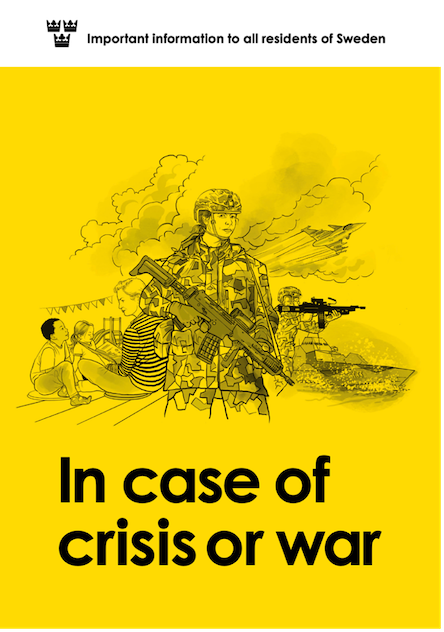
It is clear from this brochure, as well as from other European governments’ communications, that war panic is discursively coupled and intertwined with preparedness for environmental crises due to climate change, and above all with risks from pandemics such as COVID-19. In doing so, an equivalence is created between the war against the virus and a military war with Russia.
Just as with moral panics, the war panic is also designed to affect policies and political choices. The fear and panic created through such discourses are needed to provide the justification for diverting funding from education, health and social policy to defence spending and to engineer the re-militarisation of Europe. The NATO secretary general acknowledged this quite explicitly; “[t]here is no imminent military threat”, and “I know spending more on defence means spending less on other priorities”, but “[t]o prevent war, NATO must spend more”. The ground must be prepared for this, and war panic does just that.
This is very much in line with classic adage: “If you want peace, prepare for war”, as proclaimed by the Roman General Vegetius. The history of how wars start teaches us, however, that war panic is also a recipe for a self-fulfilling prophecy. Aligning with the steps-to-war theory, scholar Andrew Owsiak points out that “[e]mpirical evidence generally finds a positive relationship between arms races and the onset of war”. In other words, if you prepare for war to achieve peace, you get war…
This post represents the views of the author, and not the position of the Media@LSE blog nor of the London School of Economics and Political Science.
About the author

Bart Cammaerts
Bart Cammaerts is Professor of Politics and Communication and former Head of Department in the Department of Media and Communications at LSE. His current research focuses on the relationship between media, communication and resistance with particular emphasis on media strategies of activists, media representations of protest, alternative counter-cultures and broader issues relating to power, participation and public-ness.
