

Listen to the article
Originally published by The Jerusalem Post
Insights from the Israel-Africa Relations Institute show how strategic partnerships—not aid dependency—can unlock Africa’s vast potential.
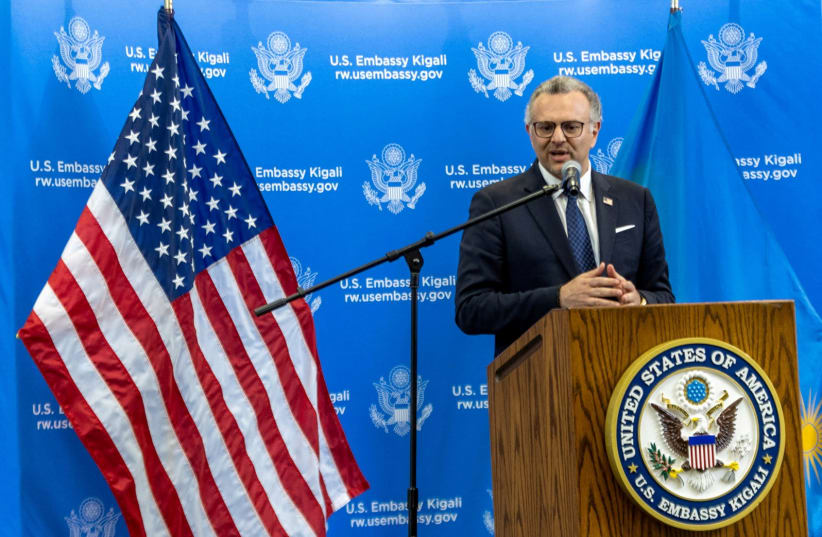
(photo credit: REUTERS/Jean Bizimana/File Photo)
Africa stands at a pivotal juncture in its development journey. As the world’s second-largest continent, spanning more than 30 million square kilometers and home to nearly 1.4 billion people, Africa’s population is expected to double by 2050, presenting both extraordinary potential and formidable challenges. According to the African Development Bank, the continent’s economy is forecast to grow by 3.8 per cent in 2024 and 4.2 per cent in 2025, outpacing the global average.
However, opportunity does not come without obstacles. Youth unemployment in Sub-Saharan Africa remained high at 8.9 per cent in 2023, underscoring the urgent need for job creation and economic inclusion. Nearly half of Africa’s population lives in poverty and relies heavily on rain-fed agriculture, making the region especially vulnerable to food insecurity. Climate change compounds these vulnerabilities, triggering more frequent droughts, floods, and extreme weather events that erode agricultural productivity and strain food systems.
Meanwhile, limited infrastructure and outdated farming practices continue to constrain access to nutritious food and economic opportunities. Today, Africa’s young, connected generation demands more than rhetoric from its leadership—it demands real, transformative change.
Beyond aid: Global interest, strategic stakes
This analysis draws on insights from the Israel-Africa Relations Institute (IAI), a platform founded by Haim Taib, who has been working in Africa for more than 34 years. Taib’s vision is to deepen strategic partnerships between Israel and African nations through development, innovation, and trade.
Africa’s wealth of critical minerals — including cobalt and lithium—has made it central to global energy and technology supply chains. China currently controls 60 per cent of global production and 85 per cent of processing capacity, underscoring the strategic importance of Africa’s resources.
China’s longstanding engagement in Africa—anchored by trade, infrastructure, and the Forum on China-Africa Cooperation (FOCAC)—is now challenged by alternative models. The EU’s Global Gateway initiative, launched in 2021, aims to mobilise €300 billion by 2027 to fund sustainable infrastructure projects. Italy’s €5.5 billion Mattei Plan focuses on infrastructure, energy, and human capital investment, marking a shift from a migration-centric lens to long-term partnership. Regional powers are also increasingly active. The UAE has become Africa’s largest investor, with over $110 billion in projects between 2019 and 2023. Turkey expanded its diplomatic footprint from 12 embassies in 1998 to 44 as of July 2024. Saudi Arabia and Iran each maintain over 22 embassies across the continent.
In the US, a strategic pivot has occurred since the first Trump administration—from aid to trade. Joshua Meservey, Senior Fellow at the Hudson Institute – which has several ongoing collaborates with IAI—notes that Africa is “central to the global contest with China, Russia, and Iran” and stresses that for the US to compete effectively, it must show that partnership with America brings “real, mutual benefits.”
Thriving US companies in Africa, he argues, strengthen not only economic ties but also “the rule-based norms that underpin fair competition.” Unlike aid, which often entrenches dependency, Meservey emphasises that trade fosters reciprocal relationships and can help build democratic resilience.
Infrastructure and integration: Lobito as a turning point
The Lobito Corridor Project is a transformative infrastructure initiative aimed at revitalising and expanding the Benguela Railway, extending a high-speed, heavy-haul transport corridor from Lobito Port in Angola to Dar es Salaam Port in Tanzania.
By modernising this vital link, the corridor provides the shortest, fastest, and most efficient route for transporting critical minerals, agricultural produce, and manufactured goods from the DRC and Zambia’s Copperbelt to global markets. It is backed by over $6 billion in public-private investments from the US, EU, African Development Bank (AfDB), and the African Finance Corporation (AFC).
Angola, Zambia, and the DRC have aligned regulatory frameworks to support the initiative. A 30-year operating concession was awarded to the Lobito Atlantic Railway consortium.
Dr. Irit Back, a co-founder of the Israel-Africa Relations Institute, and one of Israel’s leading researchers on Africa, sees the Lobito Corridor as representing “a strategic shift in Washington’s engagement with Africa—one that prioritises sustainable partnerships over debt dependency.” As competition with China escalates, especially over critical minerals vital to EV batteries and defence systems, the Corridor offers a model that contrasts sharply with more exploitative approaches like Belt and Road.
The Institute’s CEO, Shiri Fein-Grossman, emphasizes that “regional integration is the foundation for peace, prosperity, and resilience,” and draws a parallel to the Abraham Accords, noting that the Lobito Corridor similarly connects nations, aligns infrastructure, and promotes a new model of global cooperation.
Israel and Africa: A natural partnership
Israel’s expertise in water management, agriculture, and healthcare offer valuable tools for African development. “Throughout the years, Israel has played a role in sustainable development and innovation in Africa’s nations, implementing innovation, water solutions, agriculture models, healthcare initiatives and more,” says Fein-Grossman. “Israeli entrepreneurs and companies have already made significant inroads in various African countries.”
Haim Taib has dedicated more than three decades to working across Africa, focusing on strengthening and developing nations. Driven by his belief that Africa represents the future of the world, he founded the Israel-Africa Relations Institute to transform and deepen Israel’s ties with African countries.
Throughout his years on the continent, Taib drew inspiration from Israeli innovations and models — from kibbutz communal farming, to pioneering technologies like drip irrigation for water conservation, to practical job training methodologies developed by the Amal education network.
Through Mitrelli, his international, Swiss-based company, as well as other initiatives he champions, Taib integrates these concepts and technologies into large-scale national projects. His efforts span critical sectors such as water, agriculture, education, healthcare, technology, and more, advancing sustainable development across Africa.
Among Taib’s most impactful initiatives is Aldeia Nova. Launched in 2004, the Aldeia Nova project in Angola is a transformative rural development initiative that fosters self-sustaining food production, economic growth, and social integration by uniting former rebels and government supporters, previously on opposite sides of Angola’s civil war.
Spanning 20,000 hectares, it supports around 3,000 families and creates thousands of jobs. By producing large quantities of eggs, milk, meat, corn, and soy, Aldeia Nova has strengthened food security, reduced imports, and developed one of Angola’s largest dairy sectors.
Fein-Grossman explains that Israel recognized Africa’s potential early on, with Golda Meir founding MASHAV in 1958 to coordinate technical cooperation. However, she warns that today, Israel’s engagement often lacks the strategic vision and resources necessary for a truly lasting partnership.
A strategic opportunity: Africa, the US, and Israel
While still largely aspirational, a triangular relationship between Africa, the US, and Israel presents a compelling opportunity for inclusive, long-term development. The potential is clear: American scale and capital, Israeli technology and adaptability, and Africa’s young population and resource wealth offer complementary strengths.
Taib highlights this as a “once-in-a-generation opportunity” to reshape Africa’s role in the global economy through strategic economic development, bolstered by US initiatives to strengthen partnerships and foster growth, while both expanding and deepening the Abraham Accords across Africa.
This vision was echoed in a recent statement by the official US Africa Media Hub account on X, which declared: “President Trump’s vision for Africa is to see an Africa anchored in shared economic opportunities, not conflict.”
If the Abraham Accords offered a blueprint for reshaping regional cooperation in the Middle East, extending that vision to many more countries in Africa could forge a future of shared prosperity and stability.
Africa is not waiting for rescue. It is looking for real allies. And those who step forward now—strategically and sincerely—may help shape the next chapter of global development.
