

Listen to the article
By André Pienaar
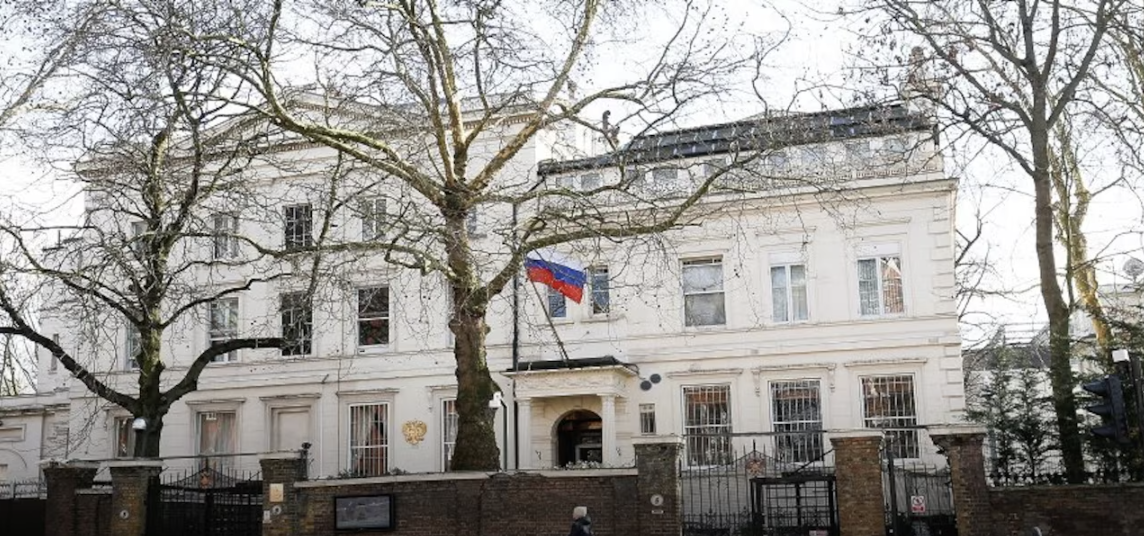
This week, the Russian embassy in London issued a statement of war against the United Kingdom. Responding to reports that British-made drones have been used by Ukraine in long-range strikes against military and industrial targets inside Russia, the embassy declared that London’s actions “will inevitably carry consequences” and that the deeper Britain’s involvement, the higher the price it will pay. Britain, Moscow says, is an “accomplice” and a “co-perpetrator” in the defence of Ukraine.
Strip away the diplomatic packaging and the message is unambiguous: Russia regards the United Kingdom as a belligerent, and it intends to act accordingly. This is not a warning. It is a statement of hostile intent from a state that has waged an escalating hybrid war against Britian for many years.
History taught us that you have to take dictators at their word when they communicate hostile intent. And we should prepare with great urgency.
The war Russia is already waging
The truth is that Russia’s declaration merely announces a hybrid war Putin has been prosecuting against Britain for years. The evidence is not classified. It is in our courtrooms, our coroners’ reports and our security service assessments.
Russian agents perpetrated the first act of nuclear terrorism in London with the assassination of Alexander Litvinenko, a former FSB officer who blew the whistle on high-level corruption in the Kremlin, in 2006 using polonium-210 in a hotel on Grosvenor Square. Several more assassinations and suspected attacks on Russian dissidents followed, culminating in GRU agents deploying a military-grade nerve agent on the streets of Salisbury in an attempt to kill a Russian defector and his daughter. Instead, the operation ultimately killed a British citizen who unwittingly came into contact with the nerve agent used by the assassins.
GRU-directed proxies have set fire to warehouses on British soil linked to Ukraine’s supply chain. A GRU-directed arson attack targeted properties linked to the former Prime Minister’s family. Russian vessels loiter over the undersea cables that carry our data and energy and menace shipping in the English Channel. Russian cyber operations probe and hack our critical national infrastructure, while a relentless propaganda machine, documented in detail by NATO’s Strategic Communications Centre of Excellence, works to corrode British public confidence from within. Meanwhile, the prospect of a nuclear attack on Britain is openly discussed by the Kremlin’s propaganda mouthpieces on Russian state television.
None of this happened after this week’s statement. All of it happened during the preceding two decades, beginning with the murder of Litvinenko. The embassy’s threat is not the opening of hostilities; it is the moment Moscow stopped pretending. When an adversary that is already burning your warehouses, poisoning your citizens and mapping your seabed infrastructure tells you that you will “pay the price”, the rational response is not to parse the language for deniability. It is to ask whether we are ready for whatever attack comes next.
Why Britain is the target
Moscow has singled out Britain deliberately, and the logic is worth understanding because it is a credit to the British people’s resolve despite our limited means. Britain has been among the most consistent and operationally consequential of Ukraine’s partners. Britain has stood by Ukraine in the face of relentless Russian aggression. We were first with main battle tanks, first with long-range strike capability and among the first to provide large-scale training. We are now first, according to reporting in The Sunday Times, with sovereign deep-strike drones that have reached refineries in Volgograd and Yaroslavl. The Government has committed £16 billion in military support and plans to deliver more than 150,000 drones to Ukraine by the end of this year.
The refinery strikes matter strategically because they attack something the Russian war economy cannot easily replace: export revenue from hydrocarbons. Every refinery taken offline compresses the margins that fund Putin’s war. Moscow’s fury is a direct measure of Ukrainian effectiveness. The Kremlin does not issue threats over things that do not hurt.
But there is a second, colder calculation at work. The Kremlin believes Britain is uniquely vulnerable to attack precisely because our society has not internalised that we are now at war with Russia and its allies. Our air defences are thin. We have inadequate provision to shelter the population from air attacks. Our stockpiles are shallow. Our critical infrastructure, including energy generation, subsea cables, data centres and ports, was built for a world of peace. Moscow’s theory of victory is not to defeat the British Armed Forces. It is to demonstrate to the British public that support for Ukraine carries a terrible price, and to bet that our political system will flinch first.
We have to prove the Kremlin’s calculation wrong. Whether we do so is a matter of national resolve. It is a decision we have to make now, while our homeland remains under peacetime conditions.
What urgency actually requires
First, we must prepare to defend the homeland against a clear and present danger. The pattern from Poland and the Baltic states to Germany and Denmark is one of drone incursions, sabotage and infrastructure attacks conducted just below the threshold of open conflict. Britain needs effective air defences over its critical national infrastructure, including airports, ports, energy terminals and defence factories, and it needs them in months, not through the decade-long procurement cycles of the past. The technology exists. British and allied companies are fielding counter-UAS systems on NATO’s eastern flank today. What is missing is the wartime tempo and urgency of acquisition.
In addition, we urgently need a strategy to shelter our population from air attacks, whether from hypersonic missiles, conventional missiles or drones. Countries such as Finland and Israel have invested heavily in civil protection and shelter infrastructure. Britain needs to take civil defence with the same seriousness.
Second, we must treat the drone industrial base as strategic national infrastructure. The lesson of Ukraine is that the nation that can iterate, produce and field autonomous systems fastest holds the initiative. Britain’s commitment of more than £4 billion to autonomous systems is a beginning, not an end. Production capacity, secure supply chains for components and critical minerals, and the skilled workforce behind them deserve the same strategic attention we give to other pillars of national defence.
Third, we must harden the resolve and resilience of our society itself. Finland and the Baltic states teach us that resilience is a civic discipline: protected infrastructure, exercised continuity plans and a population educated about hybrid threats rather than shielded from knowledge of them. The British public is not fragile. It has been under-informed by successive governments reluctant to say plainly what the intelligence community has known for years: Russia is waging a sustained campaign against the United Kingdom and its people.
Fourth, we must respond to escalation with resolve, not symmetry. Russia’s threats are designed to make us deliberate ourselves into paralysis, turning every new capability for our own defence and that of our allies into the subject of months of anxious internal debate. We must prioritise and increase investment in our national defence, as successive US administrations have encouraged Britain and its NATO allies to do.
The Churchillian point
In the 1930s, Britain’s tragedy was not ignorance of the threat but the gap between knowing and acting. Churchill warned of a gathering storm. We are again living through an exceptionally dangerous period. Russia has already struck on our soil through terrorism, assassination and sabotage. Russia’s allies, North Korea, Iran and the People’s Republic of China, possess a formidable and increasingly interconnected defence industrial base.
Russia has told us of its intent to harm the British people. The embassy statement was not diplomacy; it was a declaration of strategic intent. The question before Britain is no longer whether Russia is waging a campaign against us. It is. The question is whether we prepare for the next attack.
