


Listen to the article
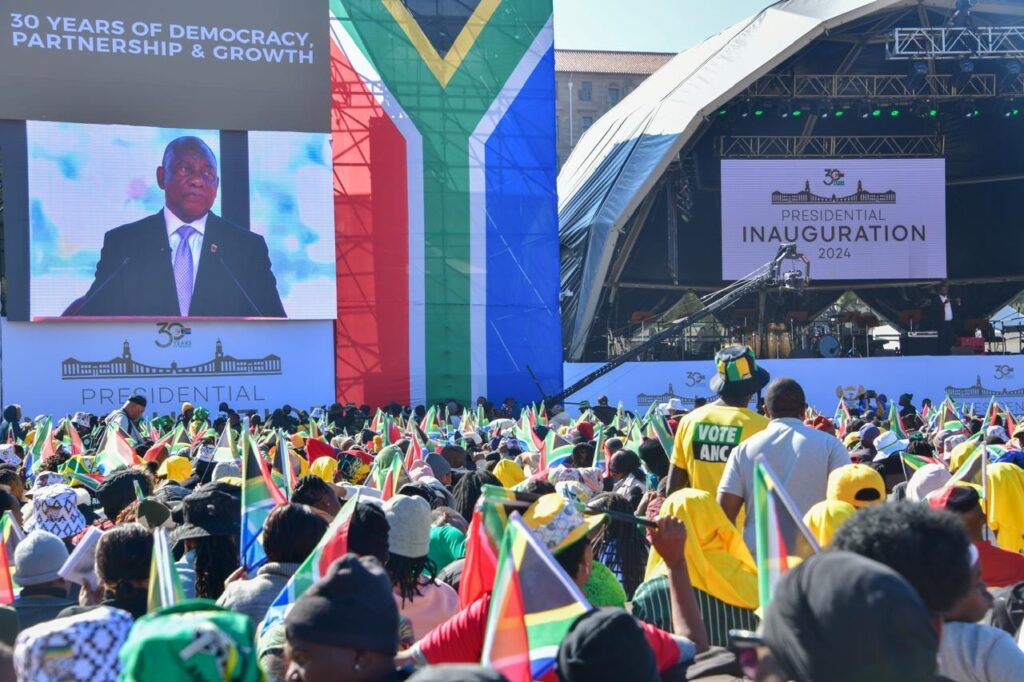
It was a week of highs for South Africa as the African National Congress (ANC), which lost its majority in the May election, struck a deal with the Democratic Alliance (DA) for a Government of National Unity. The deal enabled Cyril Ramaphosa to be elected as President of South Africa, and he was inaugurated on Wednesday with flypasts, dignitaries, and flag-waving South Africans. Supporters of a constitutional democracy in South Africa gave a collective sigh of relief.
However, negotiators who hunkered down today to reach an agreement on the Cabinet and roles in Ramaphosa’s government appear to have hit a deadlock. Sources close to the negotiations say they are being hampered by a view within the ANC that having Mr. Ramaphosa elected as President secures his position and that of his government, even if the GNU agreement with the DA is broken and the DA is not offered Cabinet representation.
There is said to be resistance within the ANC to giving the DA a proportional share of Cabinet seats, which would grant the DA significant prominence and influence in Ramaphosa’s Cabinet. To avoid this, they may instead offer the DA very little and gamble that the DA will not support the Economic Freedom Fighters (EFF) and the Umkhonto weSizwe Party of Jacob Zuma (MKP) in a no-confidence vote against Mr. Ramaphosa that would bring down his government.
The internal reasoning among supporters of this idea is that they can offer minor roles to the DA and other smaller parties. If this deal is turned down, the ANC could continue as a minority government, forming piecemeal alliance deals on a case-by-case basis to pass legislation or policies. This scenario could function as a government structure, but an analyst told NSN it would be very uncertain, and policy reforms would be very difficult.
Exchanges in the next 24 hours will be critical, but it appears that negotiations are deadlocked. One observer told NSN that the only way to clear the deadlock is to make it clear to the ANC that a secret no-confidence ballot in Parliament against Mr. Ramaphosa could succeed.
Commenting on rumours of a deadlock in the negotiations, political analyst from the University of Johannesburg, Prof. Theo Venter said he thinks that political parties on both sides of the negotiations are driving a hard bargain. He noted pushback within the ANC and counter-demands from the Democratic Alliance.
In an interview with National Security News, Prof Venter warned that there are great risks if an agreement cannot be reached and that the ‘Ramaphoria’ that boosted markets could be short-lived.
Prof. Venter said the markets reacted to the fact that South Africa was heading in a new direction in support of the decision on a Government of National Unity. However, he said if it takes too long, the country might find itself in the same situation as five or six years ago.
He was, however, optimistic that neither the DA nor the ANC would walk away from the deal. They may take a different approach, but he believes that politicians who “have a whiff of power, even if it means sharing power, can’t be stopped.” The problem, Venter said, is that the ANC culture, which has developed over 30 years, has been so dominant and “you don’t change a 30-year culture of being in command, being in control.”
Prof. Venter said that although Mr. Ramaphosa used a lot of Mandela symbolism in his speeches, he is no Mandela. However, he thinks Mr. Ramaphosa is usually at his best when he is a facilitator among the power-hungry and when facilitating different approaches.
The delay currently happening in the negotiation process for the GNU’s Cabinet, Prof. Venter says, reflects the difficulty of accommodating the demands of every political party in Parliament in the GNU. “It is a hard bargain.”
The next two days will be critical to determine if the deadlock in the negotiations can be broken. There was huge optimism, Prof. Venter said, that “we will have a Cabinet announced today.” But that deadline first slipped to Saturday and then Sunday. The big question, he said, is whether the ANC can put national interest before the interest of the party.
