

Listen to the article

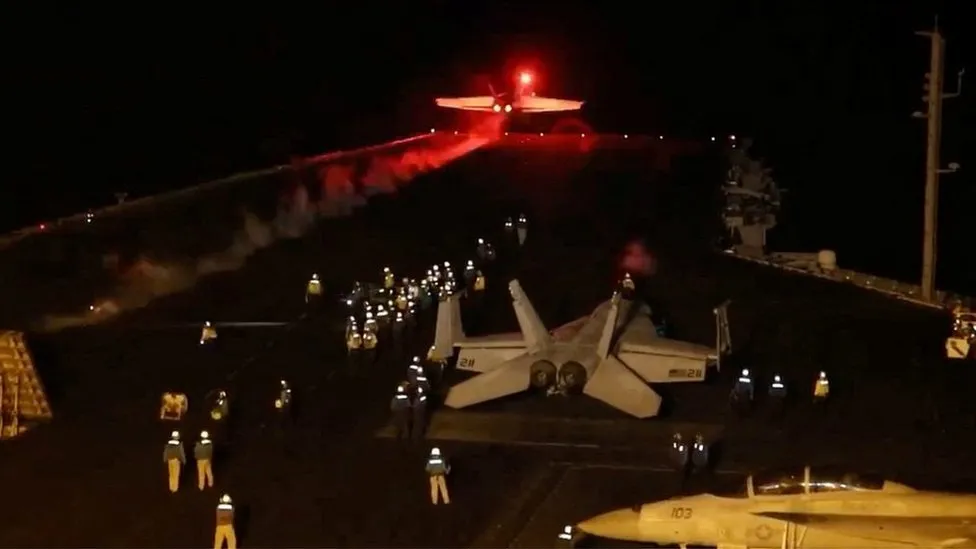
The United States and Britain have carried out strikes against targets linked to Houthis in Yemen. It’s the first time strikes have been launched against the Iran-backed group since it started targeting international shipping in the Red Sea late last year.
An international alliance is backing the action, with a joint statement by the governments of Australia; Bahrain; Belgium; Canada; Denmark; Germany; Italy; Japan; Netherlands; New Zealand; Republic of Korea; Singapore; United Kingdom; and United States.
It said, “Let our message now be clear: we call for the immediate end of these illegal attacks and release of unlawfully detained vessels and crews. The Houthis will bear the responsibility of the consequences should they continue to threaten lives, the global economy, and free flow of commerce in the region’s critical waterways.”
Nearly 15 percent of global seaborne trade passes through the Red Sea, including 8 percent of global grain trade, 12 percent of seaborne-traded oil and 8 percent of the world’s liquefied natural gas trade. International shipping companies continue to reroute their vessels around through the Cape of Good Hope, adding significant cost and weeks of delay to the delivery of goods, and ultimately jeopardizing the movement of critical food, fuel, and humanitarian assistance throughout the world.
The missing Chinese
But one nation, whose goods are brought on almost every container vessel making its way into the Red Sea via the straits of the Bab el Mandeb, is not participating in the attacks: the Chinese.
This is not because they do not have assets in the area. Since 2017 the Chinese have an important base in Djibouti – its first overseas military base. It has been developed into a major facility, capable of servicing the expanding Chinese navy.
Rather, China has used its diplomatic muscle to try to ensure that its own shipping is not targeted. As Reuters reported, Chinese officials have asked their Iranian counterparts to help rein in attacks on ships in the Red Sea by the Iran-backed Houthis, or risk harming business relations with Beijing.
The discussions about the attacks and trade between China and Iran took place at several recent meetings in Beijing and Tehran, the Iranian sources said, declining to provide details about when they took place or who attended.
“Basically, China says: ‘If our interests are harmed in any way, it will impact our business with Tehran. So tell the Houthis to show restraint’,” said one Iranian official briefed on the talks, who spoke to Reuters on condition of anonymity.
These efforts have borne fruit: the Houthis have granted Chinese and Russian vessels immunity from attack. This obviously benefits Chinese and Russian exports, but does nothing for other nations, who must rely on the American and British attacks to reduce the Houthi attacks.
The Financial Times quoted Dennis Wilder, a former top CIA China expert now at Georgetown University, as saying that Beijing had “worked assiduously” to court Middle Eastern nations, including Iran, for economic and geopolitical gain. But he said it would be “very reluctant to use its limited influence with the Islamic state in a way that it perceives advance US interests without benefit to China”.
Russia side-lined
President Putin, who has not been able to exert much influence in the Red Sea. For one thing, he has no naval base from which to operate. The closest Russian facility is in the Syrian port of Tartus. One option for the president would be to push ahead with an alternative suggestion: a port on the Red Sea in Eritrea.
Eritrea under President Isaias Afwerki has had warm relations with the Russians for many years, but it was Eritrea’s support for Putin’s invasion of Ukraine at the UN that probably sealed the deal. Eritrea was the only African country to vote against the UN resolution condemning Russia’s actions.
Following this President Afwerki made two trips to Moscow, spending time in talks with President Putin – the second during the Russia-Africa Summit of July 2023.
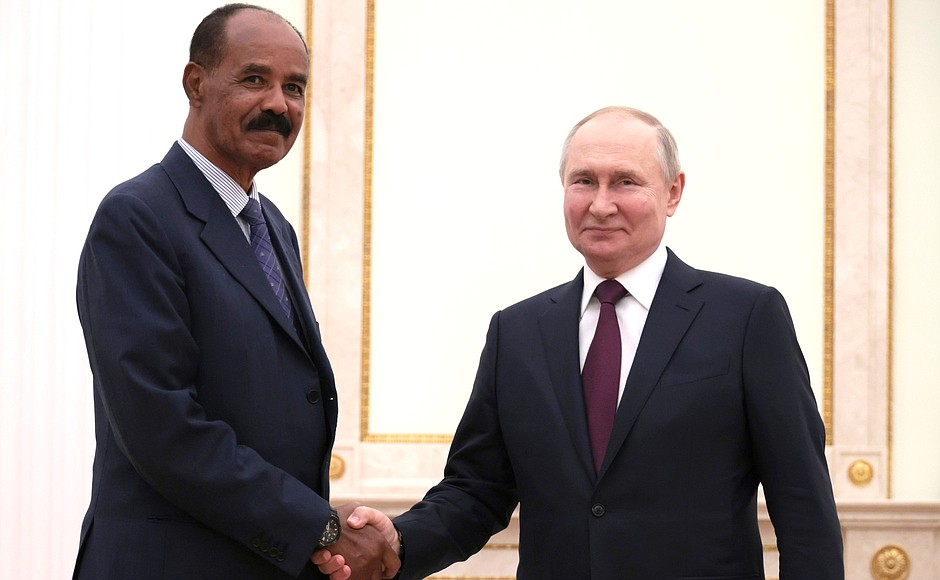
Both men share a loathing of the United States and what they term its “hegemonic strategy.” Rather, Russia wishes to promote a “multipolar” world, in which it has greater control via a series of alliances.
“There’s a sort of synergy around Russia’s desire to see a dismantling of the post–World War II order that no longer really privileges them beyond their Security Council veto, and African desires to see reform of multilateral institutions which were created before most African states even existed,” said Michelle Gavin, of the Centre for Foreign Relations.
An Eritrean base
The suggestion that Russia might build a base in Eritrea dates back at least as far as 2018, when Sergei Lavrov, the Kremlin’s long-standing Foreign Minister is reported to have announced the plan. The suggestion that this was on the cards was confirmed in the British Parliament by Lord Goldsmith on 7 April 2022, when he said in a reply to a question about a possible base in Eritrea that: “Russia has long sought to pursue interests on the Red Sea. We continually monitor developments in the region.”
On a visit to Eritrea in January 2023 Lavrov elaborated on Russia’s intentions. He is quoted as saying that “Both sides will conduct a joint study to establish the logistical and transit opportunities presented by the Red Sea port of Massawa and its airport, TASS said. “I would like to mention the possibility of using the logistical potential of the Massawa port and the city’s airport. The airport of Massawa looks interesting from the point of view of its transit possibilities,” Lavrov said.
These initiatives come after Russian plans to build a base in Sudan came to nothing. “They’re very hesitant to give them access to this port. They continue to try and delay and do delay tactics,” said a U.S. intelligence official. “We see it as unlikely that the Port Sudan deal is going to be done anytime in the near future and that Russia is potentially looking to seek other options if Port Sudan doesn’t work out.” If confirmed, the present Russian scheme to construct a naval base on the Dahlak would be the fulfilment of these long held ambitions, and match other foreign navies that have a presence in the region, including the US, Chinese and French bases in Djibouti. Having a base on the Red Sea is a tempting prize for President Putin, but it is still years away.
