


Listen to the article
The Alternative for Germany (AfD) has won a landslide victory in Saxony-Anhalt, bringing the party within reach of governing a German state and raising concerns over what its growing influence could mean for Germany’s policy towards Russia and Ukraine.
The AfD won 43.8 per cent of the vote and secured 39 seats in the 83-member state parliament. Chancellor Friedrich Merz’s Christian Democratic Union (CDU) finished second on 17.2 per cent.
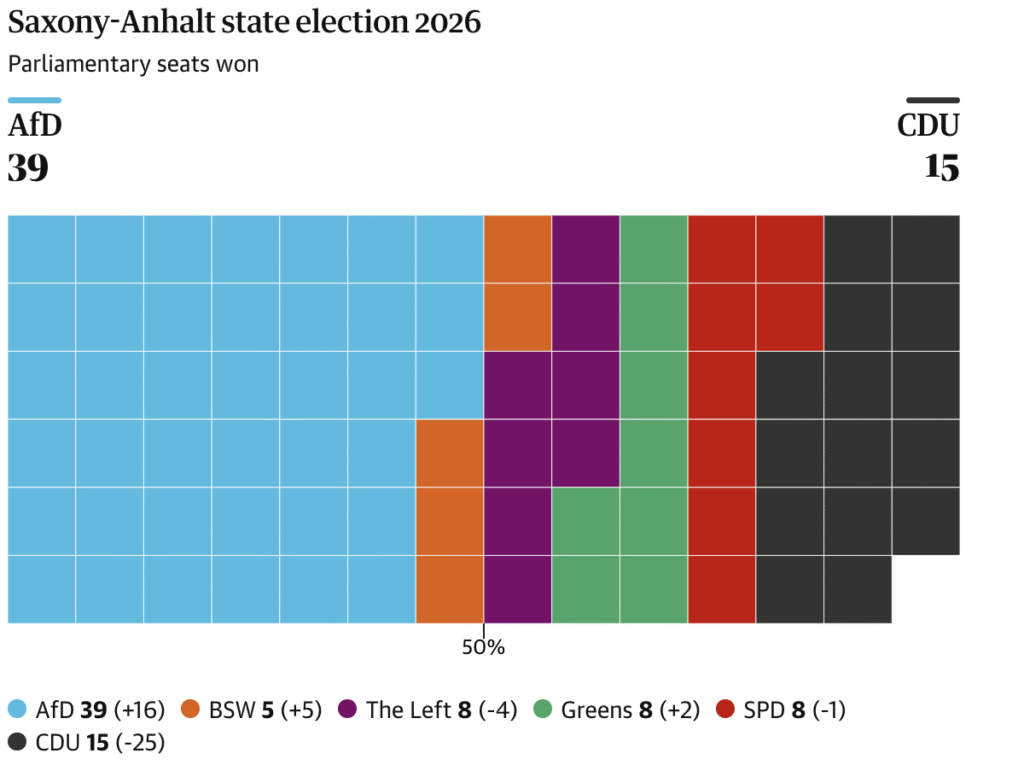
The AfD fell three seats short of an absolute majority. Mainstream German parties have maintained a political “firewall” against entering coalitions with the party.
The result prompted concern among European leaders.
France’s European affairs minister Benjamin Haddad said: “To see the far right prevail in the German regional election marks a very grave moment for Europe.”
Polish foreign minister Radosław Sikorski described the result as “a very worrying sign”.
The result was welcomed in Moscow.
Kirill Dmitriev, President Vladimir Putin’s special envoy and head of the Russian Direct Investment Fund, described it as a “historic win for the pragmatic AfD”.
Dmitriev has also held talks with senior AfD figures. In June, he met Markus Frohnmaier, the party’s foreign policy spokesman in the Bundestag, in St Petersburg.
Dmitriev said afterwards: “Looking forward to building a great FUTURE together with AfD, Germany’s most popular party.”
He said the pair discussed economic cooperation and restarting a Russia-Germany-US business dialogue.
The AfD has opposed sanctions against Russia and German military support for Ukraine. It has called for Russian energy supplies to Germany to resume. Its 2025 election manifesto also proposed a neutral Ukraine outside NATO and the European Union.
The party’s position contrasts with Merz’s government, which has increased defence spending and continued military support for Kyiv.
The AfD’s contacts with Russia have attracted scrutiny in Germany. In November 2025, the Bundestag debated the implications of the party’s Russian connections for national security. The AfD rejected accusations that it maintained problematic links with Moscow.
The issue could become more significant if the party enters government.
German states have authority over policing and domestic intelligence. An AfD-led administration could gain access to sensitive security information.
Defence Minister Boris Pistorius has warned that classified information would need to be protected if the AfD entered government. Thuringia’s Interior Minister Georg Maier has also raised concerns over intelligence relating to espionage and critical infrastructure.
The AfD’s Saxony-Anhalt branch has also been classified as a confirmed right-wing extremist organisation by the state’s domestic intelligence service.
The party cannot determine German foreign policy from Saxony-Anhalt. But its victory strengthens a political force that opposes sanctions on Moscow and continued military support for Kyiv as Germany takes a larger role in European defence.
Further AfD gains could increase domestic pressure on Merz over defence spending, sanctions and long-term support for Ukraine.
For Germany and its allies, the result carries implications beyond Saxony-Anhalt. The AfD’s growing electoral strength could make it increasingly difficult for Berlin to maintain its current approach towards Russia and sustain long-term support for Ukraine.
