

Listen to the article
By André Pienaar
During the Second Congo War from 1998 to 2003, the Directorate of Special Operations (DSO), otherwise known as the Scorpions, the elite law enforcement unit I architected for President Mandela, carried out several impactful investigations to combat international illicit arms networks that helped fuel the war. The DSO conducted these operations to help protect the peace process that culminated in the Pretoria Accord of 2002 and the Sun City Agreement of 2003. Today, the chessboard in Africa is considerably more complex, with many more non-African countries engaged in the growing number of conflicts across the continent. The new war that broke out in Ethiopia last week adds greatly to this complexity.
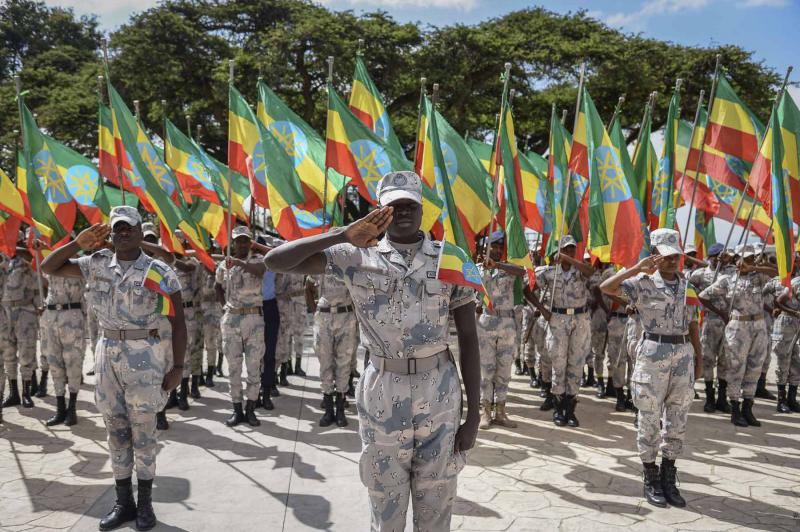
Last week, on the night of 22 September, Tigrayan fighters walked into the airports at Mekele, Shire and Axum and took them without a fight. Ethiopian Airlines cancelled its flights the next morning. Within 48 hours, a coalition calling itself the Alliance for Survival — the Tigray People’s Liberation Front, the Amhara Fano movement, Afar and Oromo insurgents — had opened fronts on three regional borders and declared that its aim was the overthrow of the federal government in Addis Ababa.
Most Western media coverage treated this as the return of Ethiopia’s civil war. The seismic geopolitical impact of this new war is much larger. The second Tigray war is the moment at which four African conflicts that have been converging for two years — Sudan’s civil war, the Ethiopia–Eritrea rivalry, Libya’s rival governments and the DRC Government’s war on its own ethnic minorities represented by M23 — became one regional war. The new regional war is being fought across the centre of the chessboard of Africa, the western shore of the Red Sea and the southern shore of the Mediterranean. The direct belligerents are African. The money and weapons being supplied to the belligerents are not. The critical minerals vital to Western economies and the sea lanes that matter most to Europe run directly through the African theatre of war.
Four wars, one theatre
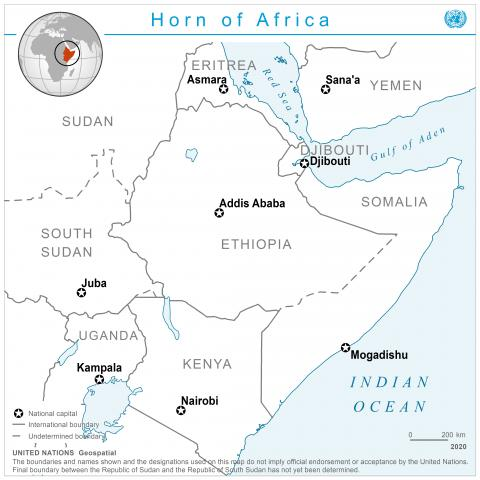
Start with Sudan, where the state army under General Burhan has spent the past fortnight pushing west across North Kordofan while the Rapid Support Forces (RSF) open a second front towards Ad Damazin in Blue Nile. The secondary front matters because of what lies behind it. Ethiopian territory has, by credible accounts, been used to train and stage RSF fighters. On the other side, Tigrayan units are physically based in eastern Sudan fighting alongside Burhan’s army, while Eritrea and Sudan — and, by extension, Sudan’s ally Iran — have both armed the TPLF. The Sudan war and the Ethiopian war now share a border, a set of combatants and a set of paymasters.
In Ethiopia, Prime Minister Abiy Ahmed has declared access to the sea an existential and strategic question. He has spent two years positioning to gain access to Eritrea’s port of Assab. Eritrea’s President Isaias Afwerki, who has run a garrison state since 1993, responded by doing what he has always done: arming Ethiopia’s internal enemies. The rebel seizure of Tigray’s airports closes the last federal foothold in the region. The rebels have a line of advance towards Woldia and towards the A1 highway to Djibouti, which carries more than 90 per cent of Ethiopia’s trade. A rebel offensive that threatens this vital corridor is effectively laying siege to a country of 130 million people.
Then there is Libya, which most analysts consider only in the context of the Mediterranean rather than the Horn. This is a mistake. Southern Libya, under the control of the Haftar family’s eastern government, is the northern conduit through which drones, arms and mercenaries reach the RSF in Darfur in Sudan. Libya’s oil, its migrant routes and its Russian airbases are the same war seen from the other end.
Who is paying
The alliances are clearer than they have been at any point since the Sudan war began in 2023, and they are worth setting out plainly because they explain the behaviour of every actor on the board.
On one side stands the new emerging military alliance in the Middle East — Saudi Arabia, Turkey and Pakistan, with their silent partners in Egypt and Qatar. They back the Sudanese army, Eritrea and the federal government in Mogadishu in Somalia. Egypt wants a leash on the Grand Ethiopian Renaissance Dam and a Red Sea coast that is under its influence. Riyadh wants to deny Abu Dhabi the maritime power it has been building port by port. Ankara supplies the drones that enabled the Sudanese Armed Forces to retake Khartoum and is building a naval presence at Suakin and Port Sudan, having already sent F-16s to Somalia in January.
On the other side stands the United Arab Emirates, with Israel as a silent partner. Abu Dhabi is the RSF’s indispensable patron in Sudan, Abiy’s decisive backer in Ethiopia and the Haftar family’s original financier in Libya. The UAE is building strategic infrastructure in the region — naval facilities at Berbera in Somaliland, logistics at Assab and communications facilities on Socotra. Israel recognised Somaliland’s independence in December 2025. There are reports of an Israeli presence at the Berbera base in Somaliland. Abiy’s government in Ethiopia has quietly built a working relationship with Israel.
Two things are noteworthy. First, the positions of the two blocs are reversed in adjacent countries: the UAE backs the government in Ethiopia and the insurgents in Sudan; Egypt and Saudi Arabia back the government in Sudan and the insurgents in Ethiopia. Second, Egypt and the UAE overlap on only one square — eastern Libya. Here, Cairo tolerates Haftar’s links with the UAE while opposing everything else Abu Dhabi does south of the Sahara. Iran and Saudi Arabia, on the other hand, are at war in the Gulf but backing the same side in Sudan. Tragically, the old map of a strategically coherent “Arab” or “Gulf” position is gone.
In the DRC — at the centre of the African chessboard — President Tshisekedi’s government in Kinshasa wages a war against M23, a rebel group backed by Rwanda that represents the interests of ethnic minorities in the east of the DRC. The Gulf states have a growing portfolio of infrastructure and critical minerals investments across both the DRC and Rwanda. Israel provides military training for both the DRC and Rwanda. Iran provides weaponry for the armed Hutu forces that perpetrated the genocide in Rwanda — the FDLR — through the Sudanese Armed Forces (SAF) to destabilise the US-led peace process. The US is working to end the conflict under the auspices of the Washington Accords for Peace and Prosperity led by President Trump, with Switzerland and Qatar also acting as mediators.
The engagement of the totalitarian axis
There is a third layer of foreign actors in the African regional war. It is the one that should concern Western capitals most. Russia, having lost its Syrian bases, has made eastern Libya its Mediterranean front. The successor to the Wagner Group — the Africa Corps — garrisons Al-Khadim airbase and Tobruk port. Russian destroyers dock regularly in these Libyan ports. In Sudan, Moscow has switched from Hemedti, the leader of the RSF, to Burhan, who leads the SAF, in pursuit of a naval base at Port Sudan. Iran supplies weapons, including Mohajer and Ababil drones, through the same port to the SAF for attacks on RSF positions. The People’s Republic of China (PRC), which established its first overseas military base in Djibouti in 2017, has also just been shown by satellite imagery to be building signals-intelligence facilities there — 35 miles from Bab al-Mandeb and right next door to the US, Japanese and Italian military bases in Djibouti.
The pattern is repeating itself across several theatres in a world at war: regional wars converge, the totalitarian axis arms its proxies and seizes the chokepoints, and the West is left scrambling to protect sea lanes when it no longer controls the shores.
Why it matters to the UK and Europe
Consider what has happened to the geography of energy since February 2026. With Hormuz under blockade, Saudi Arabia has been exporting three to four million barrels a day through the Red Sea — nearly double last year’s volumes — with the East-West pipeline and Iraq’s proposed link to Aqaba set to push more in the same direction. The Red Sea was already a corridor under Houthi pressure from the Yemeni shore. It now has a second hostile shore: the RSF’s drones reach Port Sudan, Eritrea is at war by proxy, control of the port of Assab is a live casus belli, and in the Gulf of Aden piracy has returned with al-Shabaab’s help, producing more hijackings this spring than in the previous five years combined. There is no prospect of an imminent settlement with Iran.
The Mediterranean is the second front. Libya is Russia’s bridge not only to the Mediterranean but also to the African military governments in the Sahel that the Russian GRU is developing as its clients. It provides Russia with a lever on European politics by increasing illegal immigration and people smuggling. Sudanese refugees are the fastest-growing group of people being smuggled on the central Mediterranean route to Europe. The war in Ethiopia will soon add large numbers of Eritreans and Ethiopians to it.
With both chokepoints contested in the Middle East, the route around Africa and the Cape of Good Hope has become the artery between the US, Europe and Asia, and also between the Middle East and Asia. The convergence of the four wars and their destructive impact on the Horn of Africa mean the situation will stay that way. This further shifts the maritime security burden south — to the Mozambique Channel, where Islamic State (ISIS) is attacking westwards out of Cabo Delgado and where Rwanda continues to play a vital role in defending the largest US and French energy investment in Africa: Mozambique’s LNG.
Policy recommendations
The instinct of many Western governments will be to treat the war in Ethiopia as another humanitarian file and another problem for the African Union (AU) alone. This would be a strategic error. The converging wars of Africa are fusing with the wars in the Middle East and Europe. This creates a serious risk that a world at war could become a world war before the end of this dangerous decade. In addition, Europe is only eight miles from Africa, and the terrible consequences of these wars will come to our shores. Finally, the vital sea lanes and access to the critical minerals on which our economies depend are at risk.
Four things are needed now. First, the alliance of democracies should, with great urgency, work together with our Gulf allies to prevent an escalation of the war in Ethiopia. Second, the alliance of democracies should deploy their military assets in coordination with the US to help secure the Strait of Hormuz and the Red Sea as a strategic priority. Third, the alliance of democracies should support US leadership in bringing about a long-term and sustainable peaceful solution to the Great Lakes region that balances the DRC’s ability to exercise sovereignty over the country’s vast territory with Rwanda’s legitimate security concerns. Fourth, the democracies should work with the states on the Cape of Good Hope route to build a maritime security architecture that recognises the route as one of the main arteries of the global economy it has become.
The forcing move has been played. A regional war now runs from the Libyan desert to the Ethiopian highlands to the rainforests of the Congo. The totalitarian axis is already positioned at both ends of this war. The question is whether the alliance of democracies recognises the gambit on the board before the next square falls.
