

Listen to the article
Britain, France and Germany pledged to increase support for Ukraine after talks with President Volodymyr Zelenskyy in London.
The meeting came as Kyiv reported its strongest run of territorial gains in more than two years. Separately, the European Union released nearly €2.8 billion in new financing for Ukraine under its Ukraine Facility programme.
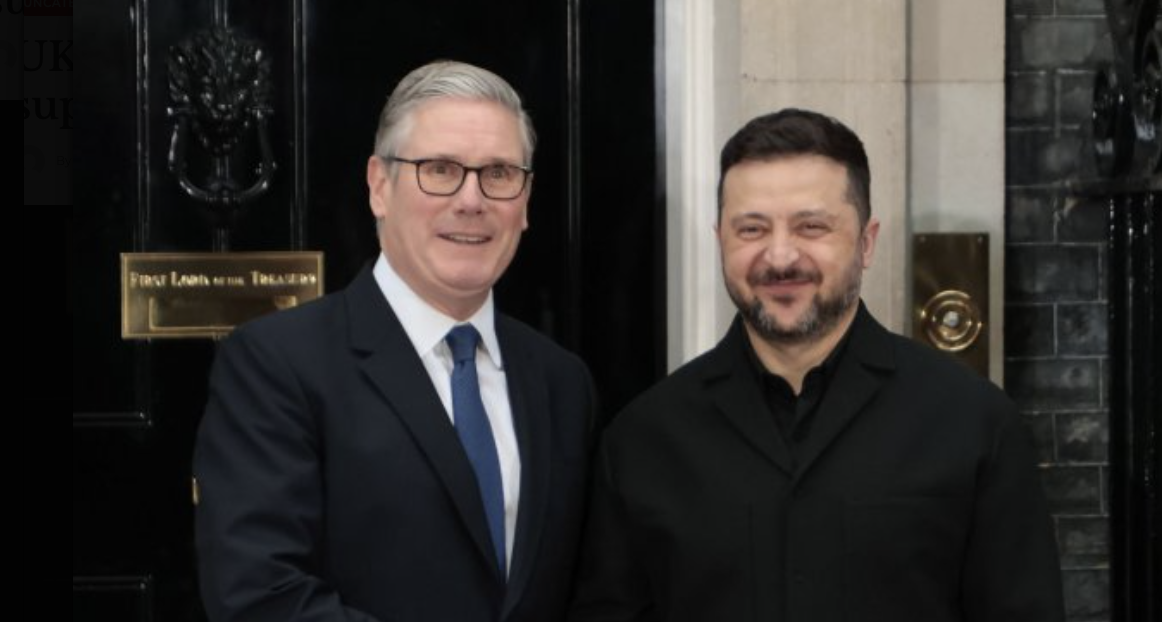
Prime Minister Keir Starmer hosted Zelenskyy, French President Emmanuel Macron and German Chancellor Friedrich Merz at Downing Street for talks on air defence, long-range weapons, security guarantees and any future ceasefire with Russia.
The four leaders reiterated their “unwavering support” for Ukraine and discussed “next steps in negotiations to support a just and lasting peace”.
The leaders said Europe had an important role to play in any settlement and that diplomacy should involve Ukraine, European partners and the United States.
The statement welcomed recent Ukrainian battlefield successes, including territorial gains and advances in drone technology, and said the leaders had discussed using forthcoming G7, Coalition of the Willing and NATO meetings to coordinate further support.
Ukraine’s top military commander, Oleksandr Syrskyi, said Ukrainian forces had recaptured more than 600 square kilometres of territory this year. He said Ukraine retook nearly 100 square kilometres more than it lost in May, but did not specify where.
Recent reports have suggested Russian advances have slowed sharply, or even reversed in some areas, after years of steady but limited gains by Moscow.
Syrskyi described the frontline as “difficult and dynamic” and said Russian forces were continuing attacks in the east and south, including around Pokrovsk, Oleksandrivka and Huliaipole. Analysts said drone warfare had widened the contested grey zone along the 1,200-kilometre front, making precise assessments difficult.
Zelenskyy said after the London talks that the military picture had improved for Kyiv.
“Russia is not winning,” he said, adding that Ukrainian battlefield experience would be shared with allies. “There is no price for this experience. It’s not about money, it’s about people’s lives.”
The Ukrainian president also said Kyiv needed more help against Russian missile and drone attacks.
“We are trying, through the PURL programme [NATO’s Prioritised Ukraine Requirements List initiative], to buy anti-ballistic missiles from the United States,” he said.
Referring to funds linked to the sale of Chelsea Football Club by Roman Abramovich, he added: “Russia began this war. Why not use Russian money?”
The British Prime Minister said the UK would continue to stand behind Kyiv.
“Our support for Ukraine is ironclad,” Starmer said. “We will stand with Ukraine for as long as it takes. Ukraine’s security is Europe’s security.”
The leaders said there was an urgent need to scale up production of interceptor missiles and develop anti-ballistic missile and deep-strike capabilities with Ukraine. They also discussed industrial cooperation with Kyiv and how NATO could learn from Ukraine’s battlefield experience.
The meeting followed major Russian missile and drone attacks on Ukrainian cities. The joint statement condemned Russia’s strikes, including the repeated use of Oreshnik missiles, and expressed condolences to civilian victims.
The leaders outlined five conditions for a peace process, beginning with an immediate and complete ceasefire. They said the current line of contact should serve as the starting point for negotiations; that Ukraine must receive legally binding security guarantees following any ceasefire; and that Russian assets should remain frozen until Moscow ends the war and compensates Ukraine.
“International borders must not be changed by force,” the statement said.
The leaders also backed Zelenskyy’s call for direct dialogue between Ukraine and Russia, with active US and European participation, to secure a ceasefire and advance further negotiations. Zelenskyy wrote to Russian President Vladimir Putin on 4 June proposing direct talks.
Putin rejected the proposal, saying he saw no point in meeting and questioning Zelenskyy’s sincerity. Russia’s representative at the United Nations dismissed the offer as “rudeness and ultimatums” and said Moscow wanted a genuine settlement rather than “imitation talks”.
In Brussels, the European Commission said it had released nearly €2.8 billion to Ukraine under the Ukraine Facility, the EU’s main instrument for supporting Kyiv’s recovery, reforms and path towards membership.
“Ukraine’s speed and commitment to delivering meaningful reforms has merited this payment,” European Enlargement Commissioner Marta Kos said.
Britain says it has committed up to £21.8 billion to Ukraine since Russia’s 2022 invasion, including £13 billion in military support, up to £5.3 billion in non-military assistance, and a £3.5 billion export finance cover limit.
