

Listen to the article
After the Constitutional Court’s Phala Phala ruling, the question Parliament shelved in 2022 must now be answered — and the money trail leads to Khartoum and Teheran.
By Staff Writer
On Friday 08 May 2026, exactly thirty years after the adoption of the South African Constitution, Chief Justice Mandisa Maya delivered a unanimous judgment of the Constitutional Court that places one of the document’s principal architects, President Cyril Ramaphosa, under formal parliamentary investigation. The court declared the National Assembly’s December 2022 vote rejecting the Section 89 independent panel’s Phala Phala report to be irrational, unconstitutional and invalid; struck down Rule 129I of the Assembly’s standing rules; and ordered Parliament to refer the report to a properly constituted impeachment committee. Under the Government of National Unity, in which the African National Congress no longer commands an outright majority, that committee will be a different animal from the one Ramaphosa’s party was able to dispatch in 2022.
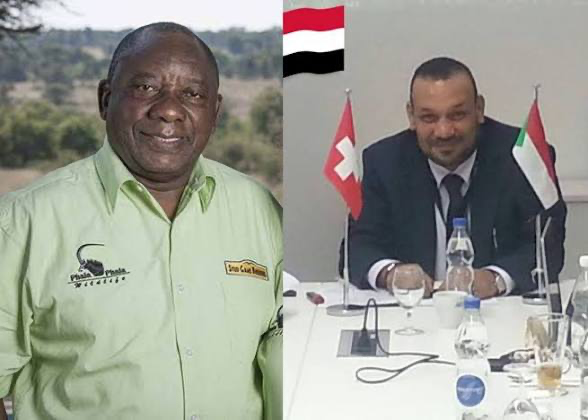
The ruling is a constitutional victory for parliamentary accountability. The Section 89 panel, chaired by retired Chief Justice Sandile Ngcobo, found prima facie evidence that the President may have breached section 96(2)(a) of the Constitution and the Prevention and Combating of Corrupt Activities Act, and explicitly recommended that the South African Reserve Bank (SARB) and the South African Revenue Service (SARS) establish the source of the foreign currency at the centre of the affair. Parliament’s 2022 vote suppressed that question. The Constitutional Court has now reopened the necessity for this investigation. The committee that follows will have to investigate a shadowy figure that has hovered at the edge of the South African public record for almost four years and that has never been seriously interrogated: Hazim Mustafa Mohamed Ibrahim, the Sudanese businessman who delivered the cash that was stuffed in the sofa.
The buyer who turned up on Christmas Day
On the President’s own account, recorded in his submissions to the Public Protector and to the Section 89 panel, the money stuffed under the cushions of a sofa in his guest bedroom at Phala Phala in February 2020 was the proceeds of the sale of twenty buffalo to one Mustafa Mohamed Ibrahim Hazim, a citizen of Sudan, on 25 December 2019. Cash, hard currency, no banking record, paid to a lodge manager who signed an acknowledgement of receipt and stored the bundle in the President’s residence because, in his judgment, too many staff had access to the farm safe. The animals were never collected. The cash sat in the sofa for some forty-five days until it was stolen in a burglary that the President did not formally report, on the apparent ground that doing so would have invited scrutiny he preferred to avoid.
The buyer is publicly known. He is Hazim Mustafa, a Dubai-based Sudanese businessman, married to a South African national, Bianca O’Donoghue of KwaZulu-Natal. Hazim Mustafa is the long-time president of Al-Merrikh Sporting Club one of the two most prominent football clubs in Sudan. In December 2022, Mustafa provided an implausible account to Sky News and eNCA that that he had originally intended to buy a house in South Africa, but switched on advice to buffalo breeding, that he had no idea the farm or the animals belonged to the President of the Republic, that he was in Limpopo for Christmas and his wife’s birthday, and that he had nothing to hide. He has not been charged with any offence in any jurisdiction in connection with the transaction.
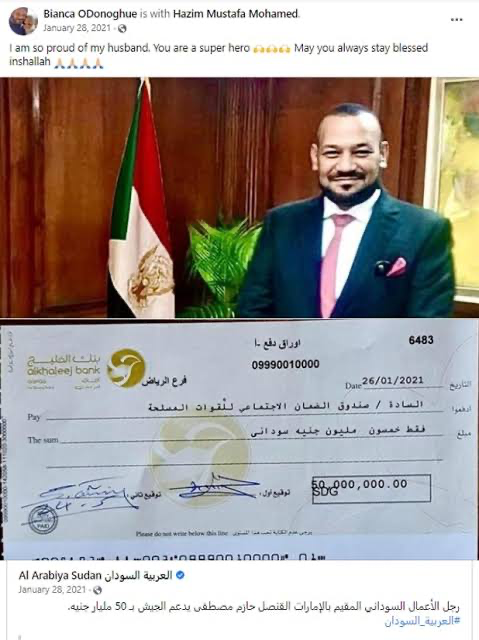
The issue that Parliament must now address and which the President’s own panel directed it to address, is provenance. Where did Mustafa’s suitcase of United States dollars come from?
From a small printing shop to a Dubai fortune
According to a campaign biography prepared during his contested 2021 re-election as president of Al-Merrikh, reported by Sudanese outlets and summarised in South African coverage, Mustafa was born in Egypt and grew up in Bahri, the industrial city across the Nile from Khartoum. His commercial career, on his own telling, began with a small printing business and a trade in fertiliser and other agricultural inputs. His father, Mustafa Mohamed Ibrahim, sat on the Al-Merrikh board, and the family’s connection to the club is multi-generational.
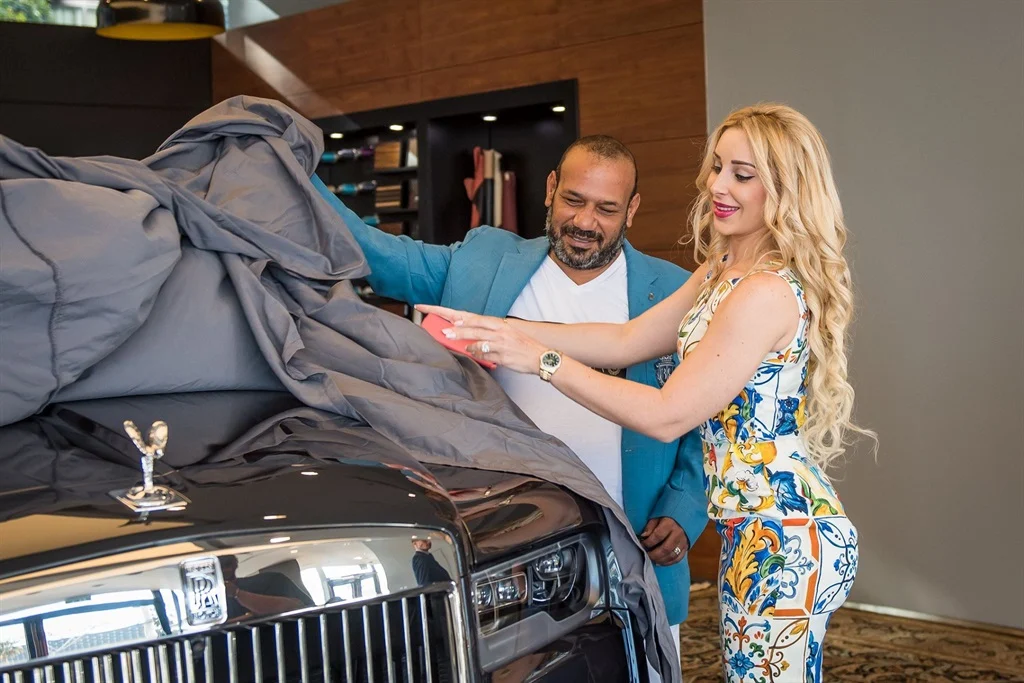
By the early 2010s, Mustafa had moved to the United Arab Emirates (UAE) and was operating from Dubai. By the late 2010s, he was a multi-millionaire whose social-media footprint, captured by South African investigative outlets at the time of the Phala Phala disclosures, recorded a wedding at Lake Como in 2018, a residence of some opulence, designer wardrobes and luxury cars.
Two data points on the public record warrant the impeachment committee’s attention. First, in 2021, Al-Merrikh itself, in a letter to the Court of Arbitration for Sport in Lausanne in connection with a contested election for the club presidency, stated that Mustafa was attached to criminal complaints inside Sudan relating to financial corruption, money laundering and the waste of public funds during the Bashir regime. The Sudanese newspaper Al-Hadatha, in the same year, named him as one of three businessmen alleged to have been involved in large-scale corruption under Bashir. Mustafa has, again, not been convicted of any offence, but the allegations are part of the public record and were not, on any reading, manufactured for South African political consumption.
Second, and more concretely, in 2017 the United Arab Emirates (UAE) froze Mustafa’s personal bank accounts and assets, and imposed a travel ban on him, in connection with a federal level national security investigation into his business partner. That partner is the figure whose name has, until now, been the missing piece of the Phala Phala puzzle.
Omar al-Bashir’s adopted son
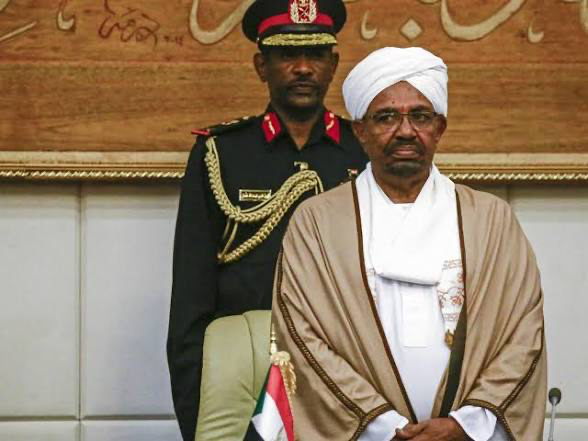
Ayman al-Mamoun Hussan Mahjoub has been described in investigative reporting, including the 2020 Loan Wolves report by the Washington-based NGO The Sentry, which was later withdrawn following litigation according to Intelligence Online, as the adopted son of the deposed Sudanese President Omar al-Bashir. Until his arrest in the UAE in 2017, he served as General Manager and partner, alongside Hazim Mustafa, of two Dubai-registered commercial vehicles: Badr Overseas Group, which traded publicly under the brand Dubai Chem, and Oil Trade and Marketing Company. Mustafa was the chief executive of Badr Overseas Group and Ayman al-Mamoun ran the operations. Together they assembled, in The Sentry’s documented account, an import-export franchise that secured contracts to supply fertilisers, refined petroleum products and other strategic commodities to the Sudanese state at systematically inflated prices.
The first source of the money: the TDB fraud and $728 million credit line
Badr Overseas Group’s contracts to supply Sudan with strategic commodities were funded through revolving lines of credit drawn on the Eastern and Southern African Trade and Development Bank (TDB), the regional development institution of the Common Market for Eastern and Southern Africa, in which Sudan was a member. By the end of 2016, according to The Sentry’s investigation, Sudan’s debt to the TDB had climbed to $728 million, more than that of any other member country. The mark-ups extracted on the supply contracts, augmented by tax breaks and customs preferences granted under the Bashir regime to politically connected importers, were retained by Badr and its principals. The cost of the goods was paid by the Sudanese state. The eventual liability was paid, and is still being paid, by the Sudanese people. The TDB credit facility was ultimately frozen.
Dr Suliman Baldo, then a Senior Advisor at The Sentry, summarised the model at the time of publication. Under the Bashir regime, parasitic companies linked to powerful officials and security-sector entities were granted monopolies to import strategic commodities at inflated prices, with generous tax and customs advantages, financed through state loans drawn on multilateral and Gulf facilities. Badr Overseas, trading as Dubai Chem, was one of the more visible exemplars. It was visible because it was large; it remained operational because it was owned, in commercially material part, by Hazim Mustafa.
This is the franchise that, on the public record, generated part of the wealth that Mustafa now enjoys in Dubai. It is also the wealth from which, on the President’s own submission, the physical United States dollars was drawn that arrived at Phala Phala on Christmas Day 2019.
The second source of the money: Teheran
The Badr Overseas Group and the Oil and Trade Marketing Group procured petroleum products for the Bashir regime and financed from the TBD credit lines from Islamic Revolutionary Guard Corp (IRGC) to the tune of hundreds of millions of dollars over more than a decade.
In 2018 it emerged that the two partners- al-Mamoun and Mustafa- also had another covert line of work with the IRGC.
On 05 June 2018, an Abu Dhabi Federal Court of Appeal convicted al-Mamoun of espionage. The Emirati authorities established, on the court record, that he had recruited an Emirati national, an Egyptian, a Lebanese and a Yemeni within Emirati banking and real-estate institutions to obtain confidential financial and property data on senior UAE officials on behalf of a foreign power. The foreign power has been identified by senior UAE officials to National Security News as Iran. Aymoun al-Mamoun has been in custody in the United Arab Emirates since the proceedings began. It was during the investigation of al-Mamoun that the Emirati authorities froze Mustafa’s accounts. The freeze was eventually lifted and the travel ban released when Mustafa cooperated as a witness against al-Mamoun in the UAE proceedings. Subsequently Mustafa took full operational control of the surviving business and continued to trade with Iran to supply the Sudanese state until the Bashir regime was deposed in April 2019.
The relationship between the two men is therefore not incidental. They are co-founders of a single commercial franchise, in which Mustafa was the chief executive and beneficial principal alongside the adopted son of Bashir as the head of state whose patronage made the franchise possible. Their IRGC counterparts in their oil trading leveraged and exploited the two men’s high level access for national security purposes.
What the impeachment committee must ask
The Section 89 panel did not have the investigative tools to trace the provenance of the cash. The Public Protector, the Reserve Bank and the South African Revenue Service have, on the public record, conducted only limited inquiries into the foreign-currency aspects of the transaction, and none has published a substantive forensic finding on the source of funds. The impeachment committee that the Constitutional Court has now ordered Parliament to constitute is the first South African institution that will have both the standing and the political conditions to ask the question seriously.
Four lines of inquiry are now unavoidable. First, the committee must establish whether the money was drawn, directly or indirectly, from accounts or facilities controlled by Badr Overseas Group, Oil Trade and Marketing Company, or successor or affiliated vehicles in the Emirates and beyond. Second, it must request, through mutual legal assistance channels with the United Arab Emirates beneficial-ownership and transaction records for Mustafa and his associated corporate vehicles for the period 2014 to 2020. Third, it must engage the Trade and Development Bank (TDB) and request disclosure of all facilities extended to Badr Overseas and its associates between 2010 and 2018, and the eventual write-down terms. Fourth, it must invite the South African Reserve Bank and the South African Revenue Service to confirm whether the entry declarations Mustafa says he made on arrival in the country were in fact lodged, and whether the transaction was reflected in any subsequent tax or exchange-control filing by the Phala Phala estate.
Why this matters beyond the Republic
The Phala Phala affair has, for four years, been treated in South African discourse as a domestic embarrassment with foreign cameo characters. Mustafa is not a peripheral figure in that history. He is one of the surviving beneficiaries of the Bashir regime and linked to a serious espionage case involving Iran.
That a sitting head of state of the Republic of South Africa accepted, on his own account, more than half a million United States dollars in physical cash from a principal of that franchise, on Christmas Day 2019, in a transaction that left no banking trail, that produced no goods, and that he did not subsequently report when the cash was stolen, is not a private matter. It is a question, now formally placed before Parliament by the Constitutional Court, about a financial network whose ultimate provenance is the looted Sudanese treasury and whose ultimate present-day expression is a civil war that has displaced more than twelve million people.
The committee will be constituted. The hearings will follow. The names on the file are now a matter of constitutional record. Parliament has been instructed to look. It should look at all of it.
