


Listen to the article
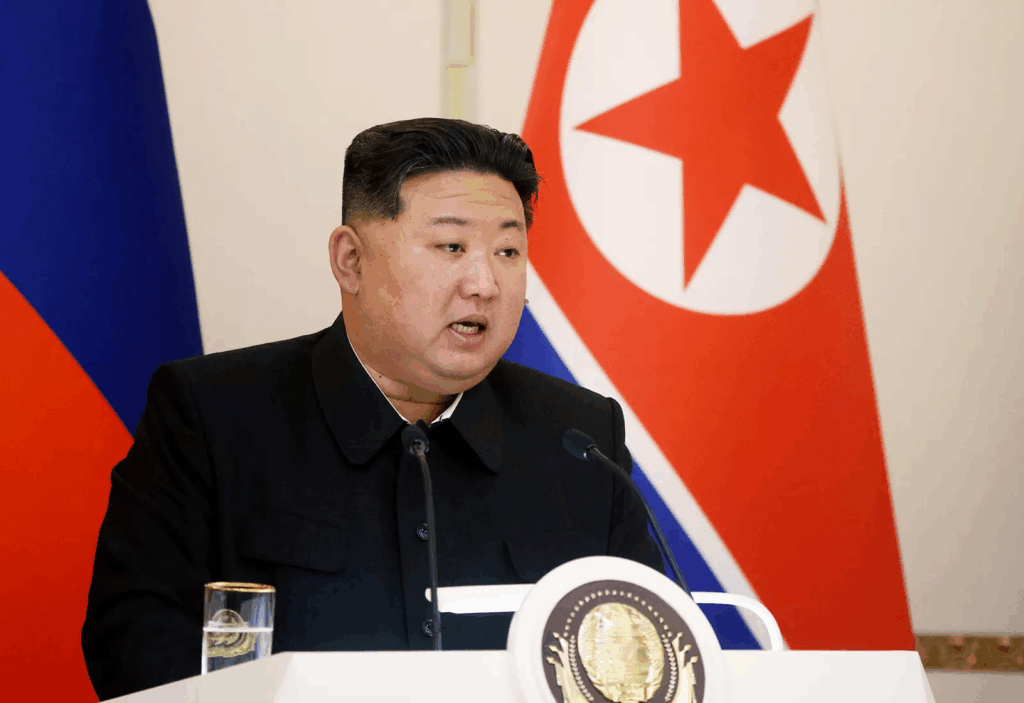
North Korea has begun a “very serious increase” in its nuclear weapon production, the head of the International Atomic Energy Agency (IAEA) has warned.
The isolated totalitarian state is believed to operate multiple facilities for enriching uranium, a key step in making nuclear warheads, South Korea’s spy agency has said.
The bases include one at the Yongbyon nuclear site, which Pyongyang purportedly decommissioned after talks but later reactivated in 2021.
The Communist regime is now thought to have assembled around 50 nuclear warheads.
“In our periodic assessments, we have been able to confirm that there’s a rapid increase in the operations” of the Yongbyon reactor, IAEA chief Rafael Grossi said at a news conference in Seoul.
The agency had also observed a rise in operations at Yongbyon’s reprocessing unit and light-water reactor, as well as the activation of other facilities, Mr Grossi said.
“All that points to a very serious increase in the capabilities of the DPRK in the area of nuclear weapons production, which is estimated at a few dozen warheads,” he added, referring to North Korea by its official name, the Democratic People’s Republic of Korea.
Since conducting its first nuclear test in 2006, the regime in Pyongyang has acquired what some experts say is a workable nuclear capability that includes intercontinental ballistic missiles capable of reaching the US mainland.
However, the country remains under a raft of UN sanctions for its banned weapons programmes.
The North Korean regime has repeatedly declared that it will never surrender its nuclear weapons.
Asked whether Russia was assisting North Korea’s nuclear development, Mr Grossi said the IAEA had not seen “anything in particular in that regard”.
North Korea has sent ground troops and artillery shells to support Russia’s invasion of Ukraine, and observers say Pyongyang is receiving military technology assistance from Moscow in return.
The country’s leader, Kim Jong-un, oversaw new tests of strategic cruise missiles and anti-warship missiles launched from a naval destroyer, state media reported.
The weapons tests took place on Sunday, the state-run Korean Central News Agency (KCNA) said, and are the latest in a string of recent missile launches.
Two strategic cruise missiles each flew for just over two hours, according to KCNA, while the anti-warship missiles flew for 33 minutes.
The missiles flew “along the flight orbits set in the sky above the West Sea of Korea and struck the targets with ultra-precision hit accuracy”, KCNA said, using its preferred name for the Yellow Sea.
The tests were carried out from the Choe Hyon, one of two 5,000-tonne destroyers in the North’s arsenal, both launched last year as Kim seeks to ramp up the country’s naval capabilities.
A photo released by KCNA showed a missile in its initial flight stage after being launched from the warship, with an orange flame trailing from its tail.
KCNA said Kim was also briefed on planning for the weapons systems of two more destroyers under construction, referred to simply as “Nos. 3 and 4”.
He reportedly “expressed great satisfaction over the fact that the preparedness of our army’s strategic action has been strengthened”.
He reiterated that bolstering the North’s nuclear deterrent was the “most important priority task”.
It comes after the Washington-based Center for Strategic and International Studies said this week that satellite imagery indicated a new facility intended for uranium enrichment was nearing operational readiness.
The think tank said the suspected new facility at Yongbyon, and another at a site in Kangson near Pyongyang, had not been declared to international nuclear authorities.
Production of enriched uranium, it warned, “would significantly increase the number of nuclear weapons North Korea could possess”.
The report echoed an assessment delivered by the IAEA last June, in which it stated that Pyongyang was building an enrichment facility at Yongbyon that could be used to produce weapons-grade material.
Mr Grossi called North Korea’s nuclear programme a “clear violation” of UN Security Council resolutions, adding that the agency “continues to maintain its enhanced readiness to play its essential role in verifying [North Korea’s] nuclear programme”.
The country has not conducted a nuclear test in nine years, but has shown clear signs of advances in its missile technology and expansion of its stockpile of weapons.
Earlier this year, South Korea’s pro-engagement president, Lee Jae Myung, said North Korea was producing enough material to build 10 to 20 nuclear weapons a year, as well as improving its long-range ballistic missile technology.
“At some point, North Korea will have secured the nuclear arsenal it believes it needs to sustain the regime, along with ICBM capabilities capable of threatening not only the United States but the wider world,” Lee said in January.
“And once there is excess, it will go abroad, beyond its borders. A global danger will then emerge.”
