

Listen to the article
By Andre Pienaar
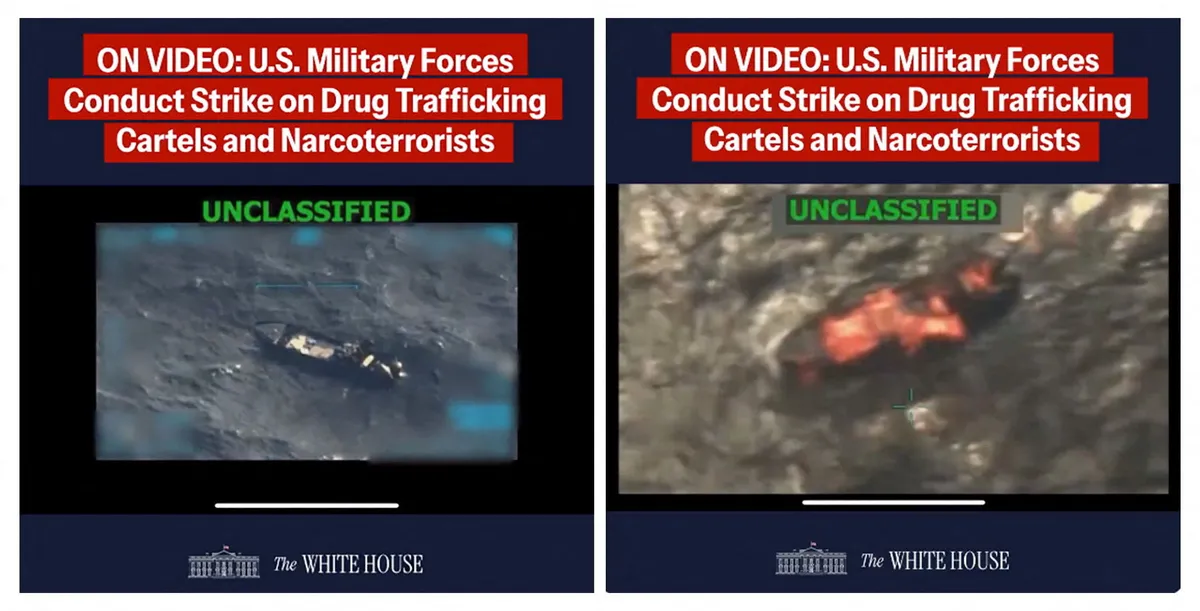
US Secretary of War Pete Hegseth confirmed on that American forces carried out a fourth successful strike against a drug-smuggling vessel in international waters off Venezuela.
The strike launched on 3rd October killed four suspected traffickers and destroyed a craft believed to be carrying narcotics destined for US markets.
This operation forms part of a new maritime interdiction campaign spearheaded by the Department of Defense (DoD) and US Southern Command, aimed at breaking the logistical backbone of transnational drug cartels.
“Cartels must know that their operations will be hunted down and destroyed wherever they sail,” Secretary Hegseth stated.

Trump Administration’s Narco-Terror Policy
The current campaign builds on a doctrine first advanced during the Trump administration, which sought to formally designate the most violent Mexican cartels as Foreign Terrorist Organisations (FTOs) under US law. This recognition allowed the US government to treat cartels not only as organised crime but as narco-terrorists—employing the same paramilitary tactics, financing networks, and transnational operations as jihadist groups.
Although diplomatic resistance slowed the designation process, it provided the policy foundation for today’s lethal interdictions, framing narco-trafficking as a national security threat demanding a military response.
Regional Security and Deterrence
The campaign is already sending a powerful deterrent message. Cartel networks are now forced to reconsider the risks of operating in the Caribbean, knowing that US surveillance and strike assets are monitoring their routes. For regional partners, these operations strengthen the security of maritime trade corridors and protect lawful commerce from criminal exploitation.
A Forward-Looking Doctrine
Defence officials have emphasised that these operations are not isolated strikes but part of a strategic doctrine of maritime dominance against transnational criminal organisations:
- Persistent Surveillance: Continuous monitoring of drug-smuggling routes.
- Rapid Response: Strike capabilities deployed in real-time.
Criteria for Designation:
- The organisation must be foreign-based.
- It must engage in terrorist activity or retain the capacity and intent to do so.
- Its activities must threaten the security of U.S. nationals or U.S. national security (defense, foreign relations, or economy).
Legal Tools Triggered by Designation:
- Criminal penalties for providing material support.
- Asset freezes and financial sanctions.
- Immigration restrictions against members and associates.
- Intelligence-sharing and expanded counterterrorism operations.
Impact on Cartels:
- Elevates cartels from criminal enterprises to national security threats.
- Expands the use of U.S. military and intelligence resources.
- Increases pressure on foreign governments to cooperate in counter-cartel operations.
- Disrupts cartel financing, recruitment, and international mobility.
Cartels Designated or Considered for FTO Status
The Trump administration and subsequent policy discussions identified several cartels as candidates for designation as Foreign Terrorist Organisations (FTOs).
President Donald J. Trump said: “The cartels are not just drug dealers. They are terrorists waging war on our communities, and we will treat them as such.”
DEA Administrator Terry Cole: “Every shipment we disrupt, every vessel we destroy, means fewer lives lost to fentanyl and cocaine in America’s neighbourhoods.”
While not all have been formally designated, they represent the groups most frequently cited in U.S. counter-narcotics and counterterrorism strategies:
- Sinaloa Cartel (Cartel de Sinaloa): One of the world’s most powerful drug trafficking organizations, responsible for large-scale fentanyl and cocaine smuggling into the United States.
- Jalisco New Generation Cartel (CJNG): Known for extreme violence and expansionist operations, including paramilitary-style assaults and international trafficking networks.
- Los Zetas: A former military special forces faction turned cartel, notorious for brutality and cross-border operations.
- Gulf Cartel (Cartel del Golfo): A longstanding trafficking syndicate along the U.S.–Mexico border.
- Beltrán Leyva Organization: Splinter group from Sinaloa with strong networks in Mexico’s Pacific states.
- La Familia Michoacana & Knights Templar: Religious and cult-like cartels involved in methamphetamine production and territorial violence.
In congressional and DoD testimony, the Sinaloa Cartel and CJNG were highlighted as the highest-priority candidates for FTO designation due to their scale, violence, and direct impact on the U.S. opioid crisis.
