

Listen to the article
South Africa’s participation in the Southern African Development Community (SADC) peace mission in the Democratic Republic of the Congo has ended in failure, prompting the community to announce a phased withdrawal following a recent meeting of heads of government. The mission faced significant criticism in South Africa after the deaths of 14 soldiers, leading to increasing pressure on President Cyril Ramaphosa to justify the deployment of troops to a conflict so geographically distant from South Africa.
In this article, republished with permission from the Institute for Security Studies Africa (ISS), Paul-Son Handy, the regional director for East Africa and African Union representative at the ISS, examines the reasons behind the failure of SADC military interventions. He attributes these failures to deep-seated political issues and limited military capacity.
“From a military perspective,” he says, “the mission was outgunned and outmaneuverd by M23 and Rwanda in Sake and Goma. From a political perspective, Handy states that the SADC mission in the DRC suffered from a lack of cohesion within the organisation.” He emphasises the need to re-evaluate the African Union’s subsidiary principle, which prioritises actors closer to a conflict over those further removed, and calls for reforms within regional bodies. “Otherwise, future military interventions are doomed to fail,” he warns.
Anatomy of SADC’s failure in eastern DRC
Published on 20 March 2025 in ISS Today
By Paul-Simon Handy, Regional Director East Africa and Representative to the African Union, ISS Addis Ababa
The premature withdrawal of SADC troops reveals deep-seated political problems and military capacity limitations.
On 13 March, the Southern African Development Community (SADC) announced the termination and phased withdrawal of its military deployment in eastern Democratic Republic of the Congo (DRC). This followed a series of setbacks for the SADC Mission in the DRC (SAMIDRC), culminating in the January seizure of Sake and Goma by the Rwandan-backed M23.
Since its deployment in December 2023, the regional force has failed to push back M23 and has suffered several casualties. SAMIDRC’s withdrawal is the second SADC deployment that has ended inconclusively – the first being the bloc’s mission in Mozambique.
Why are these military interventions failing, and what does this mean for future regional operations?
SAMIDRC’s failure in eastern DRC can be attributed to several military and political factors. From a military perspective, the mission was outgunned and outmanoeuvred by M23 and Rwanda in Sake and Goma.
SAMIDRC’s mandate in east DRC was focused on counter-insurgency rather than peacekeeping

The SADC troops were meant to fight alongside the Congolese army, but instead found a demotivated national force with limited combat readiness. SAMIDRC’s own capability constraints were also a major limiting factor. The lack of sustainable funding and equipment, particularly aerial power, and a weak road network undermined mandate implementation.
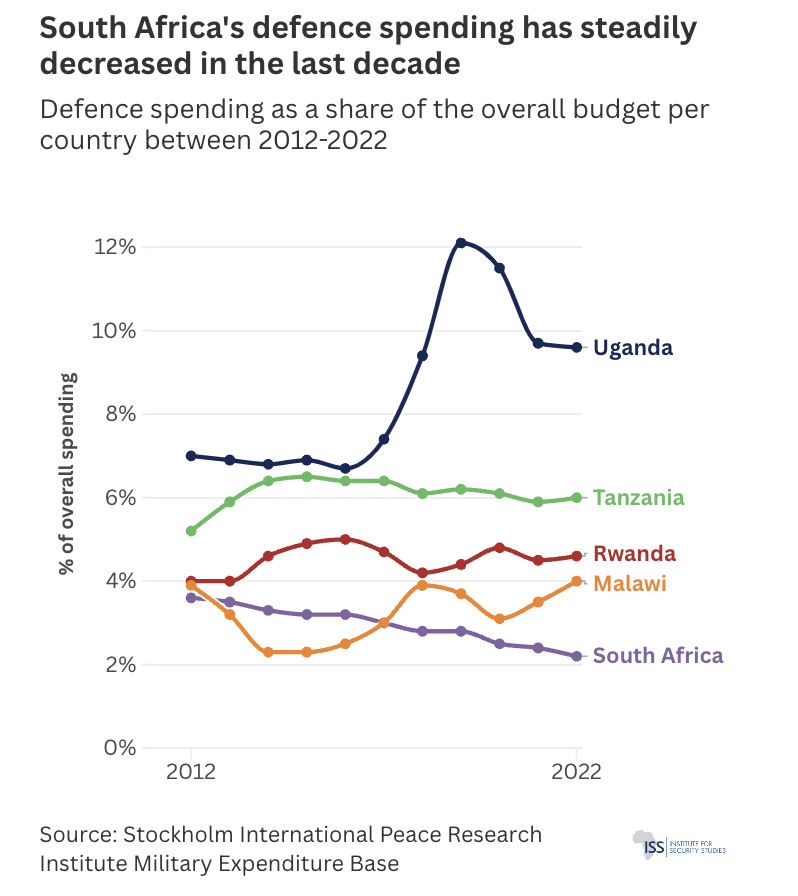
The DRC requested SAMIDRC, hoping to repeat the 2012-13 success of the United Nations’ (UN) Force Intervention Brigade in the east of the country. However, the South African forces’ operational strength – the backbone of the brigade – has significantly deteriorated compared to other armies in the region (see graph).
At the political level, SAMIDRC suffered from a lack of cohesion within SADC. Between 2022 and 2024, few member states wanted to fund a mission that didn’t align with their national interests.
Strategic ambiguity also undermined the force. The military deployment wasn’t anchored in a political process and worse still, there was some competition between SAMIDRC (backed primarily by South Africa and to some extent Tanzania) and the African Union (AU)-mandated Luanda Process, led by Angolan President João Lourenço. Given that Angola is a SADC country, the bloc could have handled the military track, while Luanda focused on the political process.
Tanzania’s shifting stance added to the confusion. Tanzania chose not to participate in the East African Community Regional Force deployed to eastern DRC before SAMIDRC. Although initially supportive of SAMIDRC, it gradually moved towards a neutral position.
With October’s elections approaching, Tanzania’s President Samia Suluhu Hassan has prioritised economic development and regional stability over military entanglements. Maintaining good relations with Rwanda and Uganda appears crucial. Rwanda relies on the Dar es Salaam port for its goods supply, and Uganda plans to transport crude oil from the Lake Albert oilfields to the Tanga port in Tanzania via the East African Crude Oil Pipeline.
Tanzania is also concerned about the spread of violent extremism from northern Mozambique into its territory. A Rwandan military contingent currently supports Mozambican forces in the area, making an open confrontation between Tanzania and Rwanda in east DRC less likely. Tanzania’s lukewarm engagement in SAMIDRC weakened the mission and contributed to its demise.
Countries involved in eastern DRC are driven by competing strategic interests. In pushing for SAMIDRC’s deployment, South Africa appeared primarily motivated by economic factors and a desire to preserve its regional prestige, despite lacking the required military capabilities. As important as the DRC may be, it isn’t a key interest for South Africa.
Regional organisations have struggled to transform into effective collective security and defence structures

In contrast, Uganda and Rwanda consider the eastern DRC vital due to their geographical proximity, security concerns and economic stakes. This explains their unwavering commitment to a long-term military presence, including through supporting M23 and other armed groups.
SADC’s failure in the DRC and its premature exit from Mozambique raise questions about the effectiveness of the SADC Mutual Defence Pact. Despite being framed by South African officials and the SADC Secretariat as a peacekeeping mission, SAMIDRC didn’t meet the standard definition of peacekeeping.
Its mandate was focused on counter-insurgency, aimed at ‘assisting the DRC government in restoring peace and security in the eastern region’. That amounts to a combat mission rather than a peacekeeping operation.
The absence of a political strategy – the backbone of traditional peacekeeping – further underscores this. Against this background, South African government statements alluding to a phased withdrawal aimed at giving way to mediation efforts are little more than face-saving.
As SADC’s ability to fulfil its mutual defence mandate weakens, it appears increasingly focused on shielding incumbent presidents following highly contested elections. As a regional organisation, it struggles to help secure its member states and promote democratic norms.
Member states in the same regional bloc may have divergent or competing interests in crisis situations

Regional organisations were originally designed for economic integration, and have consistently battled to transform into effective collective security and defence structures.
Before SAMIDRC, the East African Community Regional Force was expelled from eastern DRC following Kinshasa and that bloc’s diverging interpretations of the mission’s mandate. Central African peace support operations have often been more effective – even though this region lags behind regarding integration.
The military setbacks experienced by SADC and the East African Community suggest a need to reassess the AU’s subsidiarity principle. The principle gives precedence to actors closer to a situation (countries or regional economic communities) over those further removed (AU or UN).
Implementation of the principle reveals that member states in the same regional bloc may have divergent – if not competing – interests in crisis situations, making coordinated security responses difficult and sometimes impossible.
This issue is among those topping the priority list of the newly sworn-in AU Commission Chair, Mahmoud Ali Youssouf. However, meaningful reform will only be possible if regional bodies examine their structural weaknesses. Otherwise, future military interventions are doomed to fail.
