Close Menu
National Security News
  • Ukraine War
  • Russia
  • Terrorism
  • China
  • Iran
  • Africa
  • Tech
    • Space
    • Nuclear
    • Cyber
  • Investigations

Trending

Bahrain uncovers Iran’s latest subversion network

May 13, 2026

Ramaphosa’s Zimbabwe visit puts constitutional crisis, not succession, at centre of regional concern

May 12, 2026

UK sanctions Iranian targets in response to national security threats

May 12, 2026

White House formally adds offensive cyberattacks to US counterterrorism strategy

May 11, 2026
Facebook X (Twitter) Instagram
National Security News
Subscribe
X (Twitter)
Login
IPSO Trusted Journalism in National Security
  • Ukraine War
  • Russia
  • Terrorism
  • China
  • Iran
  • Africa
  • Tech
    • Space
    • Nuclear
    • Cyber
  • Investigations
National Security News
  • Ukraine War
  • Russia
  • Terrorism
  • China
  • Iran
  • Africa
  • Tech
Home»United Kingdom
United Kingdom

Former Foreign Secretary David Cameron was planning to sanction “extremist” Israeli ministers

Staff WriterBy Staff WriterOctober 15, 20243 Mins Read
Facebook Twitter Pinterest LinkedIn Tumblr Email
Share
Facebook Twitter LinkedIn Pinterest Email

Listen to the article
0:00
0:00

Key Takeaways

🌐 Translate Article

Translating...

📖 Read Along

💬 AI Assistant

🤖
Hi! I'm here to help you understand this article. Ask me anything about the content!
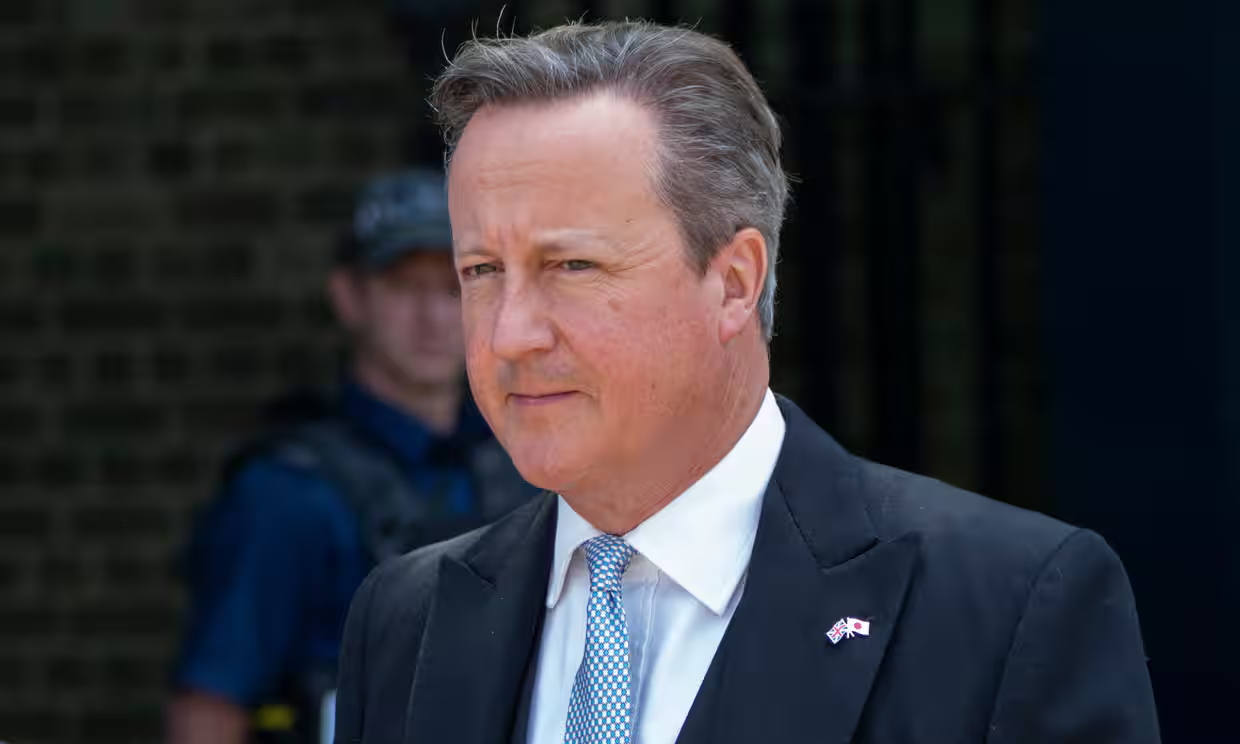
David Cameron, former foreign secretary, calls on Government to reconsider sanctions against Israeli ministers. (Source – PA)

The former foreign secretary David Cameron has disclosed in a BBC interview that he had been planning to impose sanctions on two extremist members of the Israeli government over their support for violent settlers and calls to block aid entering Gaza.

In the interview on the BBC Today Programme, Cameron said he was concerned the measure had not been adopted by the Labour government and had only held back from taking the step in the spring because he received advice it would be too political a step to take during the general election.

His first remarks on the Middle East since leaving the Foreign Office are likely to put pressure on the foreign secretary, David Lammy, to explain if he dropped a worked-up plan and why.

The sanctions – an asset freeze and travel ban – were due to be imposed on Israel’s finance minister, Bezalel Smotrich, and the national security minister, Itamar Ben-Gvir.

The former Prime Minister who returned to Rishi Sunak’s government for an eight-month period said: “Smotrich and Gvir had said things like encouraging people to stop aid convoys getting into Gaza and encouraging extreme settlers in the West Bank with the appalling things they have been carrying out.”

He said it was necessary to tell the Israeli prime minister, Benjamin Netanyahu, “when ministers in your government who are extremists and behave in this way we are prepared to use our sanctions regime to say this is simply not good enough and simply has to stop”.

Cameron criticised the Labour government’s partial ban on arms sales as a mistake, arguing “it made no sense” at a time when Israel needed to protect itself from state-on-state attacks from Iran.

He said: “There were other things we could do to put pressure on Netanyahu and say of course we respect your right to self-defence but we do want you to act within the law.”

In December last year Cameron announced on social media that a travel ban was being imposed against a small group of illegal settlers, saying: “We are banning those responsible for settler violence from entering the UK to make sure our country cannot be a home for people who commit these intimidating acts.”

Reports suggested that this covered Smotrich and Gvir, but four others were named as being sanctioned.

In the interview Cameron continued to defend the thrust of Israel’s policy to eradicate the threat posed by Hamas and Hezbollah.

He said “On October 7 Israel was not just attacked in the south by Hamas but then continually with rockets by Hezbollah in the north. We all want this conflict to end, but it has to end in a way that is sustainable so that it does not restart. That is why it is right to back Israel’s right of self-defence. But it is not a blank cheque, it’s not unconditional. We do want to see aid get through to Gaza and we do want the role of the UN in Lebanon to be respected.”

At the Labour party annual conference, at a fringe meeting, Lammy hinted at new sanctions against violent settlers, saying the issue was being considered by the G7.

Follow on Google News Follow on X (Twitter)
Share. Facebook Twitter Pinterest LinkedIn Tumblr Email
Staff Writer

Keep Reading

Britain to create joint naval force with nine European countries as ‘complement’ to Nato

When the Iranian embassy becomes a terrorist recruiting office: Britain must expel Iran’s terror operatives posing as diplomats

A world at war: Britain’s defence-tech imperative

Iran paying petty criminal proxies to carry out attacks in UK

Who will be the next Iranian Supreme leader?

UK Carrier Strike Group to deploy to North Atlantic to keep UK safe

Editor's Picks

Ramaphosa’s Zimbabwe visit puts constitutional crisis, not succession, at centre of regional concern

May 12, 2026

UK sanctions Iranian targets in response to national security threats

May 12, 2026

White House formally adds offensive cyberattacks to US counterterrorism strategy

May 11, 2026

Whose money was in Ramaphosa’s sofa?

May 11, 2026

Trending

White House formally adds offensive cyberattacks to US counterterrorism strategy

Cyber May 11, 2026

Whose money was in Ramaphosa’s sofa?

South Africa May 11, 2026

Britain to create joint naval force with nine European countries as ‘complement’ to Nato

United Kingdom April 30, 2026
Facebook X (Twitter) TikTok Instagram LinkedIn
© 2026 National Security News. All Rights Reserved.
  • About us
  • Privacy Policy
  • Terms
  • Contact
Home Topics Podcast NSN Lists

Type above and press Enter to search. Press Esc to cancel.

Sign In or Register

Welcome Back!

Login to your account below.

Lost password?