

Listen to the article
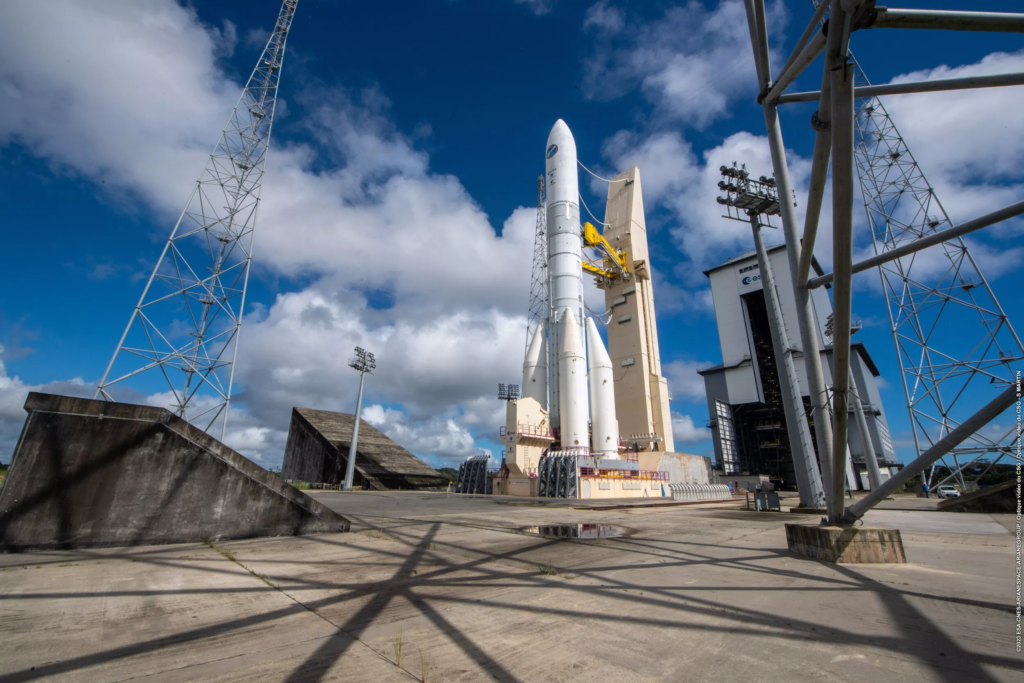
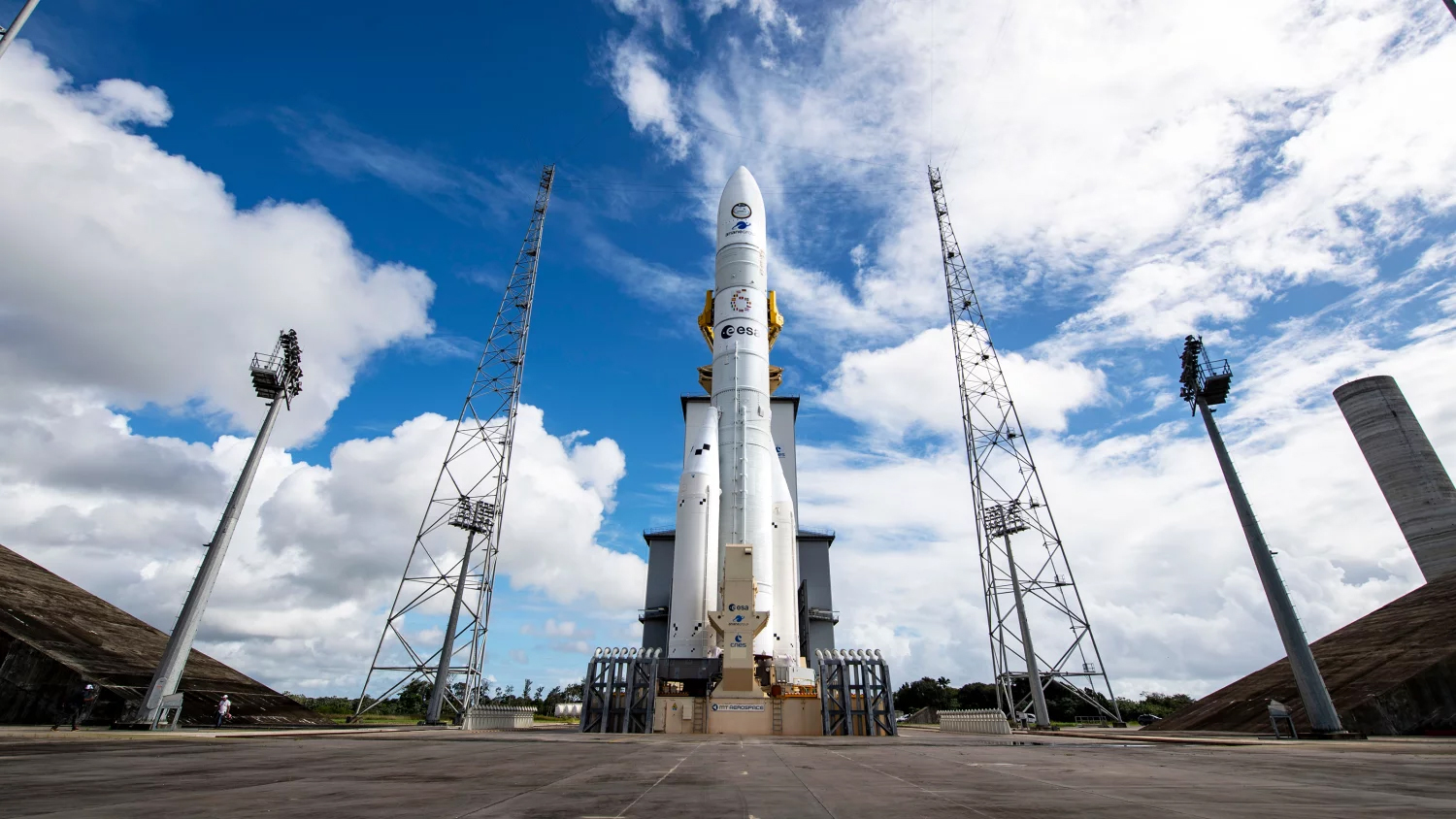
Europe’s new heavy-lift Ariane 6 rocket is set to make its long-delayed debut today (July 9).
Providing all goes to plan, the Ariane 6 will launch from Europe’s Spaceport in Kourou, French Guiana, on Tuesday during a four-hour window that opens at 2 p.m. EDT (1800 GMT).
The Ariane 6, which is operated by the French company Arianespace on behalf of ESA, will replace the venerable Ariane 5, which retired last year after 117 flights over nearly three decades.
Developed at a cost of €4bn (£3.4bn), Ariane-6 is intended to be a workhorse rocket that gives European governments and companies access to space independently from the rest of the world.
It already has a backlog of launch contracts but there are worries its design could limit future prospects.
Like its predecessor, Ariane-5, the new model is expendable – a new rocket is needed for every mission, whereas the latest American vehicles are being built to be wholly or partially re-usable.
Nonetheless, European space officials believe Ariane-6 can carve out a niche for itself.
European Space Agency (Esa) director-general Josef Aschbacher, said: “This is a big moment.”
“Daily life today really depends on information from satellites, from telecommunications and Earth observation to weather forecasting and disaster management. It is unimaginable for Europe not to have guaranteed, independent access to space,” he told BBC News.
The Ariane 6 has been in development for nearly a decade. It was originally scheduled to debut in 2020, but technical issues and outside problems such as the COVID-19 pandemic and Russia’s ongoing invasion of Ukraine pushed the timeline back multiple times.
Europe has high hopes for the new launcher, which is expected to be flying nine to 12 times per year by 2026.
On the surface, the 6 looks very similar to the old 5, but under the skin it harnesses state-of-the-art manufacturing techniques (3D printing, friction stir welding, augmented reality design, etc) that should result in faster and cheaper production.
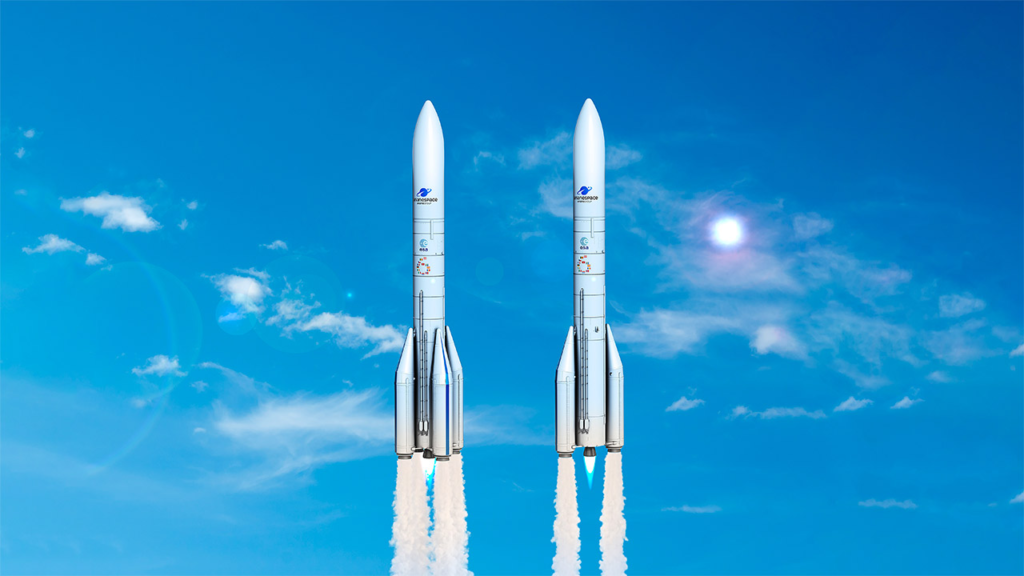
Ariane-6 will operate in two configurations:
The “62” will incorporate two solid-fuel side boosters for lifting medium-sized payloads
The “64” will have four strap-on boosters to lift the heaviest satellites on the market
The core stage is supplemented with a second, or upper, stage that will place the payloads in their precise orbits high above the Earth.
The rocket’s upper stage will come back to Earth as well, as ESA noted in its mission preview. But the upper stage won’t survive the trip, burning up in our air instead.
Tuesday’s mission will use the Ariane-62 variant. The rocket will ascend to an altitude of 580km before starting to offload free-flying payloads.
These are a mix of university and commercial spacecraft. They include two capsules that will endeavour to survive a fiery fall through the atmosphere to splash down in the Pacific.
One of the capsules, which goes by the name of Nyx Bikini, is a small-scale demonstrator from a Franco-German company that aims eventually to develop spacecraft that can transport supplies and people to and from space stations in Earth orbit.
European officials aim to have Ariane-6 flying roughly once a month.
If this flight rate can be achieved then the rocket should be able to establish itself according to Pierre Lionnet from space consultancy ASD Eurospace.
He said: “First, we need to ensure that there is sufficient demand from European customers – the European institutional ones. Then Ariane needs to win just a few commercial customers beyond Kuiper. This would give it a market,” he told BBC News.
“But it’s a matter of pricing. If Falcon-9 is systematically undercutting the price offer of Ariane-6, there will be an issue.”
Ariane-6 is a project of 13 member states of Esa, led by France (56%) and Germany (21%). The 13 partners have promised subsidy payments of up to €340m (£295m) a year to support the early phase of Ariane-6 exploitation.
The UK was a leading player right at the beginning of Europe’s launcher programme and remains an Esa member state, but its direct involvement in Ariane ended when the Ariane-4 model was retired, in 2003.
A few UK companies continue to supply components on a commercial basis, and some spacecraft built in Britain will undoubtedly continue to fly on Ariane.
