

Listen to the article
Yemen’s Saudi-backed government forces have launched a major counter-offensive against the Houthis after weeks of gains made by the Iran-backed group.
The renewed fighting has added another risk to global oil markets as Iran reiterates that the Strait of Hormuz will remain closed until its conditions for reopening the waterway are met.
Rashad al-Alimi, head of Yemen’s Presidential Leadership Council, said: “Today, I announce the start of military operations to retake the remaining territory of the republic and extend the authority of the state and its institutions across the entire national territory.”
He said government forces would continue fighting “until the country is liberated from the grip of the terrorist militia”.
Government forces advanced along Yemen’s Red Sea coast on Monday with heavy Saudi air support, seizing key positions around Dhubab at the narrowest point of the Bab el-Mandeb Strait.
Moammar al-Eryani, Yemen’s information minister, said government forces had secured effective control of the strait and captured Dhubab airstrip. Fighting continued around a nearby military base.
The Houthis disputed the government’s account, describing claims that its forces had lost ground as “completely untrue”.
Saudi Arabia said it had struck hundreds of targets in Yemen to provide air cover for government forces and the Bab el-Mandeb area. Riyadh arms and trains the forces and is seeking to restore unrestricted shipping through the Red Sea.
The offensive follows significant Houthi gains around Taiz and along Yemen’s western coast.
Houthi forces captured al Turbah on 04 October after advancing through al Safiyah and al Mansora, according to geolocated imagery and Yemeni reports.
Al Turbah sits at the junction of two major roads connecting government positions in Taiz with Aden, the internationally recognised government’s interim capital.
Its capture threatens the government’s ability to reinforce and resupply positions around Taiz. The Houthis had previously attempted to seize or disrupt sections of the Taiz-Aden route on 23 September and 01 October.
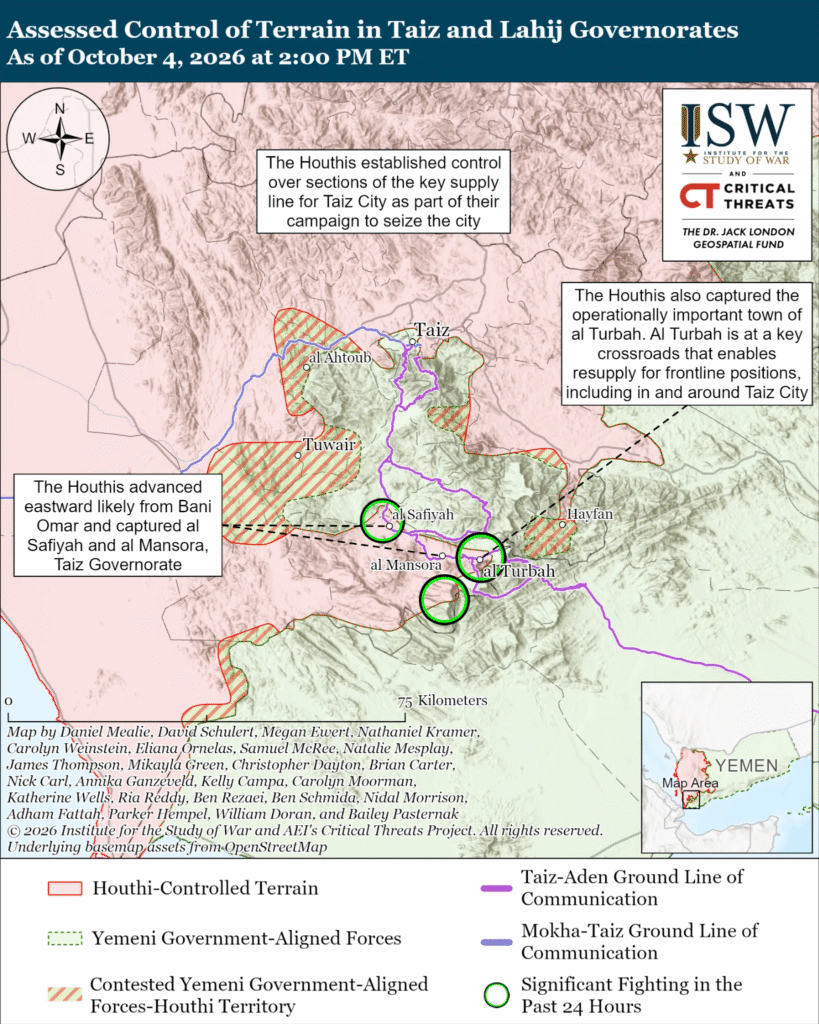
Government military sources said the Houthis had also taken sections of a mountain road around Taiz, leaving government forces increasingly isolated. Another government source disputed that the route had been completely cut.
The fighting has intensified around Bab el-Mandeb, a critical route for global energy supplies.
The strait connects the Gulf of Aden with the Red Sea and provides access towards the Suez Canal, making it a major shipping route between the Middle East, Europe and Asia.
Its importance has increased as restrictions around the Strait of Hormuz have forced exporters to rely more heavily on alternative routes.
An estimated 8.1 million barrels per day of crude oil and petroleum products passed through Bab el-Mandeb during the second quarter of this year, according to the US Energy Information Administration. That compares with 5.4 million barrels per day in the final quarter of 2025.
Iran reiterated on Sunday that Hormuz would not fully reopen until Washington met seven conditions contained in the Islamabad Memorandum of Understanding reached earlier this year.
Mohammad Baqer Qalibaf, Iran’s parliamentary speaker and chief negotiator, said: “The position of the Islamic Republic of Iran is completely clear and firm, and the Strait of Hormuz will not be opened until our seven conditions, based on the Islamabad Memorandum of Understanding, are met.”
He added that Washington “must understand that the period of dragging out the process and dictating one-sided demands is over”.
Iranian Foreign Ministry spokesman Esmaeil Baghaei said discussions remained focused on the waterway rather than Tehran’s nuclear programme.
Baghaei said: “We told them our focus in this stage is the issue of the Strait of Hormuz and the return to security in this waterway requires clear steps from the US.”
Despite Tehran’s position, Middle Eastern crude exports have recovered significantly.
Kpler data showed the seven-day moving average reached 18.3 million barrels per day at the end of September, with regional exports exceeding pre-war levels on 14 days during the month.
The recovery however has not removed pressure from the market.
OPEC+ agreed on Sunday to keep its November production targets unchanged, while Gulf members continue to pump significantly below their quotas. Global inventories have also fallen after months of disrupted exports.
UBS analyst Giovanni Staunovo said: “Consequently, the oil market remains tight.”
Brent remains above $100 a barrel, compared with about $73 before the Iran war began in February.
Higher freight and insurance costs have also kept pressure on prices despite the recovery in exports. Crude flows through Hormuz reached a seven-day average of 14.2 million barrels per day in late September, around 80 per cent of pre-war levels, according to Kpler.
The renewed Yemen conflict exposes oil markets to instability around two critical waterways.
Hormuz controls access to the Gulf, while Bab el-Mandeb forms the southern gateway to the Red Sea. Government advances could make it harder for the Houthis to threaten shipping directly from the strait, but the group retains the ability to launch drones from further inland and along the coast.
Continued fighting around Bab el-Mandeb, Houthi attacks on Saudi infrastructure and Iran’s refusal to fully reopen Hormuz leave both energy routes vulnerable to further disruption.
