

Listen to the article
The EU and NATO have vowed to increase pressure on Russia after Germany accused Moscow of carrying out an explosive drone attack at Leipzig/Halle Airport, prompting threats of retaliation from the Kremlin and former Russian president Dmitry Medvedev.
European leaders rallied behind Berlin after German intelligence concluded that Russia was responsible for the attempted attack on August 04, when a drone carrying explosives was discovered near a Ukrainian cargo aircraft.
European Commission President Ursula von der Leyen described the incident as a serious escalation and pledged to keep Europe united in its response.
NATO Secretary General Mark Rutte said Germany had presented clear evidence of Moscow’s involvement and backed Berlin’s measures against Russia.
The response came as Moscow strongly rejected the allegations and warned Germany that its actions would have consequences.
President Vladimir Putin accused the German government of blaming Russia to distract from domestic economic and political problems and falling approval ratings.
He described Berlin’s response as “another mistake” that ran counter to the interests of the German people.
Russia’s Foreign Ministry also summoned Germany’s chargé d’affaires in Moscow and described the allegations against Russia as “entirely fabricated”.
Germany has announced that it will close the Russian Consulate General in Bonn and terminate the agreement covering the Russian House of Science and Culture in Berlin.
Moscow said the measures marked a further deterioration in relations between the two countries.
“We view the German government’s decision to close the Russian Consulate General in Bonn and the Russian House of Science and Culture in Berlin under this fictitious pretext as another step toward the final destruction of the potential of bilateral relations that generations of Russian and German politicians and diplomats have built,” the Russian Foreign Ministry said.
It accused Berlin of deliberately escalating tensions and promised retaliation.
“We emphasised that Berlin has deliberately embarked on an outright provocation aimed at escalating Russian-German relations. The actions of the German authorities will draw a tough response,” the ministry added.
Dmitry Medvedev, Russia’s former president and now deputy chairman of its Security Council, went further by threatening strikes against German defence facilities.
“They deserve a direct strike on all German military equipment production facilities for the Banderite clique,” Medvedev wrote on Telegram.
“And quite possibly, some other places in Berlin as well,” he added.
Medvedev also accused Western governments of sponsoring what he described as Ukrainian “terrorism” and appeared to threaten Western officials travelling to Kyiv by train.
The comments mark a sharp escalation in Russian rhetoric against Germany, one of Ukraine’s largest European military supporters.
Berlin formally attributed the Leipzig attack to Russia on September 01 following an investigation by German police and intelligence agencies.
Interior Minister Alexander Dobrindt said the investigation, the configuration of the drone and intelligence findings demonstrated Russian responsibility. German officials believe people involved in the operation were acting on behalf of Russian state agencies.
Foreign Minister Johann Wadephul said Germany was responding with “proportionate and measured, yet equally resolute, action”.
“We are not at war, but we are a daily target of hybrid warfare,” he said.
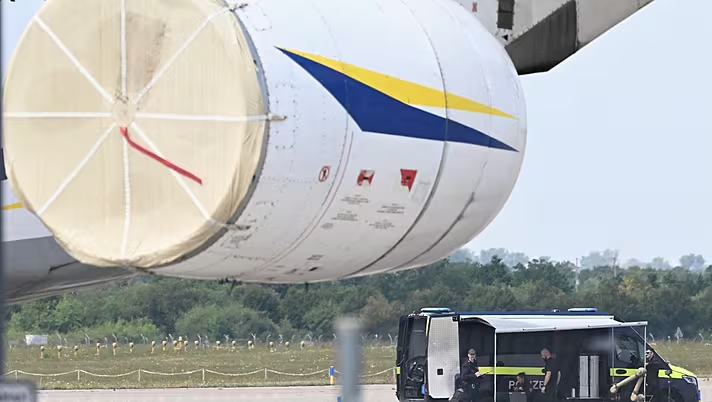
The drone was discovered in a secure area of Leipzig/Halle Airport near Ukrainian Antonov cargo aircraft. It was carrying around 600 grams of explosives, but its detonator failed.
Explosives specialists used a robot to make the device safe. Investigators later discovered traces of military-grade explosives alongside another drone near the airport.
Leipzig/Halle is one of Europe’s largest cargo airports and is used for military logistics. Ukrainian carrier Antonov Airlines also operates from the airport.
Germany has since announced further measures against Moscow, including tighter entry controls for Russian nationals and additional proposed EU sanctions against Russian individuals and organisations.
Berlin also plans to increase pressure on Russia’s so-called shadow fleet, which is used to transport Russian oil and circumvent Western sanctions.
The EU is considering further sanctions as European governments assess their response to what officials describe as an expanding Russian hybrid campaign.
EU foreign policy chief Kaja Kallas described the attempted Leipzig attack as apparent “state-sponsored terrorism” and said Russian efforts to intimidate Europe would fail.
Germany has also received backing from NATO allies, including Britain, Poland, Italy, Sweden and the Czech Republic.
The confrontation comes amid growing concern over suspected Russian sabotage, espionage and drone activity around European military bases and critical infrastructure.
Chancellor Friedrich Merz said last week that Germany had “found itself in the crosshairs of hybrid attackers” and warned that those responsible would “pay for them”.
