


Listen to the article
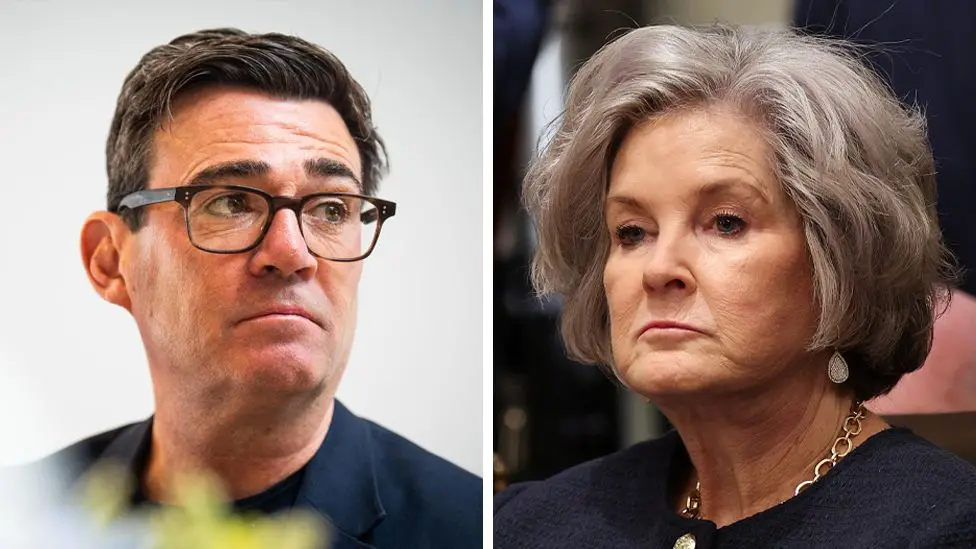
British Prime Minister Andy Burnham exchanged messages with an individual posing as Donald Trump’s White House chief of staff in an apparent security breach.
Downing Street has declined to comment on the incident, which is understood to have involved only a handful of messages before suspicions were raised about the identity of the sender.
The person claimed to be Susie Wiles, one of President Trump’s closest political allies and the first woman to serve as White House chief of staff.
Politico, which first reported the incident, said officials confirmed that Burnham communicated with the individual “before becoming suspicious that the contact was illegitimate”.
Sources said only a “few messages” were exchanged and insisted that “no messages of significance” were sent.
The suspicious contact was “quickly reported to the appropriate authorities” once concerns were raised about whether the person was really Wiles.
It is understood that all of the communication took place through written messages and that there was no telephone or video conversation between Burnham and the impersonator.
A government spokesman said: “We do not comment on national security matters.”
The incident is likely to raise fresh concerns about attempts by hostile states, criminal groups and other actors to impersonate senior government officials in an effort to gain access to politicians and sensitive information.
It also follows reports that Wiles herself has previously been targeted by hackers and impersonators.
The BBC reported last year that the FBI was investigating after Wiles’ personal phone was compromised and an impersonator, or group of impersonators, used information obtained from her contacts to approach senior figures in the United States.
Those contacted reportedly included US senators, state governors and senior business executives.
The operation targeted Wiles’ personal phone rather than an official government device.
Wiles was also among senior American political figures targeted in 2024 by a cyber espionage group associated with Iran’s Islamic Revolutionary Guard Corps.
The White House has been approached for comment on the latest incident.
British ministers have previously been targeted in sophisticated impersonation attempts, including hoax telephone and video calls involving people pretending to be senior Ukrainian politicians.
In 2024, the Foreign, Commonwealth and Development Office revealed that David Cameron, then foreign secretary, had fallen victim to a hoax involving someone pretending to be Petro Poroshenko, the former Ukrainian president.
Lord Cameron held a video call with the impersonator and subsequently exchanged a number of text messages with them.
The approach appeared credible because Cameron had dealt with Poroshenko on several occasions while serving as prime minister, including meeting him at international summits.
Officials became suspicious after the caller asked for contact details for other people.
The Foreign Office subsequently disclosed the incident because of concerns that footage or material from the exchange could be released and “manipulated”.
It said at the time that while the video call had clearly appeared to be with Mr Poroshenko, the foreign secretary became suspicious following the conversation.
Two other senior members of the Government were targeted in a similar operation in 2022, shortly after Russia launched its full-scale invasion of Ukraine.
Ben Wallace, then defence secretary, received a video call from an impostor claiming to be Denys Shmyhal, Ukraine’s prime minister at the time.
Wallace became suspicious during the call and terminated it.
He subsequently blamed Russia for what he described as “dirty tricks”.
Priti Patel, who was home secretary at the time, later confirmed that she had also received a hoax call from someone purporting to be the Ukrainian prime minister.
A Ministry of Defence source said the Wallace operation had been “fairly sophisticated”, with the call arriving through Microsoft Teams and apparently being routed through another government department, giving it additional credibility.
The latest incident demonstrates the continuing vulnerability of senior politicians to impersonation attempts even when official government computer systems themselves have not been compromised.
Such operations can potentially be used to obtain private contact details, establish relationships with senior officials or elicit information that could subsequently be exploited.
In Burnham’s case, however, government sources have stressed that the exchange was brief, contained nothing significant and was reported as soon as suspicions emerged about the identity of the person claiming to be Wiles.
