

Listen to the article
Governments across Europe and North America are accelerating efforts to reduce their dependence on China for critical minerals amid growing concern that Beijing’s dominance of global supply chains could leave key industries exposed to disruption.
The European Commission is considering legislation that would require companies operating in strategically important sectors to diversify their supply chains and reduce reliance on single suppliers, particularly China. The proposal would require businesses to source critical inputs from at least three suppliers, according to Maroš Šefčovič, the European trade commissioner.
Speaking at a conference in Brussels last week, Šefčovič said the measures formed part of a broader review of the European Union’s trade defence policies. He said the bloc needed to address “high-risk dependencies” and strengthen resilience against export restrictions and supply shocks.
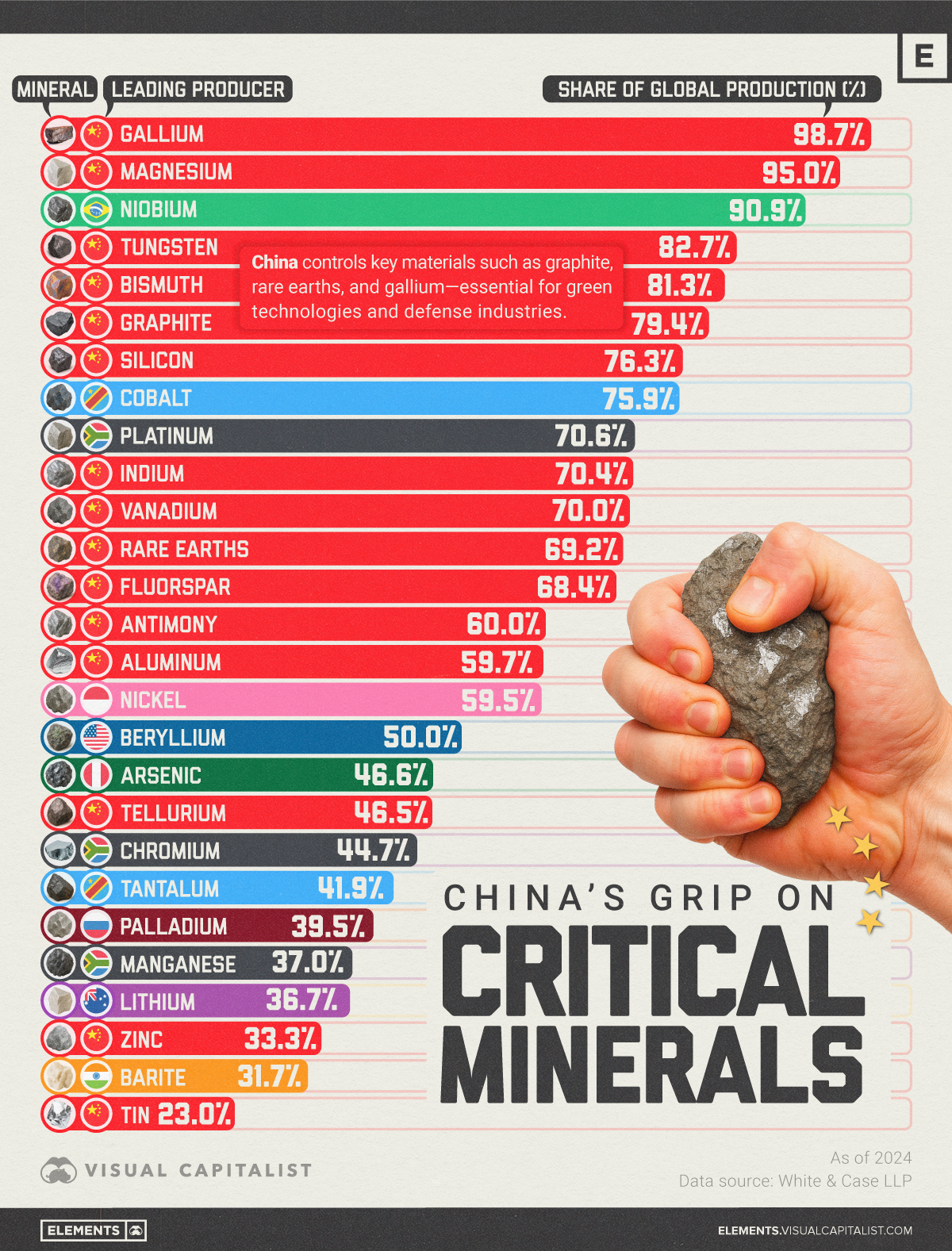
The move comes as China increasingly flexes its influence over the global supply of minerals used in electric vehicles, renewable energy systems, semiconductors and defence equipment. Rare earth elements, tungsten, gallium and graphite have become central to geopolitical competition as governments seek to secure access to materials essential for economic growth and national security.
Washington is also stepping up its response. The Trump administration has expanded efforts to secure domestic supplies of critical minerals and semiconductors through investment programmes and strategic partnerships designed to reduce reliance on Chinese-controlled supply chains.
Scott Bessent, the US Treasury secretary, urged Group of Seven nations earlier this year to accelerate efforts to reduce dependence on Chinese rare earths and other strategic materials. The issue is expected to feature prominently at forthcoming meetings of G7 leaders.
Concern has intensified following reports that Chinese buyers have been aggressively purchasing tungsten scrap from the United States, helping to drive prices sharply higher. Tungsten is used in aerospace components, industrial machinery and military equipment. According to industry executives cited by the Financial Times, Chinese traders have offered substantially above-market prices as Beijing seeks to secure supplies following export restrictions and reduced mining quotas.
Critical minerals are a group of metals and elements considered essential to modern economies and national security because they are difficult to replace and vulnerable to supply disruption. They include rare earth elements, lithium, graphite, cobalt, nickel, tungsten, gallium and germanium. These materials are used in everything from electric vehicle batteries and wind turbines to semiconductors, smartphones, military systems and data centres.
While China dominates the sector, many of the minerals themselves are found elsewhere. Australia is the world’s largest producer of lithium, the Democratic Republic of Congo supplies most of the world’s cobalt, Indonesia is a major source of nickel, and significant rare earth deposits are located in Australia, the United States, Canada, Greenland and parts of Africa. China’s strength lies primarily in processing and refining these materials, turning raw ores into the specialised products required by manufacturers.
Analysts say Beijing’s pursuit of dominance reflects a strategy that stretches back decades. By controlling processing capacity and downstream manufacturing, China has secured a central role in industries expected to drive future economic growth, including electric vehicles, renewable energy, advanced electronics and artificial intelligence. Control of critical minerals also provides strategic leverage at a time of increasing geopolitical competition.
The scramble for resources has highlighted the extent of China’s influence. China dominates the processing and refining of many critical minerals, giving it a powerful position in global supply chains even when raw materials are mined elsewhere. Industry estimates suggest China accounts for around 90 per cent of global rare earth processing capacity and a majority share of graphite refining and battery-material production.
Reuters reported earlier this year that Europe remains heavily dependent on Chinese processing capacity for minerals used in batteries, electric motors and renewable energy infrastructure.
Ruben Davis, senior policy officer at Cleantech for Europe, told Reuters Events that Europe has “minimal production and processing capacity” for several key materials required for battery storage and clean-energy technologies.
In response, the EU has launched a series of initiatives aimed at expanding domestic mining, refining and recycling. The ResourceEU action plan seeks to accelerate project approvals, increase processing capacity and reduce dependence on dominant suppliers.
Australia and the European Union have also deepened cooperation on critical minerals as both seek alternative sources of supply. The agreement forms part of a broader effort by Western economies to diversify supply chains away from China.
Meanwhile, China continues to strengthen its position. The country has built an extensive ecosystem of specialist laboratories, research centres and industrial facilities dedicated to rare earth technologies. More than 40 specialist rare-earth laboratories now operate in China, according to industry research.
As competition for resources intensifies, critical minerals have emerged as a defining issue in global trade policy. With governments increasingly linking supply security to economic resilience and national defence, efforts to loosen China’s grip on the sector are likely to remain at the centre of international policy debates for years to come.
