

Listen to the article
By Andre Pienaar
Theresa May expelled 23 Russian intelligence officers after the Salisbury nerve-agent attack by the Russian GRU. The Iranian embassy’s open call for martyrs in London, an Iranian sponsored terrorist group focused on targets across London, followed by yesterday’s stabbings of two Jewish men in Golders Green, demands the same response.
On Wednesday morning, two Jewish men aged 76 and 34 were stabbed in broad daylight on a residential street in Golders Green. The Metropolitan Police declared it a terrorist incident. Britain’s Chief Rabbi, Sir Ephraim Mirvis, named the victims as Nachman Moshe ben Chaya Sarah and Moshe Ben Baila. A 45-year-old British national of Somali origin was arrested. Within hours, a group calling itself Harakat Ashab al-Yamin al-Islamiya, known by the acronym HAYI, an Iranian regime front, claimed responsibility on Telegram channels affiliated with the Islamic Republic.
This was not isolated street violence. It was the latest data point in a sustained Iranian-sponsored terror campaign. Since late March, counter-terrorism officers have arrested 26 people in connection with attacks on Jewish, Israeli and Iranian dissident sites in London. Hatzola ambulances have been firebombed. The Finchley Reform Synagogue and the offices of Iran International, the dissident broadcaster the Tehran regime hates above all others, have been targeted in arson attempts. A memorial wall bearing the photographs of Iranians killed by their own government, alongside victims of the Hamas massacre of 07 October 2023, was set alight only days ago. On 17 April, HAYI posted a video claiming to have flown two drones at the Israeli Embassy in Kensington carrying “radioactive and dangerous carcinogenic materials”, forcing the Metropolitan Police to close Kensington Palace Gardens and deploy hazardous-area response teams in protective clothing. The drones did not strike. The point was made. Last October, Melvin Cravitz and Adrian Daulby were murdered in the Islamist attack on Heaton Park Synagogue in Manchester. The pattern is unmistakable. So is its origin.
This is not the beginning of the threat. It is the visible, escalating phase of a sustained Iranian-sponsored terrorist campaign that the British security services have been warning about for years. On 03 May 2025, the Metropolitan Police’s Counter Terrorism Command, working alongside MI5, executed two simultaneous operations across West London, Swindon, Rochdale, Stockport and Manchester. Eight men were arrested. Five Iranian nationals were detained under Section 5 of the Terrorism Act 2006 on suspicion of preparation of a terrorist act, in connection with a plot to target a specific London site widely reported to be the Israeli Embassy. Three further Iranian nationals were arrested separately under the National Security Act 2023, the first time that hostile-state legislation had been used against Iranian operatives since its enactment. The then Home Secretary, Yvette Cooper, described the operations as among the largest counter-state threat and counter-terrorism actions the United Kingdom had mounted in recent years.
Six months later, on 16 October 2025, the Director-General of MI5, Sir Ken McCallum, used his annual threat update at Thames House to spell out the scale of the problem. In just the twelve months since his previous address, he said, MI5 had tracked “more than twenty potentially lethal Iran-backed plots” on British soil. Combined with the figures he disclosed in 2024, that brings the total number of such plots disrupted by MI5 and its police partners since January 2022 to more than forty. State-threat investigations across all hostile states rose by 35 per cent in the same year. Iran, McCallum has consistently assessed, is the state actor that most frequently crosses the line into outright terrorism on UK territory. Nothing in 2026 has contradicted that assessment. The drones over Kensington Gardens, the firebombs in Finchley and the knife on Brent Street have confirmed it.
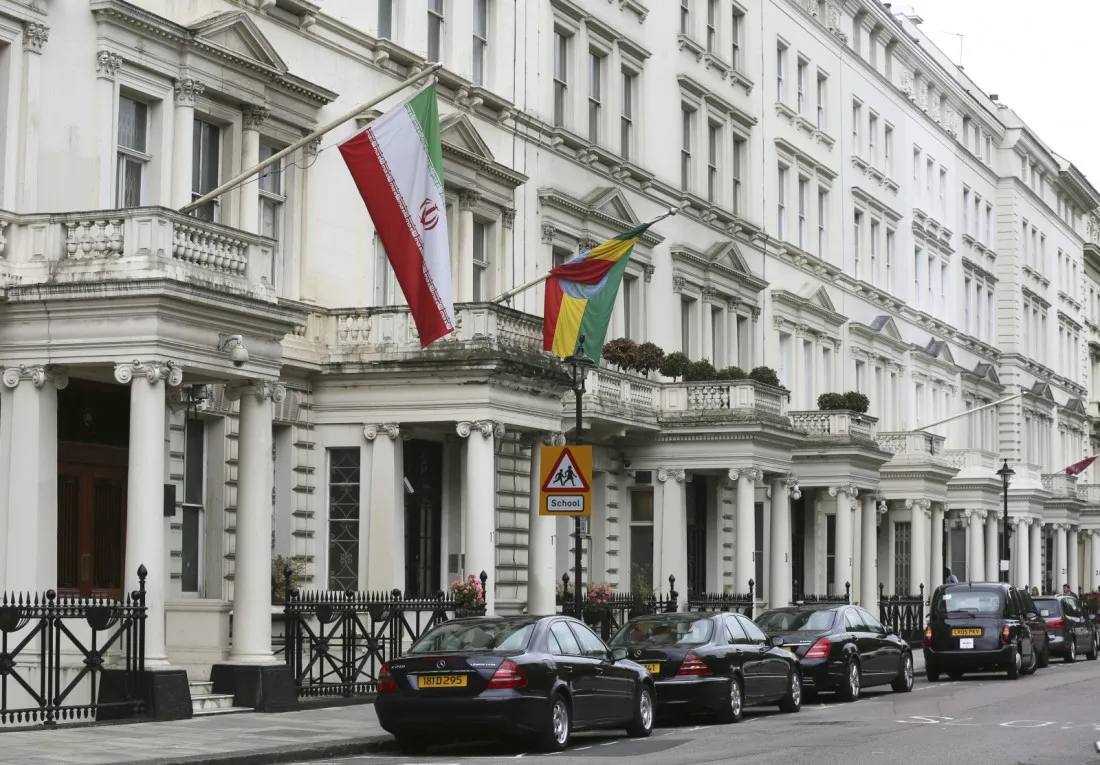
It is also unmistakable where the recruitment is taking place. Two weeks before Wednesday’s stabbings, on 15 April, the Iranian Embassy in London, operating under the diplomatic protection of the Vienna Convention from a quiet street in South Kensington, posted a message on its official Telegram channel calling on the 114,000-strong Iranian community in Britain to enlist in the regime’s “Jan Fada”, or “Sacrificing Life for the Homeland”, campaign. The post directed Iranians in Britain, including their children, to register through the Mikhak portal of the Iranian Ministry of Foreign Affairs, the same system Iranians abroad use for passport renewals, and openly solicited martyrs willing to “lay down our lives in battle”. The text borrowed verses from Ferdowsi’s Shahnameh, a thousand-year-old work of medieval Persian literature being weaponised in 2026 by a regime soliciting fighters from a foreign capital.
The Foreign Office summoned Ambassador Seyed Ali Mousavi. The Middle East Minister, Hamish Falconer, described the embassy’s communications as “unacceptable and inflammatory” and demanded that they cease anything that could be construed as encouraging violence in Britain or elsewhere. The Metropolitan Police opened a counter-terrorism assessment. Then, two weeks later, two Jewish men were stabbed.
A summons is not a sanction. A démarche is not a deterrent. The distance between the diplomatic note and the knife on the streets of Golders Green was covered in fourteen days.
His Majesty’s Government has confronted similar acts of state-sponsored terrorism before and dealt with them decisively.
In March 2018, after the Salisbury poisoning of Sergei and Yulia Skripal with a Novichok nerve agent, Prime Minister Theresa May rose in the House of Commons and announced the expulsion of 23 Russian diplomats whom British intelligence had identified as undeclared GRU and SVR officers operating under diplomatic cover. It was the largest such expulsion from Britain in three decades. May did not wait for a conviction. She did not wait for evidence beyond reasonable doubt suitable for a criminal trial. She acted on the assessment of the Secret Intelligence Service, the Security Service and GCHQ that the Russian state was responsible for an act of aggression on British soil, and that the embassy was a platform from which that aggression had been organised.
Twenty-eight allied countries followed Britain’s lead. By the end of that month, 153 Russian intelligence officers had been declared persona non grata across Western capitals. The damage to Russian intelligence operations in Europe was severe and lasting. Salisbury demonstrated that the cost of state-sponsored violence on British soil could be made meaningful, not merely rhetorical.
The threat we now face is even more dangerous: a sustained campaign of state-directed terrorism against British Jews and Iranian dissidents, with the embassy itself openly operating as a recruiting station, and Iranian-front groups claiming credit for attacks on British streets. The contrast between Britain’s response to one Russian chemical-weapons attack in 2018 and Britain’s response to a coordinated Iranian campaign in 2026 — strong words, summoned ambassadors, ministerial statements and waiting — is no longer defensible.
The Vienna Convention on Diplomatic Relations is not a shield for state sponsors of terrorism. Article 41(1) explicitly requires diplomatic missions to respect the laws of the receiving state and prohibits them from interfering in its internal affairs. Soliciting martyrs from the territory of the host country on an official mission Telegram channel is not the conduct of a diplomatic mission. It is the conduct of an intelligence operation hiding behind one.
The British government should now take three steps.
First, the Foreign Secretary should declare the Iranian diplomats identified by the Secret Intelligence Service and the Security Service as Islamic Revolutionary Guard Corps (IRGC) and Ministry of Intelligence (MOIS) officers operating under diplomatic cover, as well as those operating under non-official cover, persona non grata under Article 9 of the Vienna Convention, and require them to leave the United Kingdom within seven days. The scale should be commensurate with the threat and all should be removed from the UK.
Second, the Prime Minister should follow through on his pledge, repeated last week, to proscribe the Islamic Revolutionary Guard Corps as a terrorist organisation in the next session of Parliament. The IRGC has been designated as a Foreign Terrorist Organization by the United States since 2019. Proscription under Schedule 2 of the Terrorism Act 2000 would give British police and prosecutors the full toolkit they need, including the offences of soliciting recruits, financing, and providing material support to a proscribed organisation. The current legal architecture, which treats the IRGC as a legitimate arm of a sovereign state, makes the prosecution of its proxies in Britain unnecessarily complex.
Third, Britain should coordinate with Washington and allies to undertake a multilateral expulsion, as Theresa May did in 2018. A coordinated Western expulsion, on the model of the Skripal response, would impose a real and lasting cost on Iranian intelligence operations across the West by dismantling Iranian covert infrastructure.
The argument against expulsion has always been that diplomatic channels matter, that engagement is preferable to escalation, and that closed embassies leave Britain blind. These arguments can be valid in many circumstances. They lose their force when the embassy itself is the channel through which violence and terror are being organised. Communications with Tehran can be preserved through a chargé d’affaires, through third-country protecting powers, through neutral capitals, and through Track II diplomacy. They cannot be preserved at the cost of British lives.
We owe our Jewish community more than condolences and statements. We owe them the same seriousness of state and national security action that Theresa May showed in March 2018 against a state sponsor of terrorism on British soil.
Expel the operatives of terror shielding themselves behind diplomatic cover. Proscribe the IRGC as a terrorist organisation. Make clear that an embassy in London cannot also be a recruiting office for the murder of Britons.
