

Listen to the article

By Staff Writer
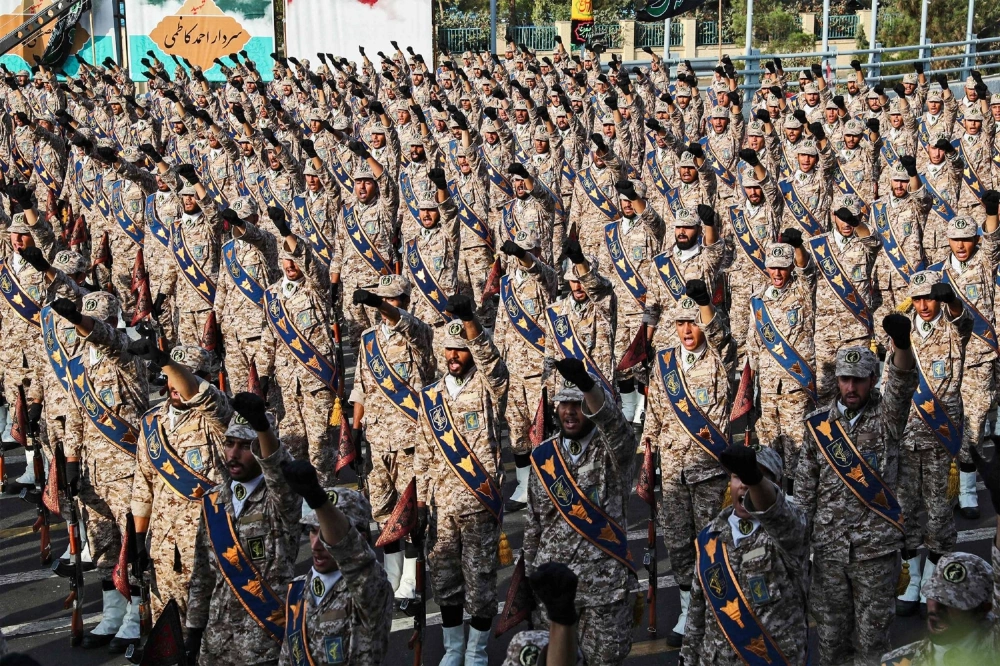
The European Union has designated Iran’s Islamic Revolutionary Guard Corps as a terrorist organisation, increasing pressure on the Islamic Republic over its violent suppression of nationwide protests.
The decision was agreed unanimously by the EU’s 27 foreign ministers meeting in Brussels and was accompanied by new sanctions targeting senior Iranian officials and state-linked bodies accused of killings, mass arrests and online repression. EU High Representative for Foreign Affairs and Security Policy Kaja Kallas said the listing reflected the scale of violence used by the authorities against their own population. “Any regime that kills thousands of its own people is working toward its own demise”.
European Commission President Ursula von der Leyen described the move as “long overdue”. “‘Terrorist’ is indeed how you call a regime that crushes its own people’s protests in blood,” she said.
Iran condemned the decision, with Foreign Minister Abbas Araghchi calling it a “major strategic mistake”. Writing on X, he accused Europe of fuelling instability. “Several countries are presently attempting to avert the eruption of all-out war in our region. Europe is instead busy fanning the flames”. He added that the EU was “making another major strategic mistake by designating our National Military as a supposed ‘terrorist organisation’”.
Kallas said the designation was based on principle. “If you act as a terrorist, you should also be treated as terrorists,” she said, adding that the move would place the Islamic Revolutionary Guard Corps on the same footing as al-Qaida, Hamas and the so-called Islamic State. The EU now joins the United States, Canada and Australia in designating the Revolutionary Guards as a terrorist organisation.
Several EU states had previously opposed the move, citing concerns over diplomacy and the safety of Europeans detained in Iran. France had been among them. However, French Foreign Minister Jean-Noël Barrot said “there can be no impunity for the crimes committed” by the Iranian authorities. He said the designation was an appeal for the release of political prisoners, an end to executions and the lifting of an internet blackout imposed in early January.
German Foreign Minister Johann Wadephul said he was “very pleased” the designation was proceeding. “This is a success for the people of Iran. It is a success for humanity and it is also a success for the EU as a community of values,” he said.
Alongside the listing, the EU imposed sanctions on 15 individuals and six entities. Those targeted include Interior Minister Eskandar Momeni, Prosecutor General Mohammad Movahedi-Azad, General Ali Abdollahi Aliabadi, head of Iran’s joint command headquarters, senior judges, Revolutionary Guard commanders and police officials. The sanctioned entities include Iran’s media regulator, state-linked online influence groups, a government internet filtering body and software companies accused of censorship, surveillance and disinformation.
The measures include asset freezes, EU-wide travel bans and restrictions on making funds or economic resources available to those listed. Many Iranian officials and institutions were already under EU sanctions over earlier crackdowns and Iran’s support for Russia’s war in Ukraine, limiting the immediate impact on the Guards.
Pressure on Tehran has also intensified from Washington. United States President Donald Trump has announced additional sanctions linked to the repression of protests and warned Iran to re-engage on limits to its nuclear programme. He said an “armada” was heading towards the country and later warned that any future US attack would be “far worse” than last June’s one-day airstrikes on three nuclear sites.
Iranian officials have suggested they may respond by designating European armed forces as terrorist organisations. EU leaders say diplomatic channels will remain open. “The estimate is that still the diplomatic channels will remain open even after the listing of the Revolutionary Guards,” Kallas said.
