

Listen to the article

By Sean Rayment
The EU has agreed to move forward with plans for a drone wall at the heart of its eastern defences as momentum grows for a €140bn loan to Ukraine based on Russian frozen assets.
After a meeting with ministers from ten mostly Central and Eastern European member states plus Ukraine, the EU’s defence commissioner, Andrius Kubilius, said a drone wall to protect against incursions from the skies was an immediate priority and a core element of the bloc’s eastern flank defences.
With the Russian threat growing through both drone and fighter incursions in recent weeks, Europe is dramatically upgrading its defences.
“What Europe does for the rest of this decade will shape the security of the continent for the whole century,” the Commission said in a report labelled Defence Readiness Roadmap 2030.
Russia, it stated, “poses a persistent threat to European security for the foreseeable future” and the only way to ensure peace through deterrence was to build strong defences.
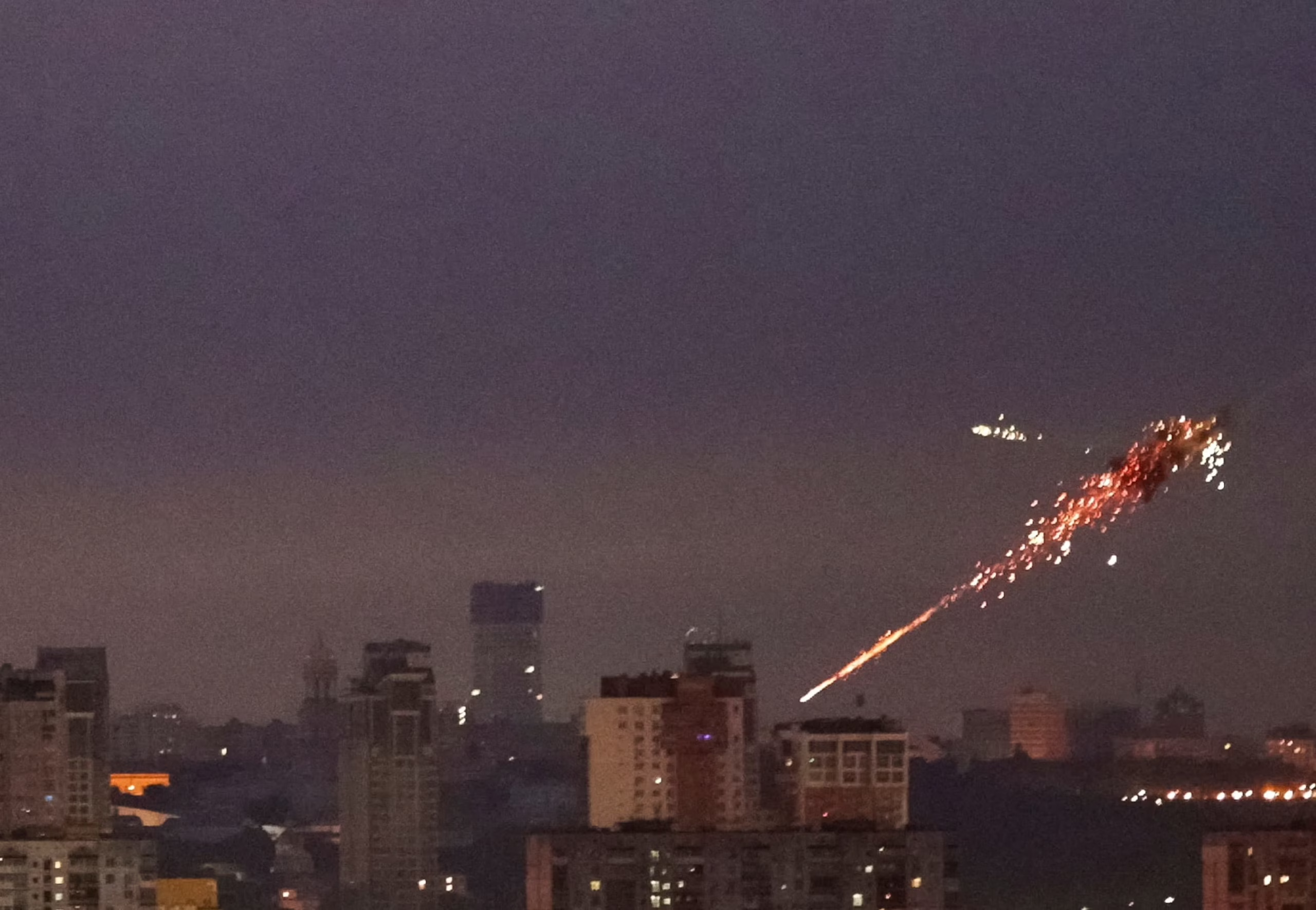
Drone incursions closed several Danish airports multiple times in September, actions that many observers linked to Russia. There were also incidents over Germany. This came two weeks after 19 Russian drones crossed into Poland, followed by further incursions into Romania. The same month, three Russian MiG-31 fighter jets entered Estonian airspace without permission.
Key to defending against incursions will be a wall of drones patrolling across Europe alongside a network of air defence systems, beginning in spring 2026.
The European Drone Defence Initiative will be able to “detect, track and neutralise” invading drone swarms and counterattack with “precision strikes” on ground targets.
“Recent repeated violations of airspace,” the report said, “have shown the urgency of creating a flexible, agile and state-of-the-art European capability to counter unmanned aerial vehicles.”
Ukraine’s drone attacks on Russia’s oil refineries have reportedly taken out about 20 percent of Moscow’s capacity, showing that such strikes can be highly effective in targeting a country’s critical infrastructure.
Kyiv will be a key partner in the initiative, as it has demonstrated an ability to be a world leader in developing cheap and effective drones, officials said.
“This is Europe’s opportunity to learn the Ukrainian way to conduct military tech innovation, and it will be linked to the proposed Drone Alliance with Ukraine,” Brussels said. “Making Ukraine a ‘steel porcupine’, indigestible to any invaders, is as important for Ukraine’s security as it is for Europe’s,” it added.
The drone shield will also be used to address non-defence threats such as border protection, the “weaponisation of migration” and transnational organised crime.
It will be complemented by the “Eastern Flank Watch”, which will include air defence missiles and combat air patrols.
The comprehensive border defences are to be completed by 2030, establishing a “sufficiently strong European defence posture to credibly deter its adversaries and respond to any aggression”. However, to reach that level of readiness in time, “Europe needs to move now”.
Work will also accelerate to develop a “European Air Shield” that is fully interoperable with NATO systems, along with a “European Space Shield” to ensure the protection and resilience of space assets. Both will be launched in 2026.
The report concluded that the continent “needs urgent action to address an escalating threat” and admitted that, while defence spending had surged in the past year, building credible defences was “an ambitious endeavour”.
However, it asserted that Europe’s “most successful projects, the single market or the euro”, had been achieved in phases with “constant political steer to drive the process forward”, and that “the same logic must drive the leap in Europe’s defence policy”.
Meanwhile, a series of leaked Russian documents appear to show that the Kremlin is losing more soldiers in combat than it is recruiting.
Between January and September 2025, Russian forces suffered 281,550 casualties: 86,744 killed, 158,529 wounded, 33,996 missing and 2,311 captured, averaging 35,000 casualties per month.
The documents showed that Russia recruited nearly 32,000 fresh troops monthly over the same period, maintaining a small surplus through most of 2025.
Recently, Russian commanders have concentrated forces on capturing the fortress city of Pokrovsk, one of the last urban strongholds before Kramatorsk and Sloviansk.
But the attempt to capture the region came with an estimated 20 percent increase in casualties in a single week.
Analyst Andrew Perpetua visually confirmed 825 Russian deaths in just five days starting on 9 October. The figures equate to an average of 65 per day.
Perpetua estimates this represents only 15 to 30 percent of actual casualties, suggesting real deaths approach 500 daily.
At current rates, Russia is losing approximately 50,000 troops per month while recruiting 32,000, a deficit of 18,000 soldiers monthly which the Kremlin may struggle to replace.
Another leaked document from 04 September showed 995 Russian casualties in a single day, with half coming from forces near Pokrovsk alone. Ukraine’s official count that same day was 810.
