

Listen to the article

By Staff Writer
Israel’s Ministry of Foreign Affairs has strongly condemned the recent summit of “The Hague Group” convened in Bogotá, Colombia, as a politically motivated assembly orchestrated to advance an international campaign of delegitimisation against the Jewish state through lawfare and sanctions. At the centre of the controversy is South Africa’s President Ramaphosa, who played a leading role in convening and shaping the summit’s anti-Israel agenda.
Described by the organisers as an “emergency conference,” the two-day meeting (15–16 July) brought together delegations from 32 countries, under the banner of opposing what the summit called Israel’s “impunity” in Gaza. The summit culminated in the adoption of six punitive measures aimed directly at Israel, including an arms embargo, restrictions on port access, and the invocation of universal jurisdiction to pursue legal actions against Israeli leaders.
An architect of hostility
President Cyril Ramaphosa was represented at the summit by a senior delegation consisting of Zane Dangor, South Africa’s Director-General of the Department of International Relations and Cooperation (DIRCO), and Ronald Lamola, the Minister for DIRCO.
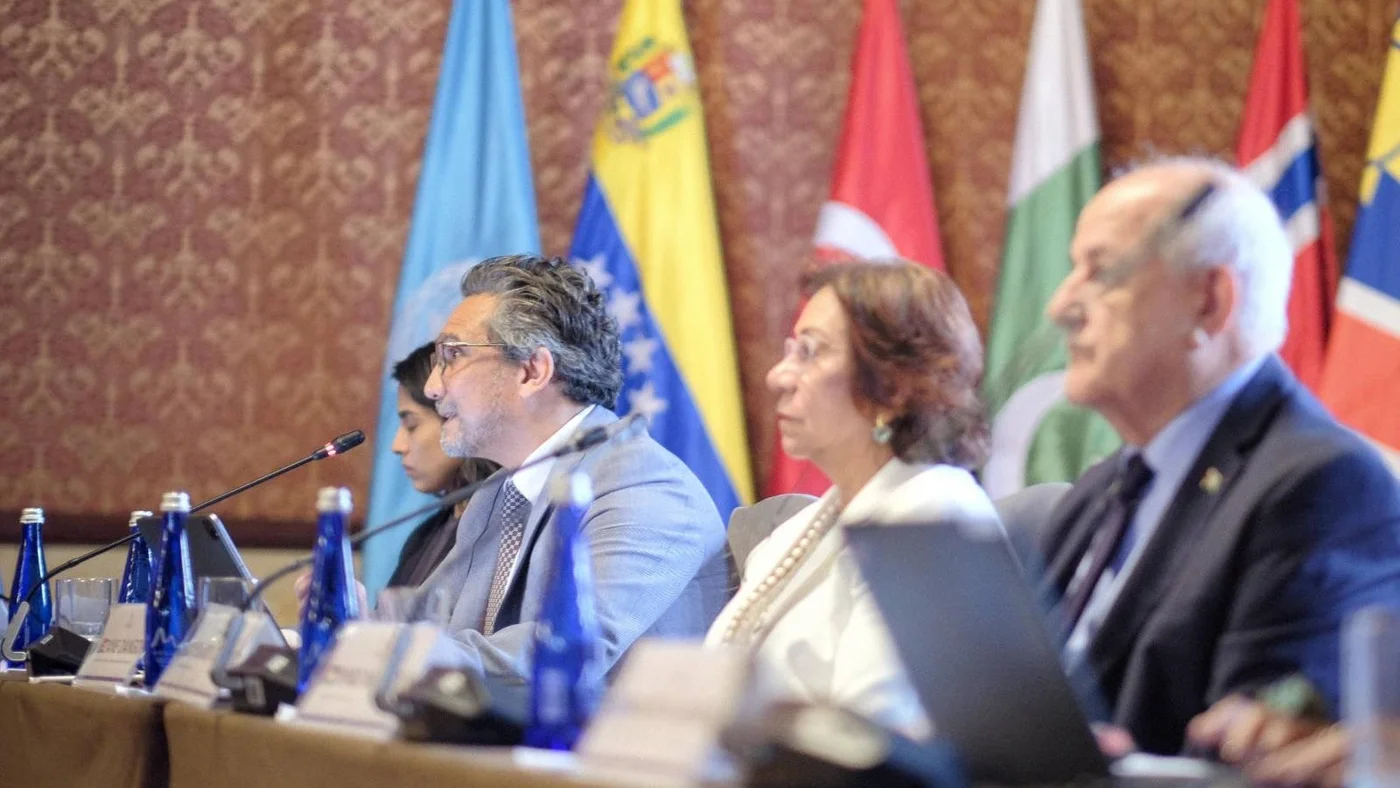
Dangor co-chaired the proceedings alongside Colombia’s acting Foreign Minister, Rosa Yolanda Villavicencio. Dangor used the platform to advance a narrative that echoed calls by extremist actors seeking to isolate Israel diplomatically, economically, and militarily.
In his opening remarks, Dangor claimed the summit marked “a new phase in the struggle against apartheid and colonialism in the 21st century,” drawing a controversial and legally unsubstantiated parallel between Israel and the apartheid regime once present in South Africa. His language, deeply inflammatory in tone, underscored the direction of the summit: away from dialogue and towards punitive collective action against Israel.
Diplomatic sources in Washington DC and Jerusalem have expressed concern that Dangor’s high-profile role in the summit reflects an escalation in South Africa’s foreign policy posture towards Israel, transitioning from rhetorical condemnation to the active mobilisation to build a global coalition to impose a wide array of punitive sanctions on Israel.
Coordinated legal warfare
The summit’s final communiqué, drafted under the oversight of Dangor and Lamola, calls for:
• An international arms embargo on Israel
• Legal reviews of all state contracts and investments to sever ties with Israeli companies or institutions, or companies affiliated with Israel
• Blocking access to ports and airspace for any vessel or aircraft suspected of supplying Israel with military equipment
• Support for universal jurisdiction laws to facilitate prosecutions of Israeli officials
In the event, only 12 out of the 32 countries in attendance signed the communiqué: South Africa, Colombia, Bolivia, Cuba, Indonesia, Iraq, Libya, Malaysia, Namibia, Nicaragua, Oman, and Saint Vincent and the Grenadines.
Israel’s legal experts see this as part of a broader campaign of lawfare — the use of international legal mechanisms to harass and delegitimise Israel under the guise of justice.
“This was not a neutral forum on human rights,” one senior Israeli diplomat told Haaretz. “It was a political tribunal, orchestrated by Zane Dangor, who has made no secret of his hostility towards Israel. His role in drafting measures that mimic the BDS playbook on a state level is dangerous and corrosive.”
Jerusalem’s diplomatic response
Israel has lodged formal protests with the governments of Colombia and South Africa and is calling on allied states to publicly reject the summit’s conclusions. Israel’s Foreign Minister, Israel Katz, described the summit as “a grotesque inversion of justice.”
“Instead of condemning the genocidal terrorism of Hamas, these nations chose to scapegoat Israel for defending its people,” Katz stated. “Zane Dangor and his allies have weaponised international law to serve an ideological agenda that erases context, erodes credibility, and emboldens terrorist actors.”
Israeli officials also noted with concern that the summit featured speeches from known prejudiced critics of Israel, including UN Special Rapporteur Francesca Albanese and Palestinian UN envoy Riyad Mansour — both of whom have been accused of employing anti-Israel rhetoric and one-sided reporting.
A line crossed
By leading the charge to create and coordinate an international sanctions movement against Israel, Zane Dangor has emerged as a chief architect of a new phase of institutionalised anti-Israel hostility — one that threatens not only Israel’s diplomatic standing but the integrity of international law itself.
As one Israeli observer noted: “The summit didn’t seek peace, dialogue, or mutual recognition. It sought to criminalise Israel’s existence. That’s not diplomacy — it’s incitement dressed in legal robes.”
