

Listen to the article

By Isabella Egerton
The UK government has imposed its first-ever sanctions targeting Kurdish-led smuggling cartels.
The move is part of a sweeping new strategy to disrupt the sophisticated networks moving migrants across the Channel in small boats. But despite the recent arrests and expanded intelligence efforts, experts warn that without sustained pressure, the impact may be fleeting.
The sanctions — announced jointly by the Foreign Office, Home Office, and Treasury this week — target key individuals allegedly behind thousands of irregular crossings each year. Those named face asset freezes and travel bans under the UK’s autonomous sanctions regime. The move followed months of behind-the-scenes coordination between the UK and Kurdish regional authorities in Iraq, with the National Crime Agency (NCA) now maintaining a presence in the region.
But financial disruption alone is unlikely to dismantle such entrenched criminal enterprises.
“It’s not so much about how much money these people have in the UK — probably not enough to make that a pressure point — but what it does do is name and shame them,” Tom Keatinge, Director of the Centre for Finance and Security at the Royal United Services Institute (RUSI), told National Security News. “That makes people think twice before working with these individuals because they are now in the spotlight and in the UK’s crosshairs.”
Keatinge described the sanctions as less about travel bans and more about signalling: “We’re lifting the lid on your business and trying to make it more difficult for you to operate.”
A network that spans continents
The Kurdish-led smuggling cartels under scrutiny have evolved into transnational, highly professionalised networks stretching from Iraq and Iran through Turkey and Europe, up to the French coast. Their control of key embarkation points — from Calais to Dunkirk — has remained largely intact despite law enforcement pressure.
Many of the smugglers hail from Ranya, a town in Iraqi Kurdistan long associated with resistance to Saddam Hussein’s Baathist regime. Today, its diaspora includes some of Europe’s most notorious traffickers.
One such figure was Amanj Hassan Zada, a 34-year-old Iraqi Kurd arrested by the NCA in Preston in 2023 and jailed for 17 years. Zada’s network — monitored through covert intercepts and overseas surveillance — smuggled migrants from the Middle East to northern France and then into the UK via small boats. His arrest was followed by joint UK-Iraq operations that led to further arrests in Iraqi Kurdistan, including a banker linked to hawala payments.

The NCA’s expanded footprint has since contributed to arrests in Libya and disrupted boat supply chains across Europe. Using covert tracking devices and sniffer dogs, UK and European agencies have intercepted hundreds of dinghies, many of which were sourced from China and routed through Turkey and the Balkans.
But even with these arrests, the cartels remain adaptable. Experts liken the trade to the drugs economy: players are swiftly replaced, and profits are reinvested in other illicit ventures, including arms trafficking and property speculation.
“There’s a term we use in the sanctions policy world — ‘sanctions maintenance’,” Keatinge said. “Everyone recognises the target shape-shifts — whether it’s the GRU in Russia, cyber hackers, or people smugglers. If you’re going to be successful, you need to be dynamic. Sanctions aren’t a one-time headline — they require ongoing pressure.”
Europe watches — but will it follow?
The sanctions were unveiled shortly after Prime Minister Keir Starmer met with French President Emmanuel Macron. Their joint communiqué pledged deeper cooperation on border security. UK ministers hope that France and other EU nations will adopt similar financial measures against smugglers.
“I know from speaking to other member states that they are watching this with a lot of interest — particularly whether this model is something they should be embracing as well,” Keatinge noted.
That model, he suggests, must be embedded in broader law enforcement cooperation. Previous success in disrupting Latin American drug cartels, for instance, only came when financial sanctions were matched by coordinated crackdowns on the ground.
“That’s the question here — to what extent are the countries connected to these smugglers involved in this initiative?” Keatinge asked. “Did they wake up surprised their nationals were sanctioned, or are they embracing it because it helps them deal with a problem they’re struggling with?”
Home Office response
A Home Office spokesperson said: “We all want to end dangerous small boat crossings, which threaten lives and undermine our border security.
The people-smuggling gangs do not care if the vulnerable people they exploit live or die, as long as they pay and we will stop at nothing to dismantle their business models and bring them to justice.
That is why this government has put together a serious plan to take down these networks at every stage.
Through international intelligence sharing under our Border Security Command, enhanced enforcement operations in Northern France and tougher legislation in the Border Security, Asylum and Immigration Bill, we are strengthening international partnerships and boosting our ability to identify, disrupt, and dismantle criminal gangs whilst strengthening the security of our borders.”
The Home Secretary recently became the first British Home Secretary in five years to visit the French northern coast, agreeing new measures to tackle smuggling gangs, including:
- Training additional drone pilots to increase operations and intercept planned boats before they reach the sea
- Urging the French to amend their operational policy so maritime forces can intervene in shallow waters as soon as possible
- Funding a new unit of elite officers to increase patrols along the northern coast, similar to arrangements during the Paris Olympics which significantly reduced small boat crossings
- Launching a new specialist intelligence unit stationed in Dunkirk to hunt people smugglers, with dual powers to investigate and prosecute criminal gangs for faster convictions
UK-Iraq deal
While the sanctions aim to squeeze the cartels financially, the UK is also betting on a new returns agreement with Iraq to reduce demand. In 2024, more than 2,000 small-boat migrants originated from Iraq. A pilot deal, secured by Home Secretary Yvette Cooper after months of backchannel diplomacy, allows failed asylum seekers to be deported back to Baghdad.
But this, too, hinges on implementation.
“If the word among the Iraqi community is that no one gets returned, then it won’t deter anyone,” Keatinge said. “But if there’s a drumbeat that people are being deported back to Baghdad, migrants will think twice — it’s an expensive trip just to end up back where you started.”
Some of the cartels’ financial systems remain elusive. While hawala — a trust-based, informal payment network — dominates, traffickers also use cryptocurrency and traditional laundering methods to purchase equipment and pay associates. Telegram remains a key platform for advertising routes, fake documents and prices. A journey from Iraq via Turkey and Belarus to Germany can cost as little as £6,900.
“The more we can use financial intelligence to identify targets, the better,” Keatinge said. “If you can’t seize their assets, then you shine a light on them. That alone can make it harder for them to operate.”
A dangerous game
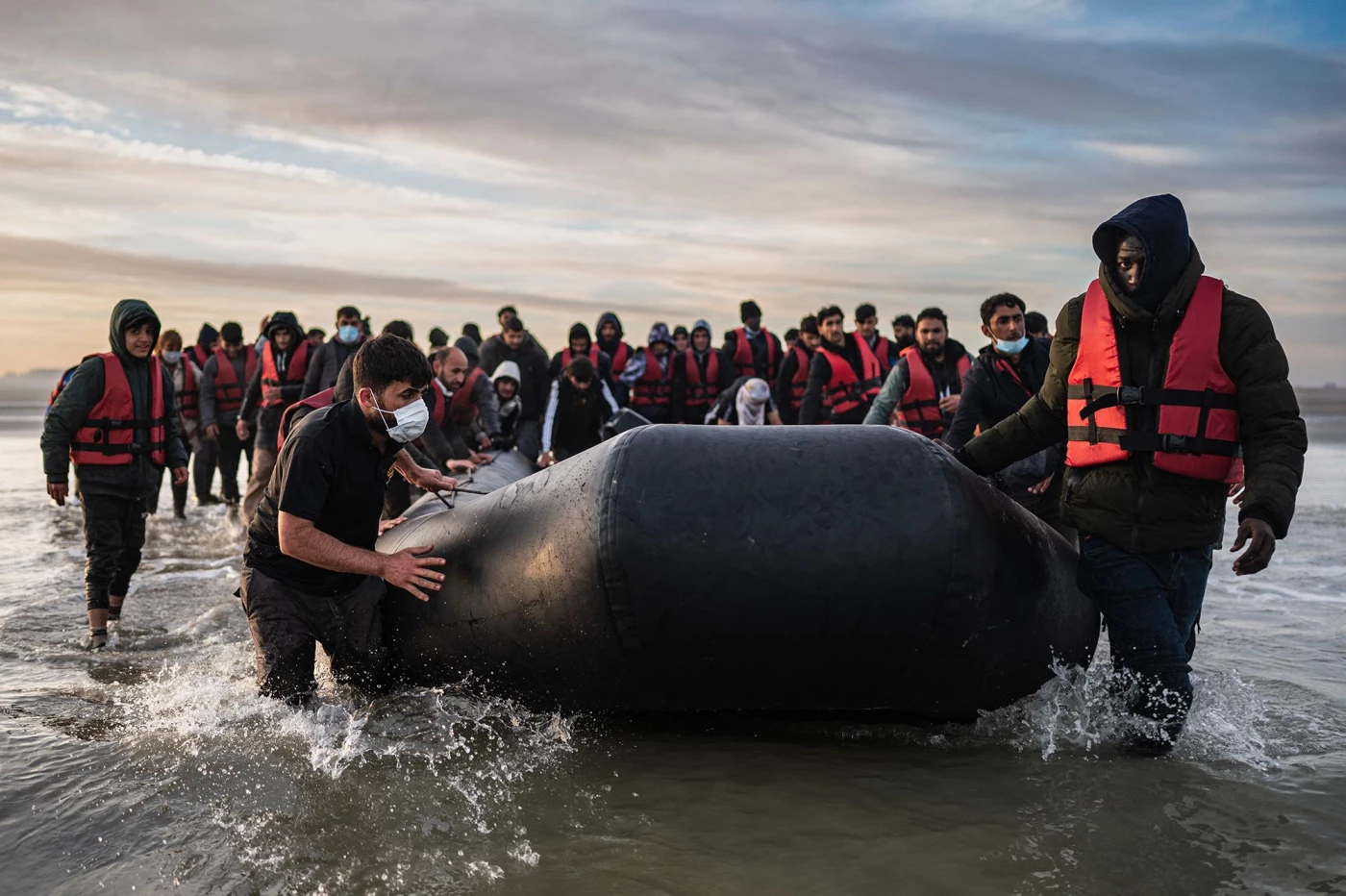
There is a darker consequence to this disruption: more risk for the migrants. With authorities targeting equipment suppliers, traffickers are squeezing more people onto fewer boats. According to the Home Office, the average number of people per boat has nearly doubled from 27 in 2021 to 54 in 2025 — with some carrying over 70.
“When operations are disrupted, traffickers might cram more people into each boat, or choose more dangerous routes to avoid patrols,” Keatinge warned. “The more desperate people are to reach the UK, the more risks they will take — until the trip is more dangerous than staying where they are.”
The government’s challenge, therefore, is to maintain pressure without pushing the trade further underground.
“Ultimately, the success of the sanctions will be measured not in frozen assets, but in the long-term disruption of the smuggling economy and the choices migrants make,” Keatinge said. “Throw grit in the gears — and keep throwing it. That’s what deters people from entering this business or makes the journey harder for those who do.”
