

Listen to the article
The Southern African Development Community (SADC) has reached an agreement with M23 rebels to facilitate the withdrawal of the organisation’s mission in the Democratic Republic of the Congo (DRC). However, Helmoed-Römer Heitman, a leading defence expert, warns that potential obstacles could hinder the swift return of the estimated 1,200 to 1,300 South African soldiers, who have for more than two months been confined to their bases in Goma and Sake by the M23 rebels. 14 South African soldiers died in skirmishes with the M23 rebels.
Heitman points to recent statements by the DRC’s Foreign Minister, Thérèse Kayikwamba Wagner, who asserted that the SADC mission will only leave when M23 and the Rwandan army withdraw from Goma. “This,” he said, “could torpedo the whole endeavour.”
Furthermore, he noted that South Africa still has troops stationed in Lubumbashi in the DRC. “If someone in the government declares that we are continuing our mission against the M23, that will effectively end the evacuation,” he cautioned.
In an interview with National Security News, Heitman elaborated on the logistics of SADC’s withdrawal from the eastern region of the DRC, indicating that it could take weeks or even months before the process is fully completed.
Generals resolved a stalemate
Heitman highlighted that the agreement for the withdrawal of troops from Goma and Sake was negotiated by military leaders, including generals and colonels from all sides, rather than by politicians or diplomats.
He recalled a similar situation in Angola in the late 1980s, where former South African General Jannie Geldenhuys collaborated with his Cuban and Angolan counterparts to reach a resolution.
“Geldenhuys excused himself from a tedious session, went to the bar, ordered a drink, and sent a message to his Cuban and Angolan counterparts to join him. They convened, and over drinks and cigars, they negotiated the settlement.”
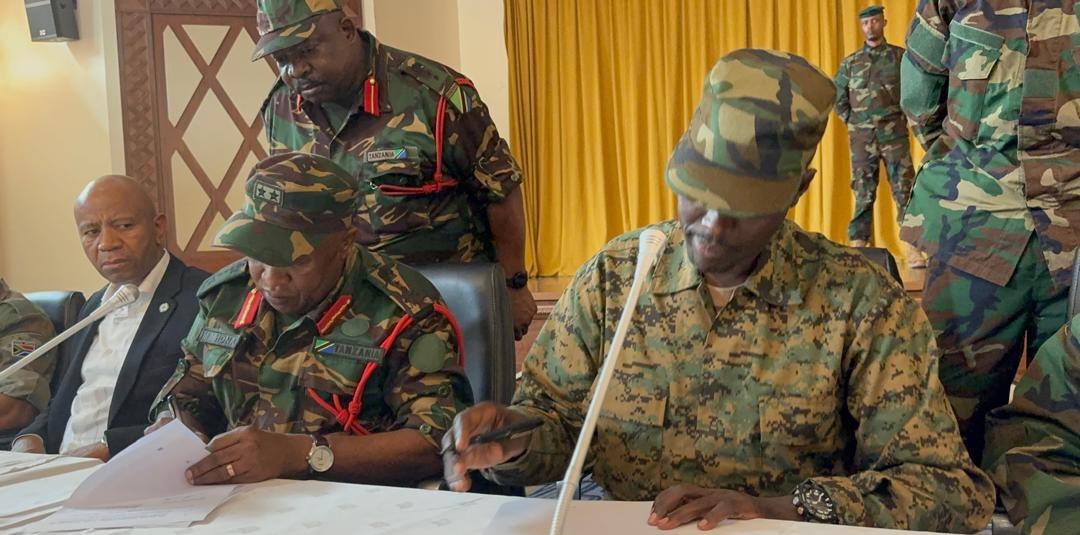
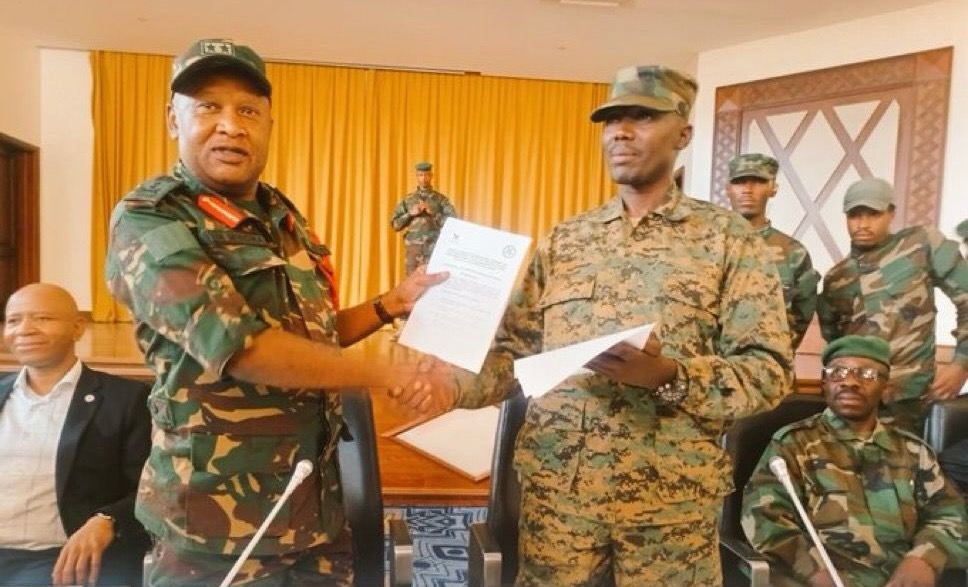
Videos and photos circulated online showing SADC and AFC/M23 commanders’ meetings, as well as SADC soldiers celebrating the signing of the withdrawal agreement.
South Africa not defeated, says South African Vice-President Paul Mashatile
Earlier, South African Deputy President Paul Mashatile stated that the decision of SADC to withdraw its SAMIDRC mission should not be interpreted as a defeat or an abandonment of peace efforts in the region. “It should be seen as a confidence-building measure to ensure peace and stability in the eastern DRC,” the Deputy President told members of the National Council of Provinces (NCOP) in Parliament, Cape Town.
However, he acknowledged that the deaths of 14 “brave” SANDF soldiers in the DRC indicated the challenges of the mission.
Military analyst Helmoed-Römer Heitman disagreed with Mashatile’s assertion that the SAMIDRC mission was not a failure. “The SADC mission was supposedly intended to neutralise M23, yet it was instead neutralised by M23. If that isn’t a failure, I don’t know what is. So, at both the mission level and the national level, it’s a defeat.”
Heitman expressed concern that the South African government does not seem to grasp the reality of the mission’s failure. “It was the wrong mission, with too few troops and no air support,” he stated. “They need to accept that this was a failure. It’s not merely a defeat; it’s a failure. They must return to the drawing board. Given the current state of the Defence Force and the embarrassment this has caused—unfairly impacting the standing of the Defence Force—it is not the soldiers’ fault, nor even the senior officers’ fault.”
South Africa should stand down for a decade
Heitman suggested that South Africa should spend the next decade rebuilding its Defence Force and focusing on local operations, including patrolling its own waters—which it currently cannot do—as well as monitoring and policing its airspace and land borders.
“We need to have a sufficient contingency capability to respond to situations in Mozambique and Cabo Delgado, should they deteriorate, allowing us to deploy a credible force—unlike last time, when the force was too small and lacked air support. Additionally, if there were to be an insurgency in Lesotho, which is a fragile country, it could easily spill over into South Africa. Therefore, we need to ensure our security. That would be my primary plan for the next decade.”
