


Listen to the article
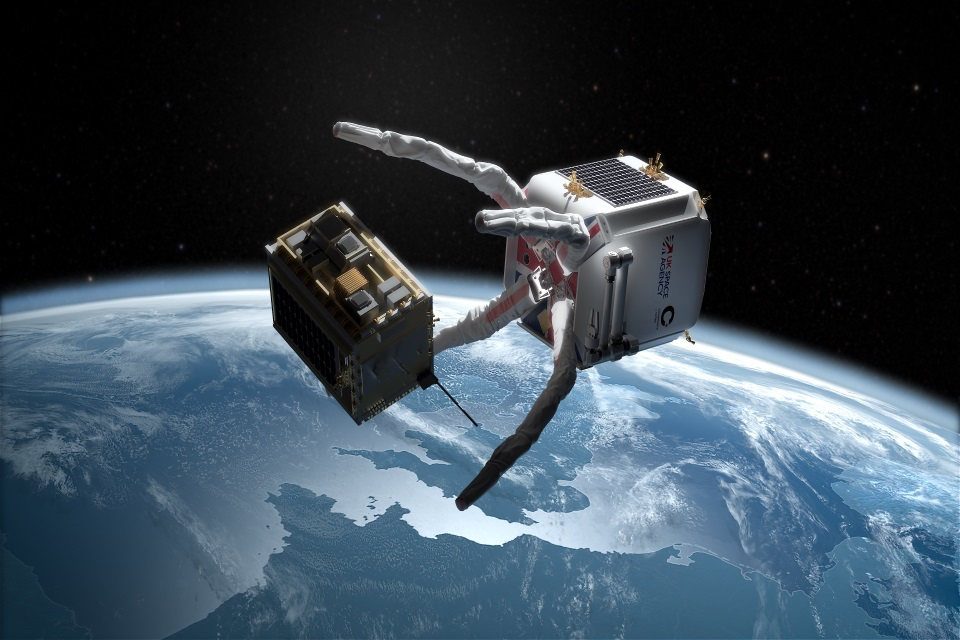
Britain has been urged to create a spacecraft capable of removing the growing amount of debris and redundant satellites from the earth’s orbit.
Speaking at the Labour Party Conference, Stephanie Ayres of UK Space said that the UK could become the “garbage man” by taking on the role of minimising low earth orbit collisions between defunct satellites.
Many scientists fear that the collisions between satellites, known as the Kessler Effect, could create a disaster with a chain reaction of collisions potentially taking out nearly all of earth’s communications.
In the UK alone this would cost the economy £1.2 billion ($1.6 billion) every day, said Ms Ayres.
She suggested that with the large-scale deployment of low-Earth orbit satellites reaching saturation point, a key area could be collecting space rubbish.
“Britain could become the garbage man of space,” she said at the New Space Age fringe event during the Labour Party conference, according to The National. “No one else wants to do it. That’s a really hot area to look out for.”
With the UK’s income from space reaching nearly £19 billion annually, she argued that “one of our best kept secrets is how big and successful the UK space industry is” and that Britain already had “an active debris removal system”.
But John Abbott, of Satellite Applications Catapult, did not agree with the “dustbin man of space” reference, although he said Britain had the ability not only to collect old satellites but to refuel existing ones to make them live longer, making the sector more sustainable.
“I do also think we can be one of the leading countries in the world to develop the in-orbit economy,” he said at the New Statesman-sponsored event. “So if you’re a pharmaceutical company, we can help you build your first drug development factory in space, or the same for a semiconductors company.”
He argued that with 52,000 people in the UK working on space projects there was a “real opportunity coming 10 years down the track that we are really well-positioned to grow economically”. The sector’s workers were also twice as productive as the UK average.
The director of Catapult, established to transform the UK’s capability for innovation, told The National there were “real opportunities” for Britain to work with the UAE and Saudi Arabia on space development.
He said: “For those nations that have got a bit further down the track to work with those newer economies, to help them move more quickly up the ladder in terms of building their space capability, that is a real opportunity.
“We have the opportunity to build structures in space and manufacture products in orbit, rather than on Earth.”
This included the development of a Catapult project looking to build a solar power station in space to provide energy 24 hours a day, 365 days a year by capturing solar power and beaming it back down to Earth as microwaves, to anywhere in the world.
“On top of that, our producers look to grow organs, develop new materials, develop new medicines, all in space,” he said. “We’re on the cusp of that.”
But with almost 80 countries now involved in space programmes or with craft already in the environment, the possibility of conflict has increased, said Ms Ayres.
“Space is already a war-fighting domain,” she said. “We are currently having issues with adversaries approaching our satellite communications providing financial transactions. If this continues unheeded, we will be in a very serious state as an economic power.”
Britain’s objects in space were “vulnerable to attack” and she named China and Russia as two countries with offensive capabilities in space. She also argued for global legislation in space as there were a lot of “privateers” operating in the arena.
Sam Sharps, a director at the Tony Blair Institute for Global Change, said space mattered because of its potential “strategic geopolitical advantage”. “There’s a huge economic opportunity that could go begging if we allow other countries to do the development,” he warned.
