

Listen to the article

African countries are open to partnerships in space exploration and innovation with all major geopolitical actors and need to be seen as economic and technological partners, says Temidayo Oniosun, the Managing Director of Space in Africa. Oniosun, who advises governments and commercial space players in Africa, says that the continent must be seen beyond just being a geopolitical tool.
“Africa has built and manufactured real critical technologies that have been part of NASA missions and some of the world’s largest space missions,” he said.
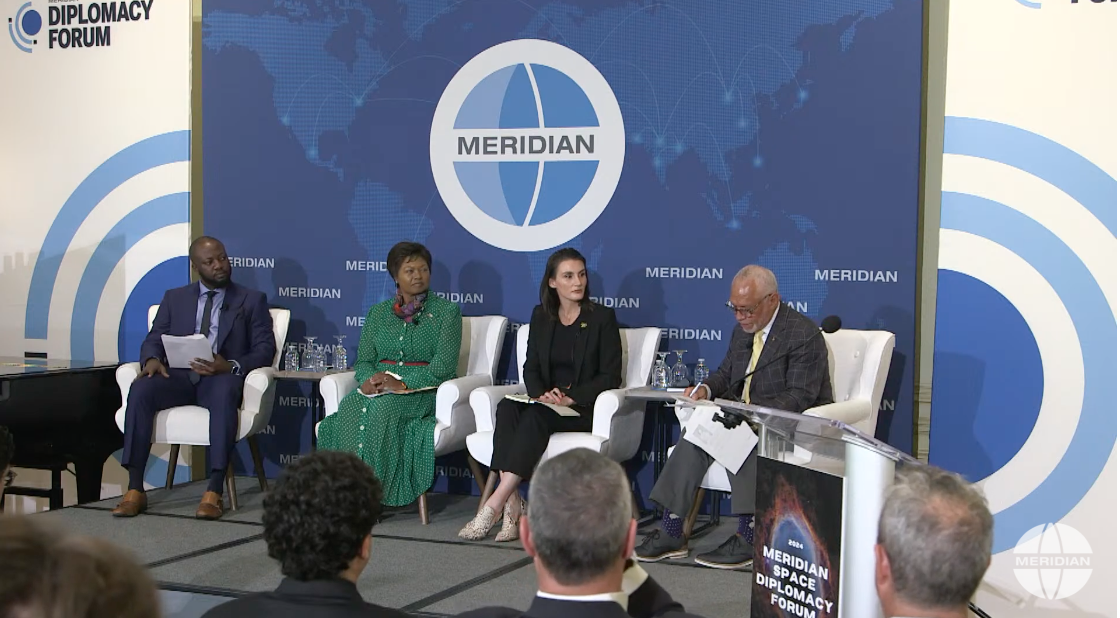
Speaking to National Security News at the Meridian Space Summit, Oniosun remarked, “There is an opportunity for the U.S. government to leverage space technology to foster stronger relationships with Africa.” He pointed out that France and China have secured significantly more contracts in Africa’s space sector than the U.S. has achieved.
Africa has a pan-African strategy for space, which was developed by the African Union Commission, a precursor to the African Space Agency that supports a continent-driven space programme. Currently, there are 22 African countries that have either established space programmes or are in the process of doing so.
The major players, according to Oniosun, are Algeria, Angola, Egypt, Nigeria and South Africa, which have developed multiple satellites. Ethiopia, Kenya, Rwanda, Senegal, Zimbabwe are starting to invest in their own national space programmes, whole new entrants such as Uganda, Djibouti, Ivory Coast, Namibia and Botswana are aiming to establish national space agencies.
African countries have so far spent $5 billion to acquire satellites, Oniosun said.
“The African space market today is valued at about $20 billion. There is significant economic value in this industry for various players. In the satellite market over the last 20 years, African countries have spent about $5 billion on satellite technology, with over $2 billion of this going to French companies. This illustrates that there is substantial economic value in the value chain. Chinese companies have secured contracts close to a billion, far exceeding what the U.S. has obtained from Africa,” he explained.
According to Oniosun, African countries do not want to become entangled in geopolitical tensions and possess the latitude to choose their partners in space development. “Whether they wish to work with China, Russia, the U.S., or Europe, it does not matter. What we are witnessing is that space diplomacy arrangements in Africa are omnidirectional. African countries tend to collaborate with anyone as long as there is mutual value,” he stated.
He cited South Africa, a member of BRICS, which has space cooperation with China and even Russia. “They are signatories to the China and Russia-led the International Lunar Research Station (ILRS) but they also have space cooperation with the U.S. They are hosting numerous space infrastructures contributing to NASA missions and so forth. Angola similarly enjoys space cooperation with China, Russia, and the U.S.” The ILRS is a collaborative project proposed by Russia and China to establish a research station on the Moon.
Oniosun pointed out that Angola has signed the U.S.-led Artemis Accord, yet its last satellite was developed by Russia. The country is also in the process of finalising another satellite agreement with European nations.
“If geopolitics is introduced into space programme development, at the end of the day, countries will make decisions that are best for them. If the West offers better cooperation, they will align with the West. If it is China or Russia, they will collaborate with them. I think this model functions effectively. It also compels the West to recognise Africa as a more strategic partner for space programme development.”
He said that the U.S. until recently has not seen Africa as a strategic partner. Observing Africa’s engagements with Russia and China is however prompting the U.S. to reconsider its stance on the region. He believes this shift represents a much more constructive approach.
Space in Africa plays a strategic role in the industry by connecting partners to create value, working with government institutions and private companies to explore business opportunities in the market.
