

Listen to the article
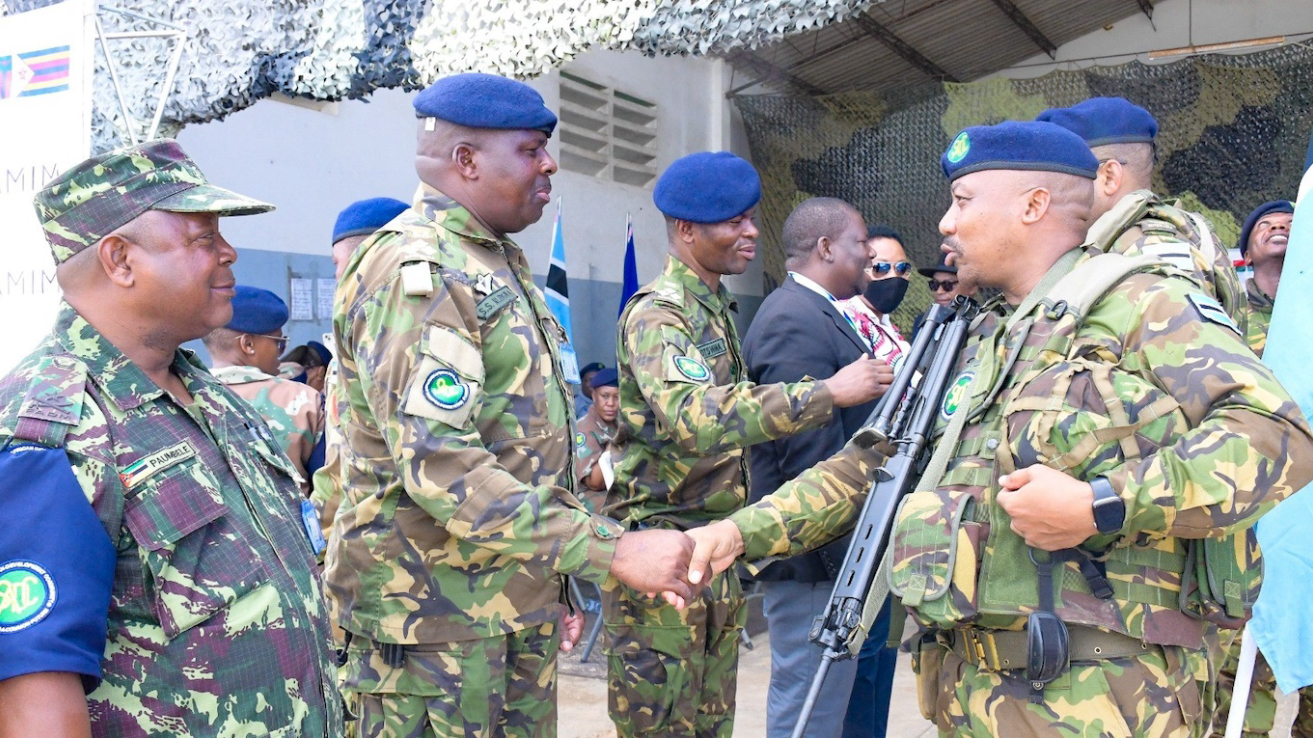
The Southern African Development Community (SADC) military mission in Mozambique (SAMIM), which was deployed on 15 July 2021 to fight the Islamic insurgents terrorising the northern Cabo Delgado province is scheduled to end by mid-July 2024. Mozambican security forces will then take full responsibility for security. In this article by the Institute for Strategic Studies in Africa, the authors question the wisdom of regional governments turning away from ISIS a global terrorist group on their doorstep. Jasmine Opperman and Piers Pigou state that SAMIM’s withdrawal to be completed by mid-July has allowed the insurgency to regain momentum.
This article is republished with the permission of the ISS.
Why is the region turning away from an international terrorist organisation on its doorstep that is growing in influence?
On 16 May, Islamic State (IS) declared victory over the Southern African Development Community Mission in Mozambique’s (SAMIM) forces in Cabo Delgado. After its 10 May attack on the Macomia district headquarters, IS claimed in Al-Naba: ‘The surprise attack redrew the map of the war in the next phase and practically confirmed the failure of the “core mission” [SAMIM] in Mozambique and the escalation of jihad.’
The Al-Naba weekly publication is a well-known IS marketing and indoctrination tool. But was the article simply propaganda? That conclusion might overlook the evolution and momentum of the insurgency, which over the past five months has been at its most active since the 2021 Palma attack.
Since the insurgency started in 2017, IS has claimed credit for 296 incidents. Since January 2024, 57 claims have been logged compared to 51 for the whole of 2023. These claims have become a relatively credible reference, exposing the paucity of official reporting from Mozambique’s government, the Southern African Development Community (SADC) and Rwanda, which also has troops in Cabo Delgado.
SAMIM’s withdrawal (to be completed by mid-July) has allowed the insurgency to regain momentum and some territorial dominance and operational presence in parts of the Macomia and Quissanga districts. This provides a springboard for attacks further afield, especially in the central and southern districts.
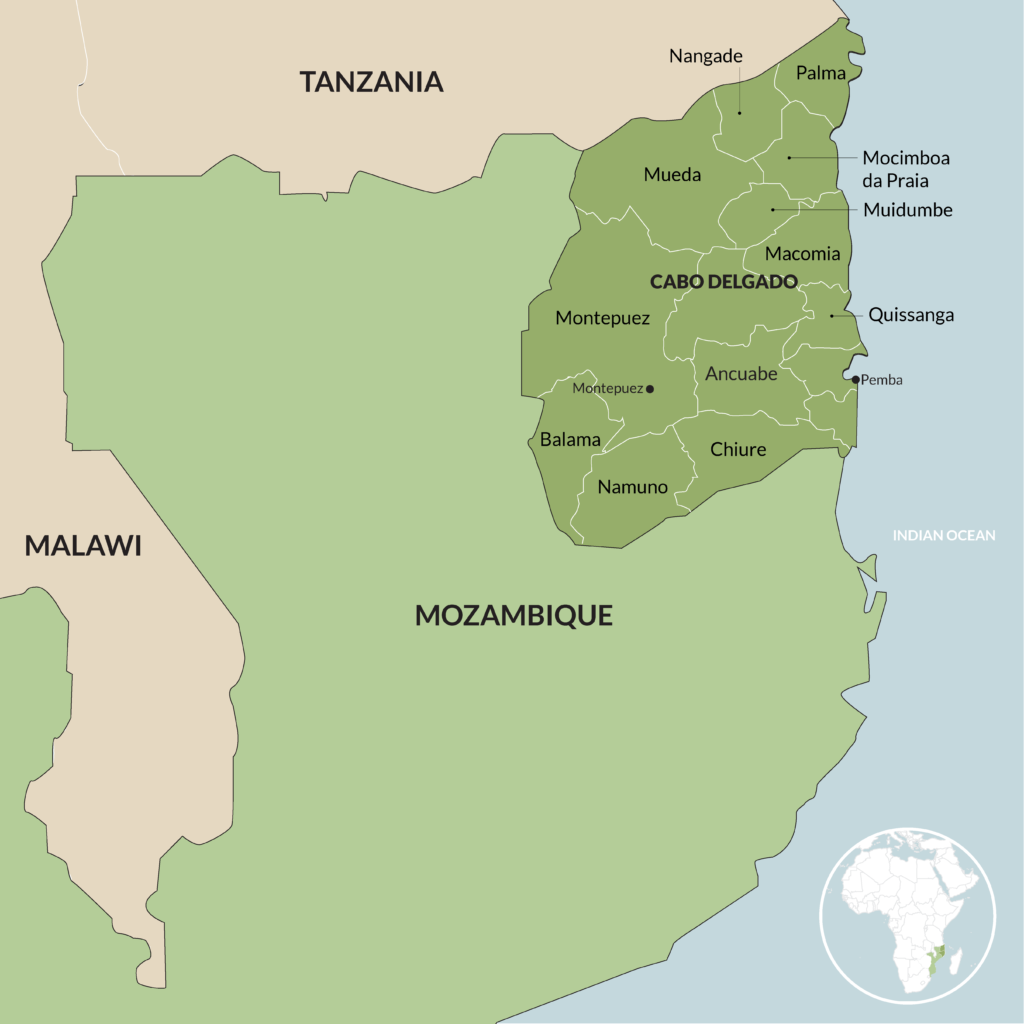
The remaining several hundred SAMIM forces who provided little more than a reduced static security role have now pulled back to the provincial capital, Pemba. Central to countering the renewed attacks is the deployment of a reported 2 000 more Rwandan soldiers and police. Al-Naba’s editorial highlights an inconvenient truth. The SAMIM drawdown provides IS not only with operational space, but also a major propaganda opportunity. The situation signifies the greatest level of instability in Cabo Delgado since Rwandan troops and SAMIM were first deployed in 2021.
So why are regional governments turning away from a global terrorist group on their doorstep that is increasing in influence? Financial constraints play a significant role. Although SADC members (especially South Africa, Tanzania, Botswana and Lesotho) covered SAMIM’s core costs over the 36-month deployment, the mission was never properly resourced. As South African National Defence Force Head General Rudzani Maphwanya told media in 2022: ‘You don’t get a single-malt service from a Coca-Cola budget.’
Over the past five months, the insurgency has been at its most active since the 2021 Palma attack
Assessed contributions from member states stretch only so far, and the cost of sending SADC forces to eastern Democratic Republic of the Congo in December 2023 means the region can’t service two deployments simultaneously.
But other factors are also in play. At a diplomatic level, Mozambique has resisted regional involvement; SADC was kept at bay for most of 2020 despite rapidly deteriorating security conditions in Cabo Delgado. The government only endorsed an intervention after the Palma attack and huge regional pressure.
Without consulting SADC, Maputo also fast-tracked a bilateral deal for Rwanda to send troops. Rwanda was responsible for security in the Palma and Mocímboa da Praia districts where the multibillion-dollar natural gas investments are located. SAMIM was deployed to Nangade, Mueda, Muidumbe and Macomia districts.
Although SAMIM and Rwanda’s troops were both mandated to support Mozambican security forces and launch counter-offensives only after getting Mozambican government approval, operational modalities apparently weren’t uniformly employed in practice. Consequently, responses to attacks were sometimes delayed or had minimal impact, fuelling criticism of SAMIM.
SAMIM’s drawdown provides Islamic State with operational space and a major propaganda opportunity
Mozambican authorities also gave preference to bilateral agreements between Rwanda and Tanzania, fuelling a breakdown in trust between SAMIM, Rwanda and Mozambique’s security forces. Relations were already strained by weak intelligence sharing and a lack of joint operations, which limited SAMIM’s ability to conduct offensive operations. Challenges on the ground were compounded by political and diplomatic rivalries, which appear to have taken precedence over security objectives.
Furthermore, SAMIM’s offensive fighting capacity was hampered by a lack of logistical support, particularly air support and combat-ready forces. Resupply lines over thousands of kilometres were also problematic. At times, SAMIM forces either had insufficient intelligence or couldn’t act on the intelligence available. And as the first SADC standby deployment, SAMIM’s command and control was tested in the field. Multilateral forces always face myriad challenges, from multiple chains of command to inter-service dynamics and doctrinal reciprocity.
SAMIM’s outreach efforts were hamstrung by the lack of coordinated community engagement between military stakeholders and non-governmental organisations. SAMIM’s mandate included supporting humanitarian aid provision and re-establishing law and order. But it had limited impact in these areas. The pilot peacebuilding programme SAMIM introduced in 2022 ends when it withdraws. Mozambique hasn’t called for its continuation, reflecting the extent to which it seems locked into a securitised response that, at best, contains the conflict in current circumstances.
After the Macomia attack, it’s even more evident that SAMIM’s withdrawal is premature. But a fighting force won’t be retained. The April announcement that South Africa’s troop deployment will be extended until year-end is probably to facilitate the exfiltration of remaining hardware and other assets.
SAMIM’s withdrawal reflects a political and diplomatic failure for the Southern African region
A detailed and public assessment of SAMIM’s impact is unlikely. The official position is that the mission’s mandate to stabilise security conditions and erode terrorist capacities has been achieved. SAMIM’s territorial dominance did inhibit insurgent attacks, enabling over 600 000 internally displaced people to return home by February 2024. But this year’s upsurge in incidents indicates that the threat is far from over.
In April, some sources recorded the highest number of incidents (both violent and non-violent) since the conflict began in October 2017. The uptick in IS claims and the choreography of their messaging convey a central point: the terrorist group is biding its time, waiting for the inevitable withdrawal of SAMIM.
SADC is withdrawing in a context where IS is clearly pushing the local insurgency. While the degree of external IS authority remains contested, its growing influence is undeniable. Al-Naba’s SAMIM editorial refers to instructions from IS’ central leadership to attack more densely populated urban centres. This raises critical questions about the insurgency’s next phase, given the overwhelming reliance on Rwandan forces.
SAMIM’s withdrawal reflects a political and diplomatic failure for the region. Beyond IS’ propaganda claim of defeating the SADC mission, some truths must be acknowledged. SAMIM didn’t achieve a battlefield victory. Instead, it stabilised vital parts of the province by displacing rather than neutralising insurgents. In the absence of a comprehensive counter-insurgency strategy and with time on their side, IS has manoeuvred to fight another day in Mozambique.
