


Listen to the article
Key Takeaways
🌐 Translate Article
📖 Read Along
💬 AI Assistant
Iran-backed rebels capture Mocha as missile and drone attacks on Saudi Arabia raise prospect of Pakistan and Turkey being drawn into widening conflict.
Iran-backed Houthi forces have seized the strategic Yemeni port of Mocha as fighting with Saudi Arabia intensifies, strengthening the group’s position near the Bab al-Mandeb strait and one of the world’s most important shipping routes.
Yemeni military sources said on Thursday that Houthi forces had taken control of the Red Sea port city following a major offensive across Hodeidah and Taiz provinces.
Pro-government forces withdrew south towards Dhubab, about 46km from Mocha, following several days of fighting. Tareq Saleh, vice-chairman of Yemen’s Presidential Leadership Council, acknowledged that government-aligned forces had suffered casualties and said an alternative command centre had been established to regroup them.
“We ordered the formation of an alternative command centre in a safe location to regroup the forces in consultation with the Arab coalition command and the Presidential Leadership Council,” Saleh said.
Mocha, around 150km south of the Houthi-controlled port of Hodeidah, had served as an important base for government forces operating along Yemen’s Red Sea coast.
Its capture strengthens the Houthis’ position along the western coastline and gives the group greater leverage near the Bab al-Mandeb, the narrow waterway connecting the Red Sea with the Gulf of Aden.
A Houthi commander claimed the group had captured strategically important terrain surrounding the city.
“Our forces took control of the most important areas, mountains and high ground around Mokha, which has come under our control. Even if there is not a physical presence of our forces everywhere, Mokha can effectively be considered a city that has completely fallen,” he said.
“With the fall of Mokha, Bab Al Mandeb can be considered under the administration of our forces. Their forces have little left to hold,” he added. “There will be surprises in the coming hours.”
Another Houthi source explicitly threatened energy shipping in the Red Sea, saying the decision to escalate was “a turning point that should have been read clearly and carefully: the Yemenis will target oil lifelines in the Red Sea to put pressure on all sides”.
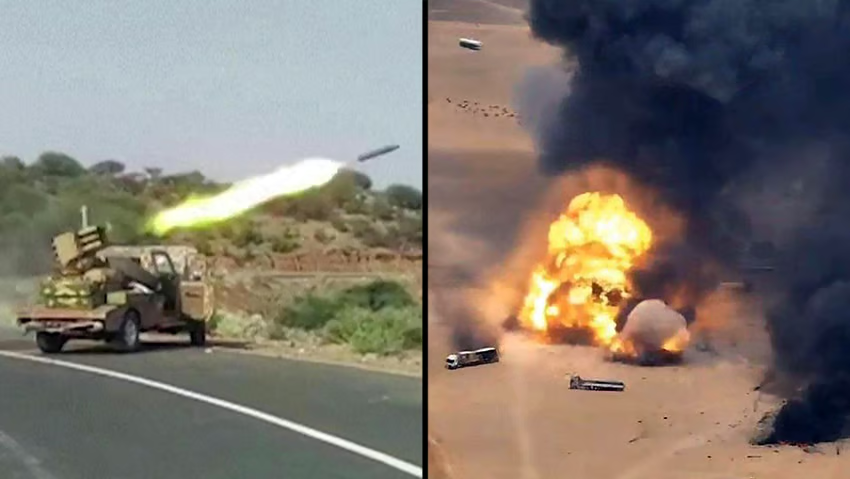
The advance comes as the Houthis escalate missile and drone attacks against Saudi Arabia, targeting cities, military installations and energy infrastructure.
Saudi officials said at least 73 people had been wounded in recent Houthi attacks. Major General Turki al-Maliki, spokesman for the Saudi-led coalition, said the group was “persisting” in attacks against Saudi assets and infrastructure, including Khamis Mushait, Abha and Jazan.
Saudi Arabia’s civil defence authority issued further alerts for Khamis Mushait and Abha on Wednesday and early Thursday. No casualties were reported from those incidents.
The Houthis have claimed responsibility for attacks on Saudi Aramco facilities in Abha, Najran and Jazan, as well as Khamis Mushait Air Base.
The escalation has prompted Pakistan to warn that continued attacks on Saudi territory could activate a recently signed collective defence agreement between Pakistan, Saudi Arabia and Turkey.
Pakistan’s Defence Minister Khawaja Asif said: “If there is unprovoked aggression, or a spillover of whatever is happening in Yemen into Saudi Arabia, definitely the Mecca agreement will become operational.”
The warning raises the prospect that an expanding Houthi-Saudi conflict could draw Pakistan and Turkey more directly into a regional confrontation already widened by the war involving Iran, Israel and the United States.
Fighting inside Yemen has also intensified.
The internationally recognised Yemeni government accused the Houthis of killing three children, including a baby, during shelling in the central Marib governorate. Six others were wounded, according to the government-run Saba news agency.
It said another Houthi attack within the previous 48 hours had killed two children and wounded 15 people.
The Houthis separately said at least 32 people had been killed in a Saudi strike on a prison in the northern al-Jawf governorate. Seven others were wounded, according to the group.
Neither account could be independently verified.
Houthi military spokesman Yahya Saree said Saudi forces carried out 54 air strikes across six Yemeni provinces during a 12-hour period on Wednesday, targeting al-Jawf, Marib, Taiz, Hodeidah, Saada and al-Bayda.
“These air strikes and the ongoing aggression against our country will not go unanswered and unpunished, by the will and power of God,” Saree said.
Houthi-affiliated media subsequently reported a further 40 Saudi strikes against Taiz, Hodeidah, al-Jawf and Marib.
Government-aligned Yemeni forces have meanwhile launched counteroffensives against the Houthis, including operations in al-Jawf, considered an important route towards the Houthi-held capital Sanaa.
Anti-Houthi forces said they had advanced towards Bir al-Maraziq and severed Houthi supply lines, while reinforcements were sent to government-aligned National Resistance forces operating along Yemen’s western coast. The claims could not be independently confirmed.
The latest fighting has displaced tens of thousands of people. The World Health Organization has said more than 1,000 people have been killed or wounded during the clashes.
The capture of Mocha could have wider consequences for maritime security. The Bab al-Mandeb is a critical route between the Indian Ocean and the Mediterranean through the Red Sea and Suez Canal, carrying energy shipments and trade between Europe and Asia.
Houthi control over a greater stretch of Yemen’s Red Sea coast would also strengthen Iran’s regional position as Tehran and its allies confront the United States, Israel and their regional partners.
Iran has denied interfering in Yemen after Arab League foreign ministers condemned what they described as “Iranian violations of Yemen’s sovereignty”.
Iran’s Ministry of Foreign Affairs said it “completely rejects the claims regarding Iran’s interference in the affairs of Yemen”, adding that Tehran had “consistently emphasised the need to preserve Yemen’s unity and territorial integrity”.


