


Listen to the article
Key Takeaways
🌐 Translate Article
📖 Read Along
💬 AI Assistant
By Andre Pienaar
President Trump put the National Space Council back in business. Chaired by Vice President J.D. Vance and armed this month with a sweeping new National Space Transportation Policy — the first rewrite of that doctrine in thirteen years — the Council’s return restores the one thing American space power has historically lacked in its fallow periods: a single point of strategic coordination at the apex of government.
And on Friday came the companion announcement by President Trump: a United States Space Academy, a new service academy for the space age. In his second term, President Trump is building on the launch of the Space Force during his first by making the biggest investment in space across multiple initiatives, creating the long-term architecture for America’s continued leadership in space.
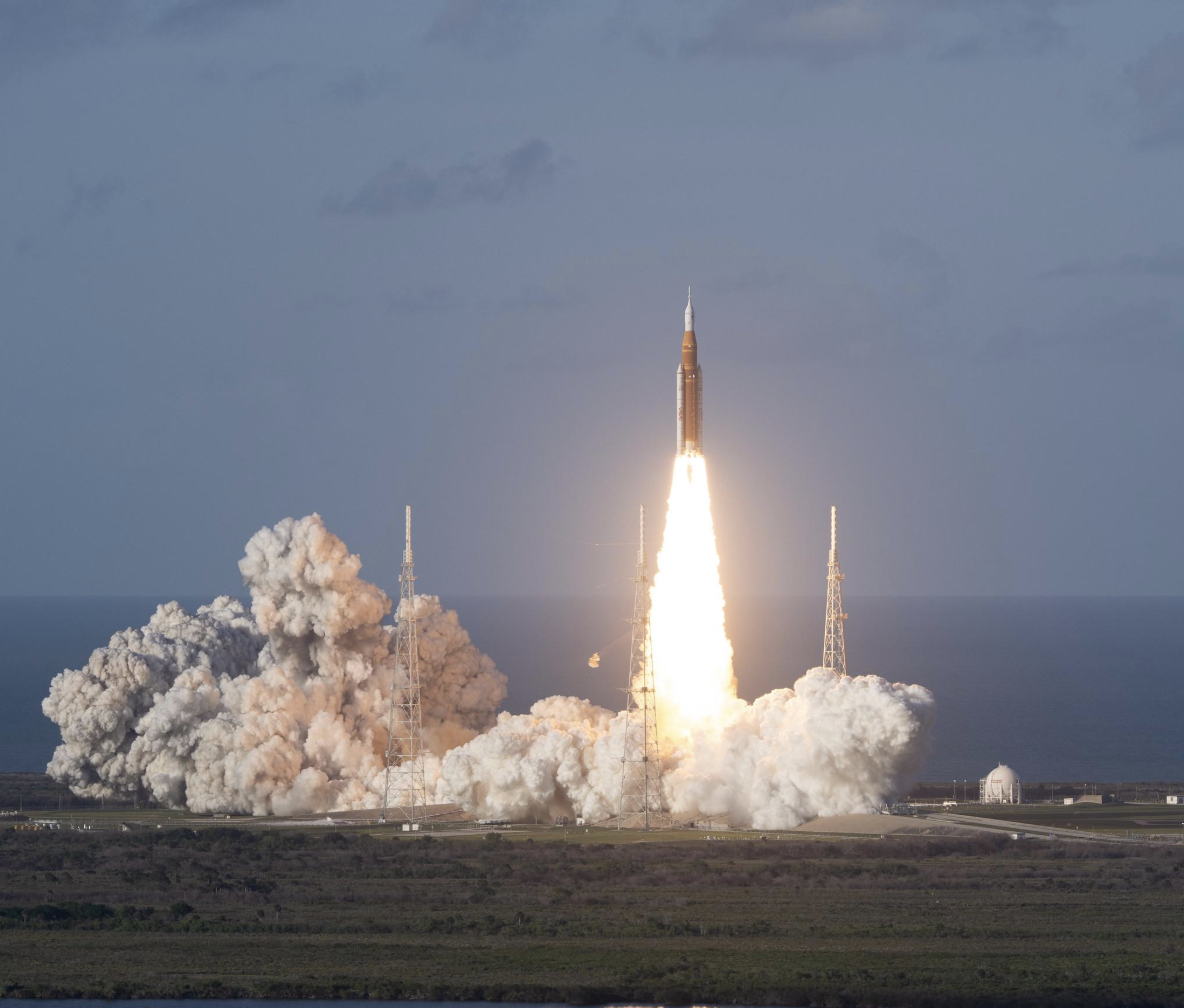
When NASA’s Orion spacecraft splashed down in the Pacific on 11 April 2026, ten days after lifting off from Kennedy Space Center, it carried more than four astronauts home. It carried proof that the United States has recovered something several other presidents allowed to atrophy for half a century: the will to lead in space.
Artemis II was the first crewed flight around the Moon in more than fifty years. Commander Reid Wiseman, pilot Victor Glover, and mission specialists Christina Koch and Jeremy Hansen flew farther from Earth than any human beings in history, surpassing the distance record set by Apollo 13 in 1970. The mission was flawless. It was also, in the deepest sense, strategic. Nations do not undertake such feats for spectacle. They undertake them because leadership in space is now inseparable from leadership on Earth.
From drift to direction
For years, American space policy drifted. Programmes slipped, budgets were nibbled at, and adversaries noticed. China set out a methodical roadmap for a crewed lunar landing and a permanent research station at the lunar south pole, backed by a military doctrine that treats space as a warfighting domain. Russia, even in its strategic decline, invested in counter-space weapons designed to blind and deafen the West’s satellites at the opening of any conflict.
The Trump administration’s response has been to move with speed and singleness of purpose. Artemis II launched on 1 April 2026. The Artemis III lander contract was reopened in 2025 to accelerate the return of American boots to the lunar surface.
The commercial space industry — the crown jewel of American advantage — has been freed from regulatory red tape that was throttling launch cadence and innovation.
This is what strategic clarity looks like: identify the decisive terrain, concentrate resources upon it, and move faster than the adversary believes possible. The Council exists to keep it that way. President Trump revived the body in 2017 after a quarter-century of dormancy, and its first incarnation produced the 2020 National Space Policy, the Artemis Accords, and the space nuclear directives on which everything now under way was built.
Its return under Vice President Vance — against early speculation that it would be shelved — means the civil, commercial, and military strands of American space power will again be pulled into a single strategy rather than left to compete for attention across a dozen agencies. The new transportation policy, issued on 20 August, is its opening move: streamlining launch licensing, expediting range and facility approvals, and directing the Pentagon and NASA to maximise commercial access to federal launch infrastructure.
The nuclear dimension
The least noticed but most consequential decision is the restart of American space nuclear power. A lunar surface reactor is targeted for 2030. Solar power cannot sustain a permanent human presence through the fourteen-day lunar night. Nuclear fission can. Whoever fields reliable nuclear power on the Moon first will set the terms — technical, legal, and commercial — for everything that follows: resource extraction, manufacturing, communications, and the cislunar economy that will define the second half of this century.
The United States pioneered nuclear technology successfully in space and then inexplicably stopped. The United States successfully launched the first nuclear fission reactor, SNAP-10A, into orbit in 1965. NASA’s two Voyager missions, launched in 1977 to travel past Jupiter and Saturn, are powered by radioisotope thermoelectric generators (RTGs), which convert heat from decaying plutonium-238 into electricity for instruments and transmitters. Both Voyager 1 and Voyager 2 remain in communication with NASA from interstellar space. Apollo missions 12 through 17 left RTG-powered science stations on the lunar surface.
Restarting the American space nuclear enterprise is the energy foundation of space superiority.
Golden Dome: deterrence comes home
Nowhere is the new tempo more visible than in Golden Dome, the layered homeland missile defence shield President Trump launched in early 2025. For four decades, America’s adversaries have built ballistic, hypersonic, and cruise missiles capable of striking the American homeland, while the homeland itself remained essentially undefended against a determined peer attack. Golden Dome aims to do for the American continent what Israel’s layered defences did for its cities: change the calculus of any adversary contemplating missile attack, and thereby make such an attack less likely ever to be attempted.
What is remarkable is the speed. Barely a year after the founding executive order, the programme’s architecture blueprint is complete, a command-and-control consortium is functioning, and contracts have been let across the entire kill chain — radars, launchers, space-based interceptors, hypersonic tracking, and the space data network that binds them together. Initial tests have already been conducted, with the first space-based interceptor prototypes due for testing before the end of this year and orbital demonstrations to follow in 2027. Congress committed an initial $25 billion in 2025 towards a programme of roughly $175 billion. By the standards of Cold War missile defence — decades of studies, few fielded systems — this is a revolution in execution.
Golden Dome also answers the critics of space “militarisation” with a hard truth: space was militarised the moment Beijing and Moscow built weapons to attack satellites and hold Western cities at risk. A shield is not an escalation. It is the restoration of deterrence by denial — convincing an adversary not that retaliation would be terrible, but that the attack itself would fail. That is the most stabilising form of deterrence there is. The task now falls to Congress to fund the programme through to completion.
Hard power in orbit
The wider architecture of deterrence has been rebuilt in parallel. The Space Force, established by President Trump in 2019, has been proposed for the largest funding increase of any military service in seventy-five years. US Space Command’s headquarters has been settled in Alabama, ending years of paralysis.
The alternative — ceding the high ground to a Chinese-Russian condominium in cislunar space — would be a strategic failure of historic proportions. In space, as at sea, presence is power. The flag follows commerce, and commerce follows infrastructure.
An academy for the space age
Hardware alone does not win long contests; people do. On Friday, at the very ceremony where the Artemis II crew received the Congressional Space Medal of Honor, President Trump signed an executive order establishing the United States Space Academy — a new federal service academy to stand alongside West Point, Annapolis, and Colorado Springs, educating the next generation of Space Force Guardians, NASA engineers and scientists, and the civil operators of the expanding space economy.
NASA will lead the planning, with a presidential commission chaired by Administrator Jared Isaacman and including the Secretaries of War and the Air Force, reporting within 120 days on curriculum and location.
The historical resonance is deliberate. West Point was founded in 1802 because a young republic understood that engineering excellence was a matter of national survival; Annapolis, because sea power required a professional officer corps rather than gifted amateurs. Every era’s decisive domain has demanded its own institution for forming the people who will master it.
That the Space Academy’s remit spans military, civil, and commercial service — Guardians alongside engineers alongside entrepreneurs — reflects an accurate reading of how space power actually works in this century: as a single ecosystem in which the warfighter, the scientist, and the founder are interdependent. Talent is the ultimate decisive terrain, and America has just committed to cultivating it at scale, for generations.
An alliance enterprise
What distinguishes the American approach from its rivals’ is that it is an open, allied enterprise. Seventy nations have now signed the Artemis Accords, committing to transparency, interoperability, and the peaceful use of space. Jeremy Hansen, a Canadian, flew aboard Artemis II — the first non-American ever to travel beyond low Earth orbit. Compare that with Beijing’s closed, military-led programme, and the choice facing spacefaring nations is stark: a rules-based order in space, underwritten by American leadership, or a domain governed secretively by totalitarian states.
For allies in Europe, the Gulf, Asia, and Africa, this is the moment to invest — in launch, in lunar infrastructure, in space nuclear power, and in the defensive architectures that protect it all. The commercial space economy is compounding at a pace that recalls the early internet, and the strategic returns will accrue to those who commit early and in strength.
The lesson of Artemis
The deepest lesson of Artemis II is about national character. Great powers decline not when their resources run out but when their leaders lose resolve. For a generation, America behaved as though the Moon were a museum piece — something achieved once, filed away, and remembered. Now the United States is once again doing hard things in space, at speed, with its allies, and in the open.
Space is the precondition for security, prosperity, and freedom of action in the decades ahead. America has restored it with the biggest investment in diverse space programmes and institutions in decades. The task for the free world now is to build upon both — together.


