


Listen to the article
Key Takeaways
🌐 Translate Article
📖 Read Along
💬 AI Assistant

By Andre Pienaar
The world is at war. The number of active cross-border conflicts now exceeds anything seen since 1945, with more than seventy-eight countries entangled in conflicts beyond their own borders.
A “world at war” is at risk of becoming a “world war.”
The war in Ukraine is linked to the conflict with Iran through the Comprehensive Strategic Partnership Treaty signed between Moscow and Tehran in 2025. That treaty enables the transfer of weapons and advanced technology, the sharing of intelligence, and the coordination of hybrid operations between two states with overlapping grievances against the West. Russia and Iran are no longer parallel adversaries. They are an alliance.
President Zelensky immediately understood the strategic logic that the enemy of my enemy is my friend. He raced to sign new defence agreements on 27 March with Saudi Arabia, 28 March with the UAE and 29 March with Qatar and separately with Jordan.
For the United Kingdom, this is not an abstraction. It is a near and present danger, as both Russia and Iran are already conducting hybrid warfare against the British nation.
Russia has carried out two acts of chemical warfare on British soil that killed British nationals. The first attack was the assassination of Litvinenko in 2008 with radioactive polonium in London and the second attack was the attempted assassination of the Skripals with Novichok in Salisbury. MI5 disrupted twenty lethal Iranian plots in 2024 and 2025. Earlier this month, an Iranian-sponsored terrorist group claimed the first drone attack in London, targeting the Israeli embassy. The attack failed kinetically, but the signal was unmistakable: the IRGC has assessed the United Kingdom as an opportunity, and it is now testing the boundaries of that assessment.
The British people have not yet experienced the full extent of either state’s hostile intent towards the UK. We owe that to the discipline and competence of our intelligence community and counter-terrorism police. But these institutions cannot be a permanent substitute for national resilience. Our intelligence services and law enforcement are doing the work of an effective defence deterrent that no longer exists.
The world and war have changed — and we have not
The deeper problem is that Britain is not prepared for the way war itself has changed. War is no longer defined by tanks, troops and territory. It is hybrid, persistent and asymmetric, fought simultaneously across physical, cyber, economic and cognitive domains.
In addition to terrorism, assassinations, disinformation and cyber attacks, Russian military probing of British defences at sea and in the air has increased by 30 per cent year on year for the last five years. The probing not only demonstrates the Kremlin’s hostile intent, but tests our defence responses and collects targeting intelligence from reconnaissance.
The spending gap
The numbers tell their own story. The UK currently spends 2.5 per cent of GDP on defence. Russia spends more than 10 per cent. The historical analogy is not the Cold War, when Britain routinely committed between five and seven per cent of GDP to defence. The right analogy is the 1930s, when Britain spent 2.9 per cent and Nazi Germany was already spending more than 13 per cent. We know how that mismatch ended. Britain ended up spending 50 per cent of its GDP to defend herself from the Nazi menace during a six-year war.
President Putin has singled out the UK by name for our support to Ukraine. British Storm Shadow missiles are now being used by Ukrainian forces against Russian infrastructure. And yet the UK does not have the air and missile defences necessary to protect its population from drone or ballistic-missile retaliation, should Russia choose to escalate.
The civil-defence picture is starker still. Finland can shelter 112 per cent of its population from aerial attack. Sweden, Switzerland, Israel, Singapore and Ukraine all maintain meaningful shelter capacity. The United Kingdom can shelter zero per cent. We dismantled our shelter infrastructure in the 1960s and never rebuilt it. The London Underground is not a viable Plan B; in a ballistic-missile attack it would be a death trap, not the refuge it was during the Blitz.
Where defence technology becomes decisive
This is where the defence-technology sector becomes the strategic centre of gravity. The threats we now face, autonomous drones, cyber attacks, AI-enabled targeting, information warfare, cannot be countered by legacy systems alone. Speed, adaptability and integration matter as much as scale.
The United Kingdom has one of the most advanced defence and technology ecosystems in the world: artificial intelligence, cyber, advanced sensing, autonomous systems, space. The problem is not capability. The problem is the gap between what the sector can deliver and what the state is willing to procure at the speed the threat requires.
Innovation must move at the speed of threat. That means faster procurement, deeper public-private collaboration, and the political willingness to deploy emerging technologies at pace rather than waiting for the perfect specification. Defence technology is no longer a supporting capability. Defence tech and innovation are frontline defence.
At C5 we invest in this sector because we believe Britain’s defence-tech ecosystem is one of the country’s most undervalued strategic assets. Properly nurtured, it delivers two things the country urgently needs at the same time: greater national security and durable economic growth. What it requires from government is urgency: faster procurement, faster adoption, and full implementation of the Strategic Defence Review.
The Roman calculus
The Romans understood this calculus better than we do: si vis pacem, para bellum. If you desire peace, prepare for war.
The cost of unpreparedness is well documented. In both world wars, the United Kingdom spent close to 50 per cent of GDP on the war effort. Ukraine, in defending itself today, is spending 37–40 per cent. The historical record is consistent: deterrence is measured in single digits of GDP; the cost of a world war will be measured in multiples.
Investing now, in the form of defence-technology investment, faster procurement and civil resilience, is a fraction of the price that will be exacted if we wait. The cheaper option is also the safer one. We should take it now.
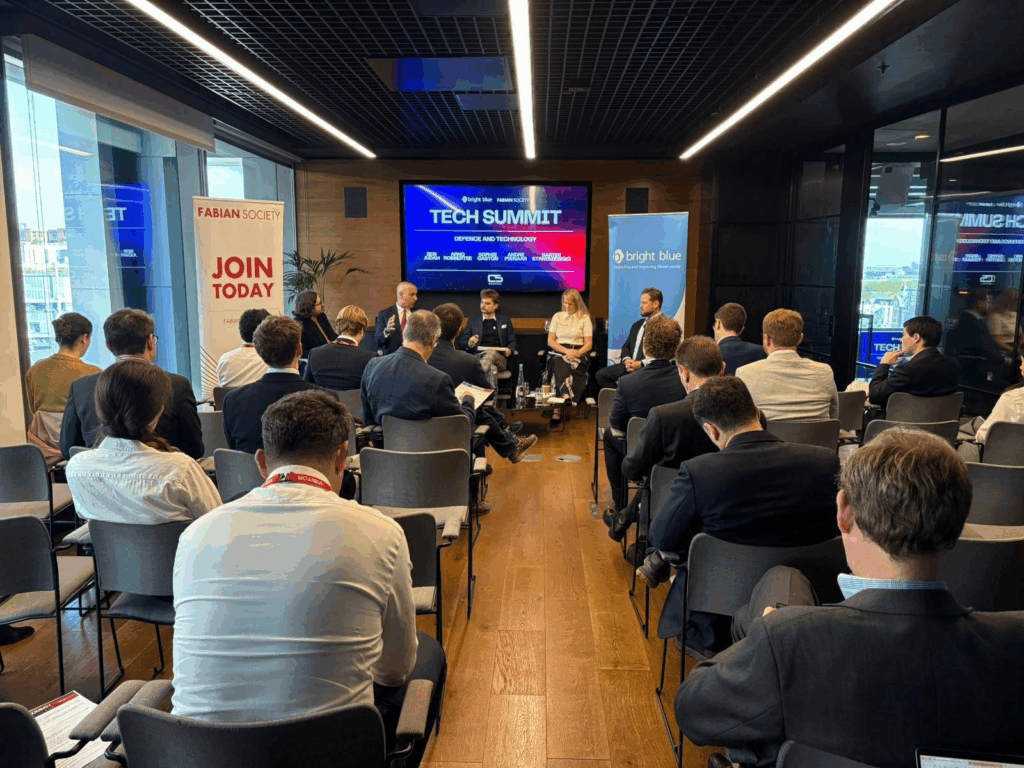
Remarks at the UK Tech Summit hosted by Bright Blue and the Fabian Society on 27 April 2026 in London.
Andre Pienaar is the Chairman of National Security News and the founder of C5 Capital, a specialist global investment firm focused on energy security.


