


Listen to the article
Key Takeaways
🌐 Translate Article
📖 Read Along
💬 AI Assistant
By Andre Pienaar
On 18 July 1994, a man named Ibrahim Hussein Berro drove a Renault Trafic van loaded with several hundred kilograms of ammonium nitrate, aluminium powder and TNT into the front of a seven-storey building on Calle Pasteur in Buenos Aires. The building housed the Asociación Mutual Israelita Argentina, the social and welfare hub of Argentina’s Jewish community. The blast killed 85 people and injured more than 300. It remains the deadliest terrorist attack in Argentine history.
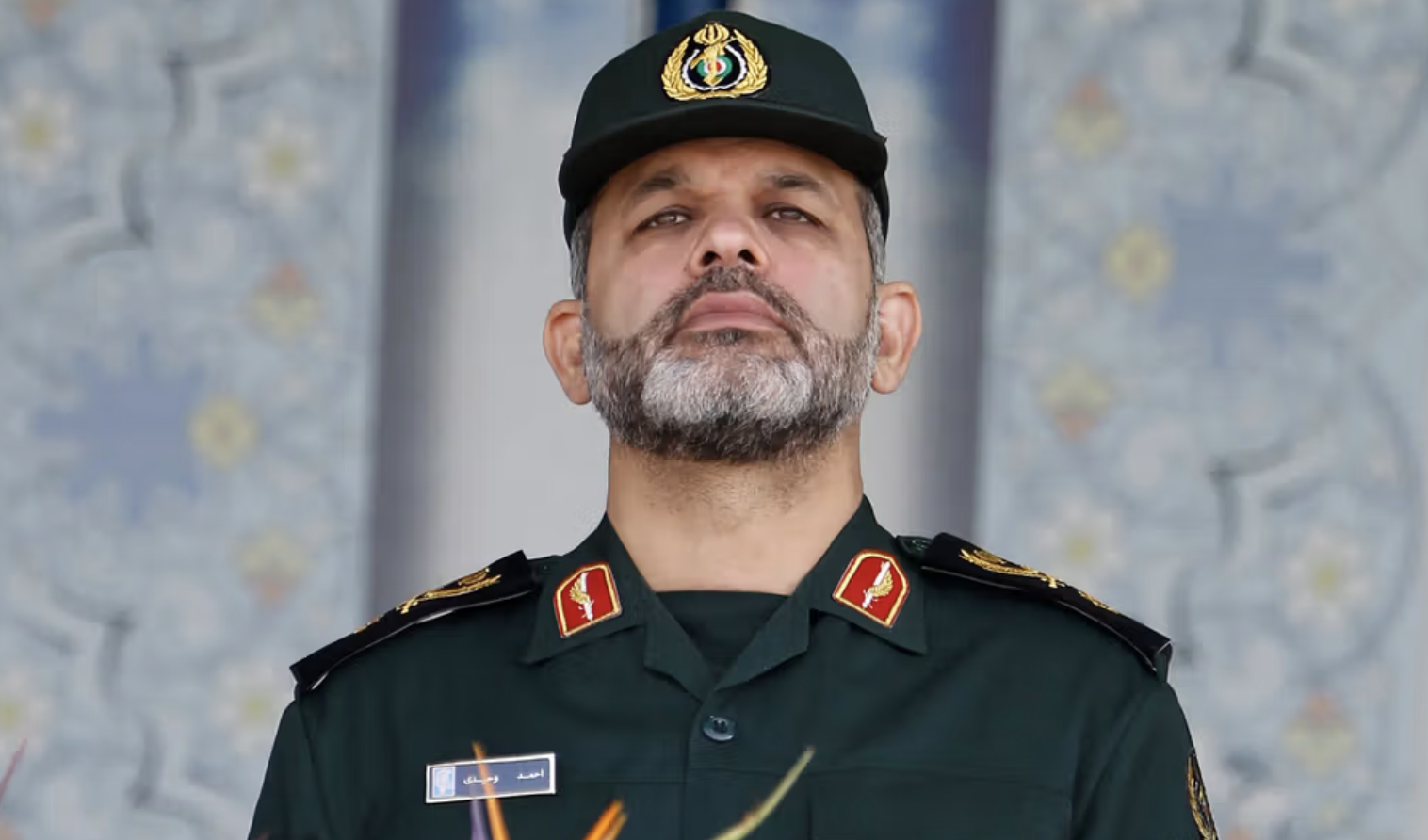
Argentina’s Court of Cassation ruled in April 2024 that the attack had been planned by Iran and executed by Hezbollah. Earlier this year, on 01 March 2026, the man Argentine prosecutors identified more than two decades ago as the senior planner of that operation was appointed Commander-in-Chief of the Islamic Revolutionary Guard Corps. His name is Ahmad Vahidi and he is now, by every credible measure, the most powerful man in Iran.
The West has spent the better part of a decade arguing about whether the Islamic Republic is reformable, negotiable or containable. The elevation of Vahidi closes that debate. The institution that once presented itself as the guardian of a clerical revolution is now run by an indicted mass murderer, and he is running the state.
The blood-soaked terrorist record
Vahidi joined the IRGC in 1979 and has been at or near the centre of every significant act of Iranian state violence since. He served as deputy for intelligence to IRGC commander Mohsen Rezaee from 1981, helped found the Ministry of Intelligence and Security in 1983, and became the first commander of the Quds Force in 1988, a post he held for almost a decade before handing it to Qassem Soleimani.
The catalogue of operations carried out under his command, or attributed to him by Western and allied authorities, reads as a chronicle of late twentieth-century mass-casualty terrorism. The 1983 Beirut barracks bombing that killed 241 United States Marines. The 1994 AMIA bombing in Buenos Aires. The 1996 Khobar Towers bombing in Saudi Arabia, which killed 19 American airmen. The 2008 attack on the United States Embassy in Sana’a. He was the mentor of Imad Mughniyeh, the Hezbollah operations chief assassinated in Damascus in 2008, and he built the doctrine using nominally civilian institutions, telecoms, banks, charities and “cultural attachés” as conduits for operational assets abroad that defines IRGC external operations to this day.
Interpol issued a Red Notice for his arrest in November 2007 at the request of Argentine authorities. It has never been withdrawn. In May 2024, Argentina formally reissued the notice, charging him with aggravated murder.
He has also been sanctioned twice over by the European Union and the United States: first for his role in Iran’s nuclear and missile programmes during his tenure as Defence Minister under Mahmoud Ahmadinejad from 2009 to 2013; and again, in October 2022, for his oversight of the Law Enforcement Forces that shot, beat and tortured protesters who took to the streets after the morality police murdered a 22-year-old woman named Mahsa Amini for the alleged crime of an improperly worn headscarf.
Why he matters now
It would be tempting to read Vahidi’s appointment as a battlefield expedient, a stopgap chosen because the United States and Israel killed his predecessors. The temptation should be resisted. Vahidi was named deputy commander of the IRGC by the late Ayatollah Ali Khamenei in December 2025, two months before the opening strikes of Operation Epic Fury. The Supreme Leader knew exactly what he was doing. He was pre-positioning the most operationally experienced and ideologically committed survivor of the 1980s generation as the wartime apex of the institution he expected to be attacked.
When the strike came on 28 February 2026, killing Khamenei himself along with the IRGC commander, the chief of staff of Iran’s armed forces, the defence minister and a senior Khamenei adviser in a single Defence Council meeting, the IRGC executed the handover within 24 hours. Vahidi was the answer the system had already prepared.
He has used the moment ruthlessly. He is reported to be liaising directly with the new Supreme Leader, Mojtaba Khamenei, wounded in the opening strike and not seen in public since, to the exclusion of every other senior official. He has blocked President Masoud Pezeshkian’s attempts to appoint a new intelligence minister, rejecting every candidate including former Defence Minister Hossein Dehghan, on the principle that during wartime all critical leadership positions must be decided by the IRGC. He has pressured Pezeshkian into installing the IRGC veteran Mohammad Bagher Zolghadr as Secretary of the Supreme National Security Council. The Institute for the Study of War assessed last week that Vahidi and his inner circle have secured at least temporary control of both Iran’s military operations and its negotiating position.
Iran is no longer a clerical theocracy with a paramilitary enforcement arm. It is a wartime military regime with a clerical façade. The apex node is a man wanted by Interpol for the murder of 85 civilians in a country he has never set foot in.
What it means for the West
Three things follow.
First, no negotiation conducted with the present Iranian government can be assumed to bind the Iranian state in any meaningful way unless Vahidi has personally consented to it. The Foreign Ministry diplomats appearing across the table from Vice President Vance in Islamabad are not without authority, but they are not the principals. The principal is in Tehran, and his institutional incentive is for the war to continue because the war is the source of his power.
Second, the Argentine prosecution process is now under way. Federal prosecutor Sebastián Basso filed a request in March to formally charge ten further suspects under Argentina’s new trial-in-absentia framework. This is no longer a peripheral matter of historical justice. Within twelve to twenty-four months, the sitting commander-in-chief of a major state’s armed forces will likely be the subject of a formal foreign judicial conviction for mass-casualty terrorism, the first since the Nuremberg trials. That has consequences. It strengthens every civil suit pending against the Islamic Republic under the Anti-Terrorism Act and the Justice Against Sponsors of Terrorism Act. It creates a basis on which neutral states can be pressed to deny Iranian state assets safe harbour. It creates, for the first time, a serious legal framework for treating the IRGC’s commercial vehicles as the proceeds of a continuing criminal enterprise.
Third, and most importantly, Vahidi’s elevation should end any remaining ambiguity about the moral and ethical character of the institution he commands. The IRGC is not a national army that has been involved in terrorism. It is a terrorist organisation whose senior leadership has been recruited, promoted and now elevated to supreme command on the basis of demonstrated capacity to kill innocent civilians worldwide. The men who chose Vahidi knew his blood-soaked record. They chose him because he is a killer.


