


Listen to the article
Key Takeaways
🌐 Translate Article
📖 Read Along
💬 AI Assistant
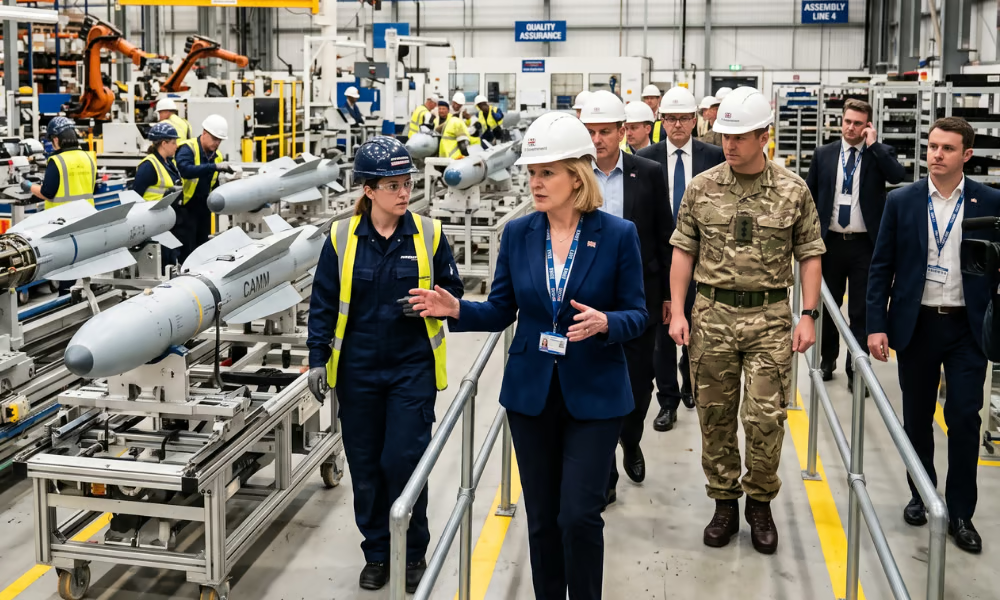
Russia has threatened to attack British factories after the UK gave Ukraine the blueprints to build its own Storm Shadow missiles.
Andrei Fedorov, a powerful adviser to Vladimir Putin, said Moscow would not “100 per cent exclude” the possibility of “semi-military action” against manufacturers supplying drone and missile components to Kyiv.
Intelligence officials believe that Russia has already launched a fresh wave of covert attacks against European armaments factories.
Mr Fedorov’s intervention on Monday escalated the war of words between London and Moscow over British support for Ukraine.
Earlier that day, the Kremlin had accused Andy Burnham of “adding fuel to the fire” of war by sharing the blueprints with Ukraine. The Prime Minister replied: “Who started the fire? That’s the question, isn’t it?”
Mr Fedorov made the comments during an appearance on the BBC’s Newsnight after Mr Burnham visited Kyiv for the first time as Prime Minister and condemned Russia’s “outrageous” threats against Britain.
Although Mr Fedorov did not explicitly say how Moscow would attack, he suggested that a producer of drones or Storm Shadow missile components could be targeted in a cyber-attack by “unknown sources”.
“There might be different political steps and I cannot exclude 100 per cent that there might be some semi-military, for example,” he said.
He then made the threat against British factories, explaining that “semi-military” action meant that “something might happen with enterprises, with the factories which are producing drones for Ukraine”.
“They could be attacked, not by Russia, but by … from unknown sources,” Mr Fedorov said.
During the Newsnight interview, he said the Prime Minister’s Storm Shadow decision was considered by Moscow to be “direct military involvement” in the war, which he claimed had moved “beyond Ukrainian borders”.
The vulnerability of British industry to cyber-attacks by malign actors has recently come to the fore, with The Telegraph revealing on Saturday that hackers linked to the Iranian regime had shut down a power plant for four days.
Moscow last week threatened unspecified consequences in response to reports that Ukrainian forces had used British-built drones to hit targets on Russian soil.
Russia insisted Britain would pay a “higher price” for its support for Kyiv.
However, repeated Russian threats and sabotage operations have so far failed to deter Britain from providing military and intelligence support to Ukraine, and the two countries have only increased their co-operation.
During Mr Burnham’s trip, Ukraine handed over a “goldmine” of intelligence to help protect Britain from Russian spies and saboteurs.
Britain is the first country to be given access to Kyiv’s large “Avenger” labs repository, containing millions of images of Russian tanks, air defences, troops, drones and artillery systems from the war.
The data will be used to train technology at British bases to help detect saboteurs and spies trying to gain access to military secrets or sites.
Mr Burnham chaired his first Coalition of the Willing meeting in Kyiv with France’s Emmanuel Macron and Germany’s Friedrich Merz.
Mr Macron told the meeting that a string of deadly attacks on Ukrainian cities in recent weeks had shown that allies needed to step up deliveries of interceptors.
Mr Burnham is expected to travel to the US next month to lobby Donald Trump. The US president has not yet given Ukraine a licence to produce Patriot interceptors, as Moscow takes advantage of Kyiv’s dwindling stockpile with deadly ballistic missile bombardments.
Russia has also launched a broader destabilisation campaign across Europe. Western intelligence sources have found that Moscow was behind a series of attacks on European armaments factories.
In recent weeks, factories producing drones and ammunition for Ukraine in Italy, Bulgaria and Estonia have been hit by yet-to-be-explained fires and explosions.
The Kremlin has recruited local gang members for sabotage operations, which the sources believe were designed to fall just short of activating Article 5, Nato’s mutual defence clause.
Mr Fedorov said Britain’s membership of the alliance increased the risk of a Russian attack.


